
U.S. GoldMining: Whistler Project Progress Meets Capital Constraints in a High-Risk Exploration Phase
U.S. GoldMining Inc. advances the Whistler gold-copper project with a Preliminary Economic Assessment but faces acute financing needs, legal uncertainties, and sector volatility. The company’s future now hinges on its ability to secure new funding and convert early technical promise into bankable development.
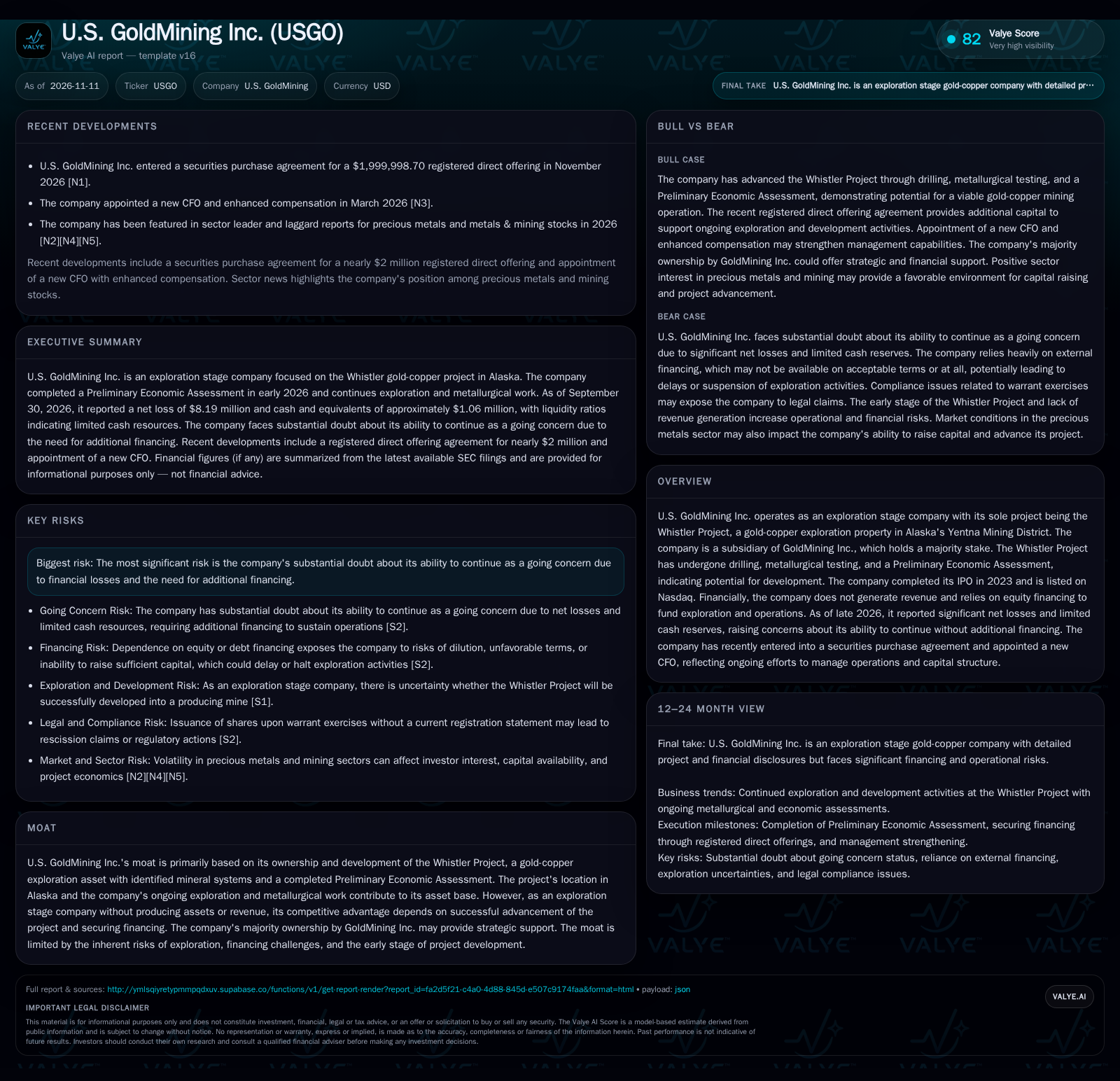
U.S. GoldMining Inc. has completed a Preliminary Economic Assessment for its Whistler Project in Alaska, but remains in the exploration stage, reporting significant losses and limited cash as of late 2026. Recent direct offering and management changes signal ongoing attempts to secure funding and operational stability. The company’s future viability depends on successful capital raising and project advancement amid sector and legal uncertainties. [S1] [S2] [N1] [N3]
U.S. GoldMining Inc. is at a critical inflection point: while its Whistler Project in Alaska has moved through a Preliminary Economic Assessment and ongoing technical work, the company’s ability to realize value remains deeply constrained by its precarious financial position. With cash reserves dwindling, a recent direct offering providing only a temporary lifeline, and unresolved legal questions around share issuance, U.S. GoldMining exemplifies the high-risk, high-reward profile of early-stage resource companies. Its next moves—especially regarding capital raising and regulatory clarity—will determine whether technical progress can translate into a viable mining venture or if the project stalls under the weight of financial and operational uncertainty.
Recent Milestones and Financial Stress Define the Company’s Outlook
U.S. GoldMining has completed a Preliminary Economic Assessment (PEA) for the Whistler Project, providing an initial technical and economic framework that may support future development but does not yet establish commercial viability or project financing. The company reported a net loss of $8.19 million for the quarter ended September 30, 2026, with cash and equivalents standing at approximately $1.06 million—a sharp decline from previous reporting periods, resulting in a stated substantial doubt about the company’s ability to continue as a going concern. To address immediate liquidity needs, U.S. GoldMining entered a $1,999,998.70 registered direct offering in November 2026. The company reported cash and liquidity metrics for the period; these figures do not by themselves establish operating runway, investment capacity, financial flexibility, or financing capacity. A compliance issue around warrant-related share issuance further complicates the outlook, potentially exposing the company to rescission claims and additional liabilities. [S1] [S2] [N1]
Exploration Economics: Cash Burn, Capital Intensity, and the Long Road to Revenue
U.S. GoldMining’s business model is typical of early-stage resource explorers: the company generates no operating revenue and instead consumes capital to fund exploration drilling, technical studies, permitting, and corporate overhead. Cash flow is entirely negative, and the only path to liquidity is through periodic equity or debt raises. The Whistler Project’s PEA provides a conceptual basis for future mine development, but until a resource is proven, permitted, and financed, the company’s economics are dominated by fixed costs (salaries, technical work, regulatory compliance) and variable costs tied to the pace and scope of exploration programs.
Should the Whistler Project eventually move to development, the capital requirements will rise exponentially—potentially hundreds of millions of dollars for mine construction, infrastructure, and processing facilities. Until then, the company’s main economic levers are the pace of exploration spend and success in raising external funds. There is little operating leverage in the current phase; cost discipline and capital market access are the primary determinants of survival. If the project advances, future economics would hinge on gold and copper prices, project scale, operating costs, and capital structure, but these remain hypothetical at this stage.
Asset Quality, Parent Backing, and Sector Volatility Shape Competitive Standing
The company’s principal asset is its 100%-owned Whistler Project, which covers multiple mineral systems with gold, copper, and silver potential. The location in Alaska offers both advantages—established mining jurisdiction, geological endowment—and challenges, such as logistical complexity and permitting hurdles. U.S. GoldMining’s competitive position is largely defined by its ability to advance Whistler technically and economically faster or more efficiently than peer exploration-stage companies.
A partial offset to typical junior-miner constraints is the company’s relationship with GoldMining Inc., which owns 74.2% of its shares. This parent backing could provide strategic, financial, or reputational support, but does not guarantee funding or operational success. The competitive landscape includes other gold-copper explorers and developers in North America, many of whom are also capital-constrained and reliant on equity markets. Sector volatility—driven by commodity prices, investor sentiment, and macroeconomic trends—can rapidly shift the availability and cost of capital, impacting all players. In this context, U.S. GoldMining’s moat is limited and contingent on both project advancement and sustained access to funding.
From Technical Validation to Strategic Funding: What Success Would Require
A favorable trajectory for U.S. GoldMining would see the company leveraging its PEA and ongoing technical work to attract new investment—either from strategic partners, institutional investors, or through further public offerings. If sector sentiment improves, gold and copper prices rise, and the company demonstrates resource growth or improved project economics through additional drilling and studies, investor interest could accelerate. Parent company GoldMining Inc. could also participate more actively in financing or project de-risking.
Confirmation of this scenario would require evidence of substantial new funding—ideally at terms that limit dilution—and tangible progress on the Whistler Project, such as upgraded resource estimates, positive metallurgy, or key permitting milestones. Signs of industry partnership or off-take interest would further validate the transition from exploration risk to development potential. A reduction in legal overhang from the warrant issue would also be a positive catalyst.
Incremental Progress Amid Persistent Dilution and Funding Uncertainty
The most plausible outcome is a continuation of incremental technical progress on the Whistler Project, punctuated by periodic equity raises that dilute existing shareholders. The company may secure enough funding to sustain basic exploration and corporate operations, but not enough to fully de-risk or advance the project to a construction decision. Cash burn remains high relative to available resources, and legal or regulatory distractions could further limit management’s bandwidth and market appeal.
This scenario would be confirmed by a pattern of ongoing small-scale financings, limited or stagnant resource growth, and continued going-concern warnings in filings. Lack of major strategic partnerships or project-level funding would reinforce the view that Whistler remains a long-dated, high-risk asset.
Liquidity Crisis, Legal Exposure, and Project Stagnation Threaten Viability
The negative chain of events would begin with failure to raise adequate capital, forcing the company to curtail exploration, reduce staff, or enter care-and-maintenance mode. Legal action related to the warrant issuance could result in material liabilities, draining cash and management focus. In this scenario, sector conditions may worsen, further limiting investor appetite for high-risk juniors. The Whistler Project could become stranded, with asset value eroding as technical momentum stalls and fixed costs persist.
Evidence of this scenario would include missed payroll or vendor payments, abrupt reductions in exploration activity, public disclosures of legal settlements or judgments, and deepening negative working capital. The company could be forced to sell the project at a distressed valuation or face insolvency.
Milestones and External Shifts That Could Shift U.S. GoldMining’s Thesis
Magnitude and terms of future equity or debt financings—especially whether new capital is sufficient to fund a meaningful work program without excessive dilution.
Updates on the legal situation regarding warrant-related share issuance; resolution or escalation of rescission claims would materially affect financial and reputational standing.
Progress in resource definition: new drilling results, resource upgrades, or metallurgical advances would test whether Whistler’s potential is improving.
Any evidence (if disclosed) of strategic partnerships, joint ventures, or off-take agreements that could de-risk funding and operational execution.
Changes in parent company GoldMining Inc.’s involvement—such as direct capital support, project-level guarantees, or increased operational engagement.
Sector-wide moves in gold and copper prices, which could shift investor risk appetite and project economics.
Disclosure of material reductions in exploration spending, staff, or corporate overhead, which would indicate liquidity strain or retrenchment.
If disclosed, updates on permitting, community engagement, or environmental review, as regulatory progress is a gating factor for project development.
Disclaimer: This is research-only, informational analysis and not investment advice. It may include AI-generated interpretation and general industry context. Always verify important details using primary sources.

Comments