
Beachbody’s Turnaround: Profitability Emerges Amid Liquidity Pressure and Strategic Brand Revamps
Beachbody’s return to profitability and renewed focus on legacy brands like P90X and Shakeology mark a pivotal phase. However, a sub-1 current ratio and intense market competition mean that execution and cash management will determine whether operational gains translate into sustainable momentum.
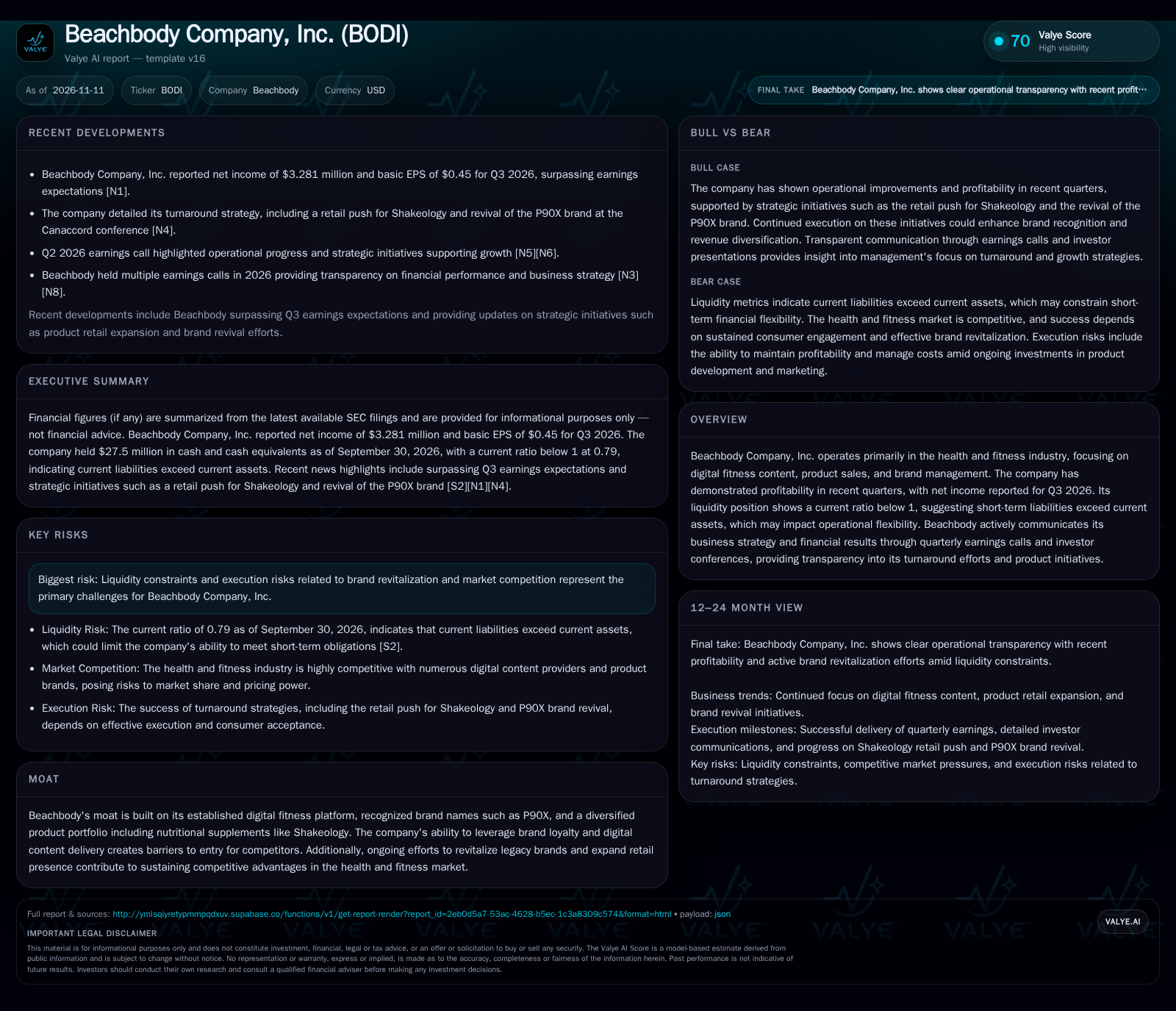
Beachbody posted Q3 net income of $3.281 million, signaling improved operating performance and progress on its turnaround strategy. The company is leaning heavily on brand revitalization—especially P90X and Shakeology retail expansion—to drive future growth, but execution risk remains high in a crowded digital fitness landscape. Sustained profitability will hinge on consumer uptake, cost discipline, and the ability to convert brand strength into cash flow resilience. [S2] [N4]
Management’s renewed push to revitalize iconic brands like P90X and expand the Shakeology product line into retail channels reflects a strategy aimed at reigniting growth and diversifying revenue streams. However, with current liabilities exceeding current assets and competition in digital fitness intensifying, the real test will be whether Beachbody can convert recent operational progress into sustainable financial stability and defend its market position.
Profitability Returns, but Liquidity Remains Tight
The most material current development is Beachbody’s reported net income of $3.281 million for Q3 2026, with basic and diluted EPS of $0.45 and $0.38, respectively [S2]. This marks a notable shift from the losses that have characterized much of the digital fitness sector in recent years. The company reported cash and liquidity metrics for the period; these figures do not by themselves establish operating runway, investment capacity, financial flexibility, or financing capacity. [S2]
Strategically, Beachbody is doubling down on the retail expansion of Shakeology and leveraging the legacy appeal of P90X, as highlighted in recent investor communications [N4]. The company’s ability to drive incremental revenue from these initiatives will be central to sustaining its return to profitability.
Revenue Streams, Cost Structure, and the Challenge of Scale
Beachbody’s business economics are rooted in a blend of digital fitness subscriptions, branded nutritional products (like Shakeology), and physical fitness programs (notably P90X). Digital content offers potential for high gross margins and operating leverage, since incremental costs for new digital subscribers are low once the content is produced. In contrast, product sales—especially through retail—carry more variable costs, including manufacturing, logistics, and retail margin concessions.
A key economic question is whether the company can achieve sufficient volume in retail Shakeology sales and P90X brand revitalization to offset fixed costs and drive sustainable cash flow. If digital subscription growth slows or churn increases, Beachbody may become increasingly reliant on product sales, which are typically lower-margin and more working-capital intensive. The sub-1 current ratio also raises the importance of careful inventory and receivables management, as cash conversion cycles can strain liquidity.
The path to scalable profitability likely depends on the mix between recurring digital subscriptions and episodic product sales, the ability to upsell cross-category users, and the extent to which fixed costs (content development, brand marketing) can be leveraged across multiple channels.
Brand Equity and Digital Reach: Moat or Mirage?
Beachbody’s competitive edge relies on its established digital platform, household brand names (P90X, Shakeology), and a reputation built over decades. The company’s moat is partially rooted in customer loyalty, proprietary content, and a diversified product portfolio, which can create switching frictions for existing users. However, the digital fitness and wellness market is saturated with both digital-native competitors and traditional fitness brands expanding into online content.
Substitutes include low-cost fitness apps, streaming platforms with fitness channels, and in-person boutique fitness offerings. While Beachbody’s legacy IP gives it brand recognition, the challenge is translating that into recurring engagement and willingness to pay in an environment where consumers have abundant free and paid alternatives. Additionally, new entrants can erode pricing power, making customer acquisition costs a persistent concern.
The retail expansion of Shakeology and the P90X revival represent attempts to diversify and defend the company’s market position, but sustained differentiation will likely require ongoing investment in content, technology, and user experience.
When Brand Revitalization and Retail Expansion Drive a Virtuous Cycle
The favorable scenario for Beachbody is one where the retail push for Shakeology gains significant traction, both expanding the brand’s reach and generating incremental revenue with attractive margins. Simultaneously, a successful P90X revival—possibly through new digital content, hybrid programs, or partnerships—could reactivate lapsed users and attract a new cohort of fitness enthusiasts.
If these initiatives drive increased engagement across digital and physical channels, Beachbody could see accelerated subscriber growth, improved cross-sell rates, and higher lifetime customer value. Evidence confirming this scenario would include sustained net income growth, improving gross margins, rising digital subscriber counts, and inventory turnover improvements as retail products gain shelf space and velocity.
Incremental Progress Tempered by Execution and Cash Constraints
The most plausible trajectory is steady but uneven operational improvement, with profitability fluctuating quarter to quarter as Beachbody works to execute its turnaround plan. Digital content subscriptions may see modest growth or stabilization, while retail Shakeology sales and P90X brand engagement provide incremental revenue but do not fully offset competitive and cost pressures.
In this scenario, cash management becomes critical: the company may need to carefully balance marketing and product investment with the imperative to improve liquidity metrics. Retail expansion could generate working-capital demands that offset short-term margin gains. Confirmation would come from continued (but modest) positive net income, stable or slightly improving current and cash ratios, and incremental but not breakout gains in digital and retail engagement metrics.
The scenario is falsified if either liquidity deteriorates further—forcing the company to seek dilutive financing or cut growth investments—or if consumer response to brand revivals falls short, leading to renewed losses.
Liquidity Crunch and Brand Fatigue Derail the Turnaround
The adverse outcome is one in which the combination of below-1 current ratio and intense competition leads to a liquidity crunch. If Shakeology retail expansion stalls or incurs higher-than-expected costs, and if the P90X revival fails to resonate, revenue growth could stagnate or reverse while fixed costs remain elevated.
In this scenario, cash burn accelerates, forcing Beachbody to seek external financing under unfavorable terms, cut key investments, or even divest assets. Deteriorating working-capital metrics—such as rising payables or inventory buildup—would be early warning signs. Net losses would return, and the company could face pressure to restructure or exit certain business lines.
Confirmation would be a further decline in the current ratio, negative operating cash flow, and missed strategic milestones (e.g., delayed product launches or failed retail partnerships).
What Will Confirm or Refute Beachbody’s Turnaround Momentum?
Quarterly net income/loss trends: Sustained profitability or a return to losses will be the clearest signal of operational progress or reversal [S2].
Digital subscription growth and churn: If disclosed, net additions and retention rates for digital fitness subscriptions would clarify core engagement health.
Shakeology retail sales velocity: Growth in sell-through rates, new retail doors, and repeat purchase patterns will show whether the retail push is gaining traction [N4].
P90X brand engagement: Metrics such as new program signups, active users, and social/digital engagement (if disclosed) would validate the effectiveness of the brand revival.
Gross margin trends: Rising or stable margins would suggest successful mix management and cost control; declines could signal rising pressure from product or channel shifts.
Operating cash flow: Positive and improving operational cash flow will be vital for reducing reliance on external financing, especially in light of liquidity constraints.
Disclaimer: This is research-only, informational analysis and not investment advice. It may include AI-generated interpretation and general industry context. Always verify important details using primary sources.

Comments