
Netlist’s Patent Strength and CXL Strategy: Innovation, Volatility, and Competition in Advanced Memory
Netlist’s robust patent portfolio and push into Compute Express Link (CXL) memory solutions position it at the innovation frontier for data center and AI workloads. Yet, customer and supplier concentration, short visibility on orders, and formidable competition from industry leaders expose the company to demand volatility and supply chain risk. The next phase hinges on converting technology bets into durable, scalable revenue streams.
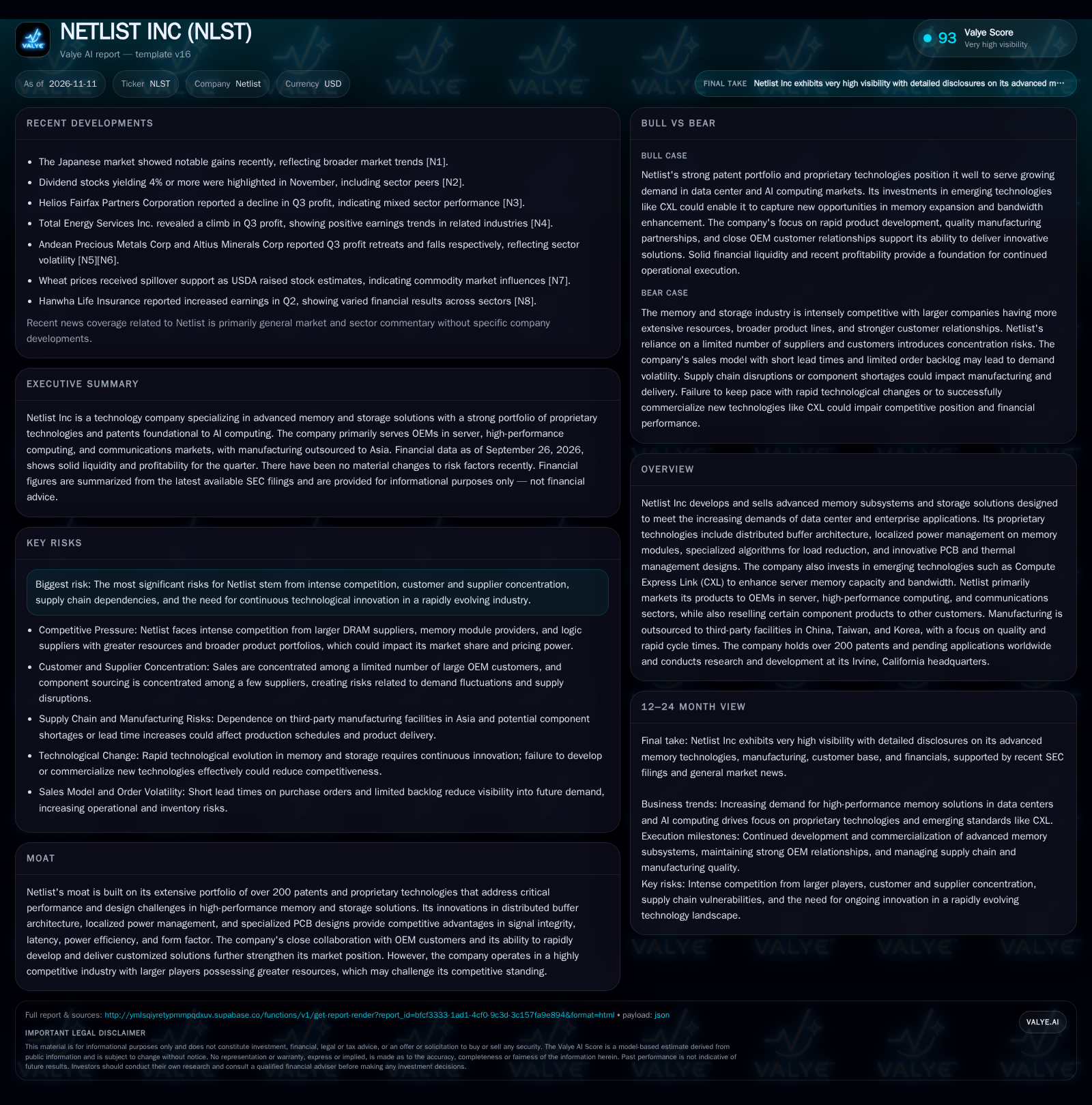
Netlist, a key innovator in advanced memory and storage, is riding demand from AI and data center growth with a patented technology base and investments in CXL. Despite recent profitability and a reported balance sheet position, its reliance on a handful of customers and suppliers, plus limited order visibility, heightens risk. The company’s future will turn on its ability to translate proprietary technologies into sustained OEM traction while managing competitive and supply chain pressures. [S1] [S2]
Netlist Inc stands at a crossroads where technological differentiation must be matched by commercial execution. With over 200 patents and proprietary memory innovations tailored for the fast-evolving needs of data centers and AI workloads, Netlist has achieved recent profitability and maintains a cash-rich balance sheet. However, its reliance on a handful of OEM customers, short-order cycles, and concentrated supplier relationships injects significant volatility. As the company invests in Compute Express Link (CXL) to extend its relevance in next-generation server memory, its ability to translate technical prowess into recurring, defensible revenue streams will determine whether it can outpace industry giants or remain exposed to the sector’s relentless competition and supply chain fragility.
Recent Profitability, Patent Strength, and Customer Concentration Define Netlist’s Immediate Landscape
As of September 26, 2026, Netlist reported $85.4 million in net income for the quarter, with cash and equivalents of $317.7 million and a current ratio of 2.38 [S2]. This marks a period of financial strength, underpinned by a robust patent portfolio of over 200 issued and pending applications that support its advanced memory solutions [S1]. However, these achievements are tempered by its sales model—primarily short-term purchase orders to OEMs—and a concentrated base of both customers and suppliers, which leaves the business exposed to demand swings and supply chain interruptions [S1]. Netlist’s focus on Compute Express Link (CXL) technology reflects a bet on the future of server memory, but commercialization and adoption timing remain open questions.
How Netlist’s Revenue Model and Cost Structure Shape Its Economic Outlook
Netlist generates revenue by selling proprietary memory subsystems and reselling select components, primarily to OEMs in the server and high-performance computing sectors [S1]. Its pricing is likely driven by a combination of technological differentiation and prevailing industry benchmarks, but intense competition places ongoing pressure on margins. The company’s order flow is dominated by stand-alone purchase orders with limited advance notice, reducing revenue visibility and making demand forecasting and inventory management more challenging than for peers with longer-term contracts or recurring revenue models.
Manufacturing is entirely outsourced to third-party facilities in Asia, which allows Netlist to keep fixed capital requirements low and scale output as needed. However, this model increases sensitivity to supply chain disruptions and may limit the company’s ability to control costs in the face of component shortages or rising input prices. With supplier relationships concentrated among a few vendors, any shift in component pricing or availability could have a disproportionate effect on gross margins.
Operating leverage is plausible if Netlist can drive higher sales volumes through OEM wins or industry adoption of its proprietary technologies, especially CXL-related products. However, the variable nature of its cost base—due to outsourced manufacturing and component reselling—means that margin expansion will depend on the mix of proprietary versus resold products and the company’s ability to differentiate on performance or patent protection.
Innovation Edge Versus Scale: Navigating a Field of Industry Titans
Netlist’s competitive position is rooted in its deep portfolio of patents and proprietary solutions targeting memory performance, latency, and form factor—traits increasingly valued in AI and cloud data center environments [S1]. Its innovations in distributed buffer architecture and localized power management offer technical advantages, but the company faces formidable competition from much larger DRAM suppliers, memory module manufacturers, and logic suppliers with greater resources, established customer relationships, and broader product offerings.
While Netlist’s close collaborations with OEMs and rapid product customization may create switching frictions for certain applications, these relationships are not locked in by long-term contracts, limiting the durability of its advantage. The company’s focus on emerging standards like CXL could help leapfrog competitors if it achieves early, scalable adoption, but this also exposes Netlist to the risk of standards fragmentation or delayed market uptake. In such a competitive landscape, the company’s ability to defend its intellectual property and continuously innovate will be critical to sustaining any moat.
CXL Commercialization and Patent Monetization Drive a Step-Change in Growth
If Netlist successfully commercializes its CXL-enabled memory solutions ahead of larger rivals, the company could secure design wins with leading OEMs as hyperscale data centers and AI workloads increasingly demand high-bandwidth, low-latency memory. This would likely result in higher sales volumes of proprietary products—delivering both margin expansion and improved revenue visibility. Additional upside could come from monetizing its patent portfolio, either through licensing deals or favorable litigation outcomes, providing non-dilutive cash inflows and reinforcing its market position.
Evidence for this scenario would include public announcements of major CXL product wins, substantially increased proprietary product sales as a share of revenue, and new or expanded licensing agreements with industry players. Accelerating adoption of CXL standards across the data center ecosystem, combined with new patent awards or successful IP enforcement, would further validate this path.
Demand Grows but Order Volatility and Industry Competition Define the Status Quo
In the most plausible near-term scenario, Netlist benefits from secular growth in data center and AI-driven memory demand, leveraging its proprietary technologies to win incremental business from OEMs. However, the absence of long-term contracts and continued customer concentration keep order volumes lumpy and forecasting challenging. The company maintains profitability and a reported balance sheet position, but gross margins remain under pressure due to ongoing competition and the variable cost structure of outsourced manufacturing.
Confirmation would come from steady, but not explosive, revenue and earnings growth, continued reporting of strong cash reserves, and periodic OEM wins. Falsification would involve a sustained drop in sales, loss of a major customer, or inability to deliver new products on the CXL roadmap.
Supply Chain Shocks or OEM Defections Expose Netlist to Rapid Revenue Contraction
Netlist’s reliance on a handful of suppliers and customers leaves it vulnerable to external shocks. An adverse scenario could unfold if a major supplier faces disruption, causing component shortages or price spikes that squeeze margins and delay deliveries. Similarly, the loss of a key OEM customer—whether due to competitive displacement, technology shifts, or in-sourcing—could result in a sharp revenue decline.
Further downside could come from delays in CXL commercialization or a failure to defend its patents, allowing competitors to erode Netlist’s differentiation. Evidence would include a sudden drop in reported revenues, gross margin compression, disclosures of supply chain interruptions, or major customer departures.
Milestones and Metrics to Gauge Netlist’s Ability to Convert Innovation into Durable Growth
Public disclosure of CXL product wins or major OEM design-ins would help test whether Netlist’s technology is translating to real market traction.
Quarterly revenue concentration among top customers, if disclosed, would indicate progress (or lack thereof) in diversifying the customer base.
Gross margin trends, especially the share of revenue from proprietary products versus resold components, would clarify the company’s pricing power and mix shift.
Updates on patent licensing agreements, settlements, or major IP litigation outcomes would show whether the patent portfolio is being monetized beyond product sales.
Supply chain commentary—such as component availability, lead times, and vendor concentration—would highlight ongoing or emerging operational risks.
Disclosure of new supplier relationships or geographic diversification in manufacturing could reduce vulnerability to regional disruptions.
R&D expense as a percentage of revenue, if disclosed, would indicate Netlist’s ongoing investment in innovation and ability to keep pace technologically.
Any signs of longer-term contracts or recurring revenue models with OEMs would represent a shift toward greater revenue visibility and reduced volatility.
Disclaimer: This is research-only, informational analysis and not investment advice. It may include AI-generated interpretation and general industry context. Always verify important details using primary sources.

Comments