
Interface Inc: Integrated Flooring, Sustainability Leadership, and the Next Phase of Commercial Interiors
Interface’s Q3 2026 results underscore the company’s transition into a diversified, sustainability-focused flooring provider. As it scales its LVT and rubber portfolios and pursues ambitious carbon goals, the challenge is to convert brand and product leadership into durable economic advantages amid cyclical and competitive pressures.
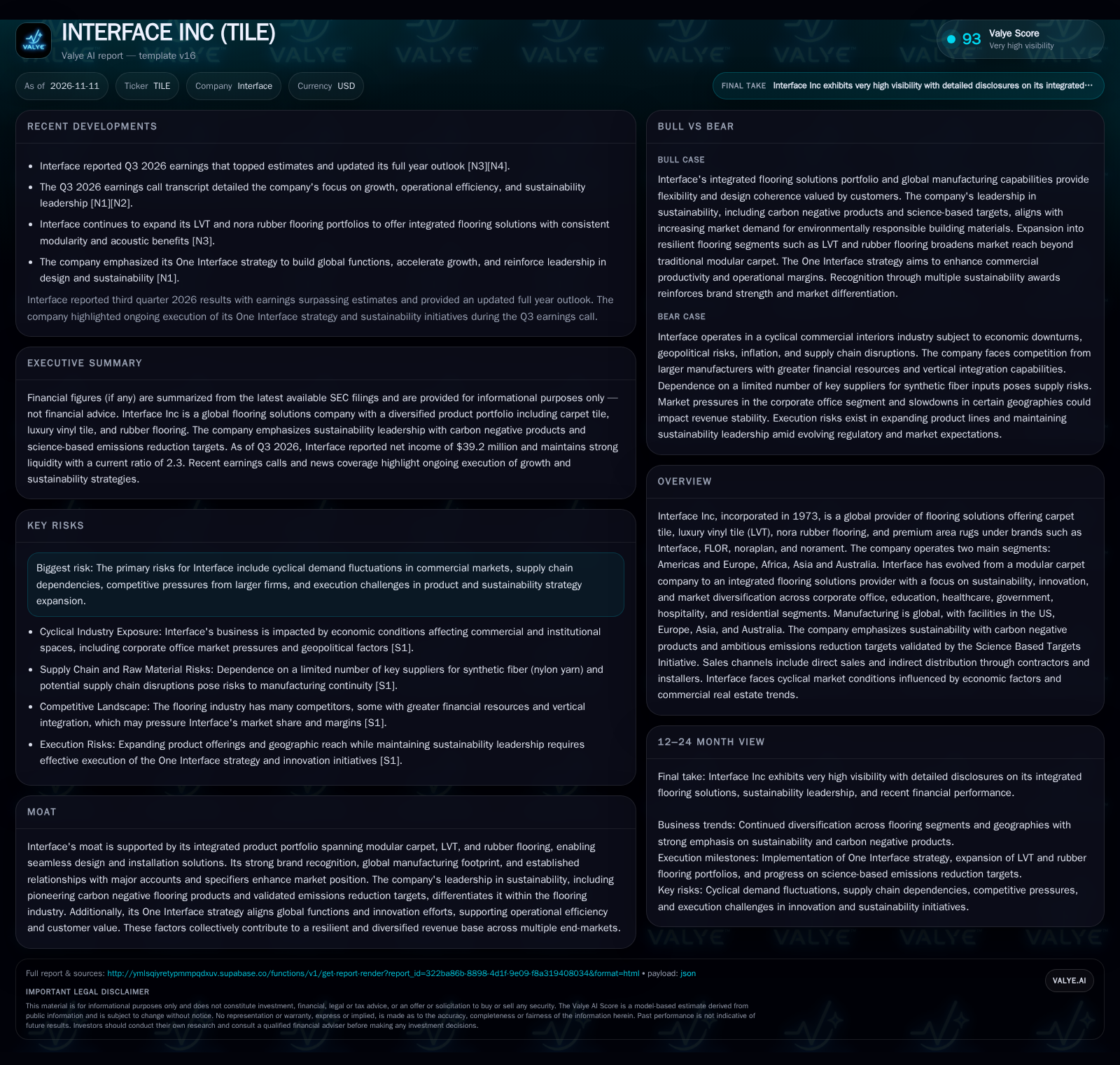
Interface posted Q3 2026 earnings above estimates and continues to expand its luxury vinyl tile (LVT) and rubber flooring lines, reinforcing its position as a design and sustainability leader in commercial interiors. [S2] [N3] [N4]
Interface Inc’s latest results highlight a company at an inflection point—leveraging decades of brand equity in modular carpet while retooling its business for a future defined by integrated, sustainable flooring solutions. Q3 2026 saw earnings beat expectations, as Interface broadened its luxury vinyl tile (LVT) and nora rubber flooring offerings and reinforced its One Interface strategy. The company’s strong sustainability positioning and global manufacturing footprint remain competitive assets, but the next phase will test its ability to translate these strengths into sustained growth and margin expansion against a backdrop of cyclical end markets and intensifying competition.
Q3 2026 Results: Financial Performance and Strategic Execution in Focus
Interface reported Q3 2026 net income of $39.2 million, basic earnings per share of $0.68, and a cash position of $81.1 million. The company’s current ratio stands at 2.3, reflecting a balance sheet with ample current assets relative to liabilities [S2]. Earnings topped consensus estimates, prompting an updated full-year outlook [N3] [N4].
The company is actively expanding its LVT and nora rubber flooring portfolios, positioning these as growth vectors within its integrated flooring offering [N3]. Interface’s One Interface strategy—focused on global functional alignment, operational efficiency, and sustainability leadership—remains a central theme across recent earnings calls and communications [N1] [N2].
These developments matter because they mark both financial resilience and a pivot toward higher-value, sustainability-led product categories. The evolving strategy is intended to buffer against cyclical commercial market swings and intensifying competition, but the path to durable margin expansion and revenue stability depends on execution within these new vectors.
How Interface’s Integrated Model Could Drive Margin Expansion—If Execution Aligns
Interface’s revenue model combines direct sales to large end users and indirect sales via contractors and distributors, targeting architects, designers, and major accounts. Historically, modular carpet has formed the backbone of revenue, but LVT and rubber flooring are increasingly prominent. Product mix is shifting toward these resilient flooring types, which generally offer higher average selling prices and, if managed well, can deliver improved gross margins by leveraging design, modularity, and acoustic benefits.
The company’s global manufacturing footprint, with localized production for carpet tile and rubber flooring and outsourced LVT manufacturing in South Korea, enables cost optimization but introduces complexity in supply chain management. Fixed costs in manufacturing can support operating leverage, particularly if higher-margin products gain share within the mix. However, cyclical demand for commercial interiors means that volume swings can quickly erode margin gains if fixed costs are not tightly managed.
Sustainability features—such as carbon negative carpet tile backings and nora rubber flooring prototypes—provide pricing power in segments where environmental certifications and ESG mandates drive purchasing, particularly in government, education, and healthcare. The question is whether these sustainability advantages can structurally lift pricing or just preserve share in a competitive market. Expansion into adjacent segments (hospitality, residential) may diversify revenue, but could require new go-to-market investments and different margin dynamics.
Sustainability as a Differentiator—But Can It Offset Scale Disadvantages?
Interface’s competitive position is anchored in its integrated, design-forward product portfolio and its long-standing sustainability leadership. The company’s carbon negative products and ambitious emissions targets—validated by third-party initiatives—have earned it repeated recognition and awards [S1]. This differentiation is most acute in markets where specifiers and end users prioritize ESG, such as government, education, and large corporate accounts.
However, Interface competes with larger, often vertically integrated flooring manufacturers that may wield greater purchasing power, broader distribution, and the ability to absorb margin pressure in down cycles. These competitors can undercut on price or bundle offerings across flooring, wall, and ceiling systems. There is also growing competition from smaller, design-focused entrants and from alternative flooring materials (such as polished concrete or engineered wood) that can substitute for carpet or LVT in some applications.
Interface’s global manufacturing and multi-channel sales infrastructure are strengths, but the company’s scale disadvantage relative to the largest players could limit its ability to fully capitalize on sustainability-driven demand. The question remains whether Interface’s innovation and brand can sustain a moat against both commoditization and the resource advantages of larger rivals.
If Sustainability and Product Innovation Unlock Pricing Power
In the most favorable scenario, Interface’s investments in carbon negative and low-carbon products drive a sustained shift in customer preferences, enabling the company to command premium pricing and win large, specification-driven projects in commercial, education, and government sectors. Regulatory tailwinds—such as green building standards and ESG procurement mandates—could accelerate this shift, especially in developed markets.
Successful execution of the One Interface strategy would deliver operating leverage through global functional alignment, improved supply chain management, and cross-selling of integrated flooring solutions. Portfolio expansion into LVT and rubber could increase average order values and customer stickiness, especially if modularity and acoustic benefits are realized at scale.
Evidence for this scenario would include rising gross margins, increasing revenue share from LVT and rubber products, successful penetration of new end-markets, and customer wins explicitly tied to sustainability criteria. Watch for contract announcements, margin expansion trends, and third-party validation of Interface’s solutions in high-profile projects.
Integrated Solutions Gain Share, but Cyclicality and Margin Pressure Persist
The most plausible pathway is that Interface continues to grow its LVT and rubber portfolios, gradually increasing the share of revenue from integrated, sustainable flooring solutions. The company maintains a strong brand in design and sustainability, but pricing power is only partially realized—offset by ongoing price competition and the need to respond to customer budget constraints in a cyclical market.
Operating leverage improves modestly as the company executes on supply chain and operational initiatives, but margin gains are tempered by input cost volatility and the fixed cost structure of global manufacturing. Revenue diversification into education, healthcare, and government provides some buffer against downturns in the corporate office segment, but does not fully insulate the business from broader economic cycles.
Confirmation of this scenario would show steady but not dramatic margin improvement, continued recognition for sustainability leadership, and incremental growth in share for LVT and rubber. Falsification would come from stagnating or declining margins, lack of traction in new end-markets, or evidence that larger competitors are eroding Interface’s core customer relationships.
Cyclical Demand Shock and Execution Gaps Expose Structural Vulnerabilities
In an adverse scenario, a pronounced downturn in commercial construction or renovation—driven by macroeconomic stress, rising interest rates, or persistent weakness in office demand—leads to sharp volume declines across Interface’s core markets. Fixed manufacturing costs and input price inflation compress margins, and the company’s balance sheet flexibility is tested if cash flows turn negative for multiple quarters.
Supply chain disruptions or loss of key input suppliers (such as for synthetic fibers) could exacerbate cost and delivery challenges, leading customers to switch to competitors with deeper supply chains or broader portfolios. If sustainability features become commoditized or are matched by larger rivals, Interface’s pricing advantage and brand differentiation could erode.
Evidence of this scenario would include sequential declines in revenue and margin, negative operating cash flow, missed execution milestones (such as delayed product launches or cost overruns), and customer losses in major accounts. Watch for adverse revisions to guidance, working capital stress, or competitive wins by larger players in key segments.
What Will Determine Whether Interface’s Integrated, Sustainable Model Delivers Durable Growth?
Gross margin trends by product category (carpet tile, LVT, rubber) would help clarify whether portfolio expansion is translating into higher-value sales and improved profitability—if disclosed.
Revenue mix evolution: Tracking the share of revenue from LVT and rubber flooring versus legacy carpet tile will test the success of diversification efforts—if disclosed.
Customer win announcements tied explicitly to sustainability criteria or green building certifications would confirm that Interface’s ESG investments are driving tangible commercial outcomes.
Operating cash flow and net working capital changes will reveal whether Interface is managing cyclicality and supply chain complexity without balance sheet strain.
Manufacturing efficiency metrics (such as capacity utilization or yield improvements) would help assess progress under the One Interface strategy—if disclosed.
Market share estimates in key segments (corporate, education, healthcare, government) would provide evidence of competitive position—if disclosed.
Third-party validation or awards for new product innovations, beyond legacy sustainability recognition, would signal continued leadership in design and materials.
Disclaimer: This is research-only, informational analysis and not investment advice. It may include AI-generated interpretation and general industry context. Always verify important details using primary sources.

Comments