
Gossamer Bio’s Seralutinib: Regulatory Uncertainty, Liquidity Strain, and the High-Stakes Path to PAH Market Entry
Gossamer Bio’s bid to commercialize seralutinib in PAH hinges on navigating an uncertain regulatory review after narrowly missing the statistical threshold in Phase 3, all while operating under pronounced liquidity pressure and capital demands.
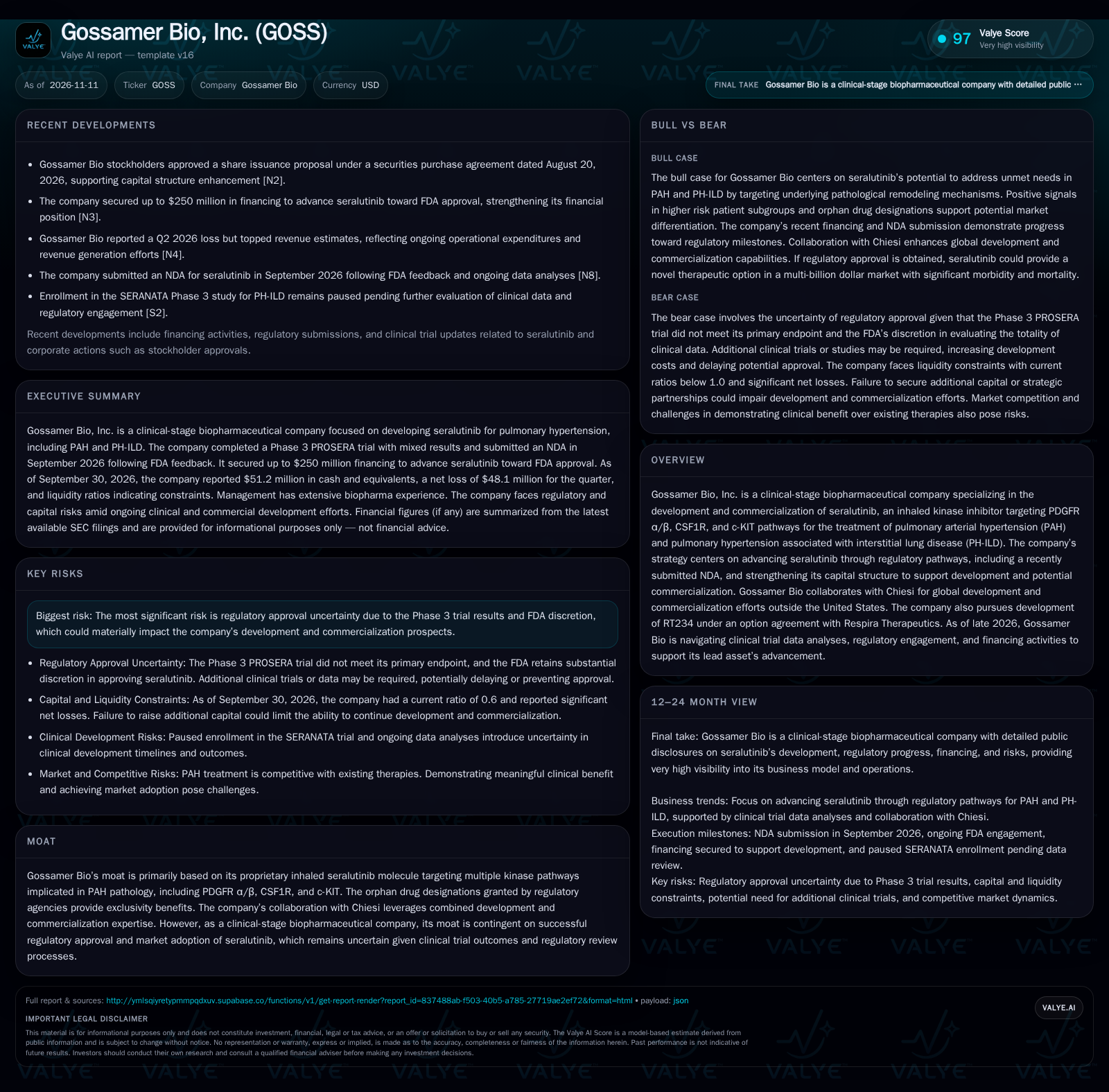
Gossamer Bio’s bid to commercialize seralutinib in PAH hinges on navigating an uncertain regulatory review after narrowly missing the statistical threshold in Phase 3, all while operating under pronounced liquidity pressure and capital demands. Recent financing and Chiesi collaboration may aid progress, but further clinical requirements or a negative FDA outcome could force strategic pivots or additional fundraises. The company’s ability to secure market entry and demonstrate clear clinical benefit will determine its future viability. [S2] [N3]
Gossamer Bio, Inc. stands at a crossroads as it seeks to bring seralutinib—its inhaled kinase inhibitor for pulmonary arterial hypertension—to market. Despite positive signals in high-risk subgroups, the company’s pivotal Phase 3 trial narrowly missed its primary statistical threshold, casting a shadow over the likelihood of FDA approval. The next 12-18 months will reveal whether Gossamer can overcome regulatory and financial headwinds to carve out a meaningful position in a crowded PAH therapy landscape. [S2] [N3]
Seralutinib’s Regulatory Review, Liquidity Strain, and Financing Efforts Define Gossamer’s Near-Term Reality
Gossamer Bio’s Phase 3 PROSERA trial in PAH patients demonstrated a placebo-adjusted 13.3 meter improvement in 6-minute walk distance (6MWD) at Week 24 (p=0.0320), which failed to meet the prespecified alpha threshold of 0.025, introducing substantial regulatory uncertainty for FDA approval. In higher-risk subgroups, the effect size was nominally larger, but these analyses were not pre-specified primaries. The FDA has characterized the trial’s statistical significance and treatment effect as issues for review, not outright filing barriers, so seralutinib’s approval prospects remain unresolved. [S2]
Gossamer ended Q3 2026 with $51.2 million in cash and equivalents, current assets of $60.4 million, and current liabilities of $99.9 million, yielding a current ratio of 0.6 and a cash ratio of 0.51. These metrics highlight pronounced liquidity constraints and an urgent need for additional capital. [S2]
To address this, Gossamer secured up to $250 million in new financing, earmarked to advance seralutinib’s regulatory and commercial journey. However, the company reported a net loss of $48.1 million for the most recent quarter, suggesting ongoing high cash burn. [N3] [S2]
Enrollment in the SERANATA Phase 3 study for PH-ILD remains paused, further concentrating risk and resources on the seralutinib PAH program. [S2]
How Gossamer’s Model Could Translate Clinical Progress into Commercial Returns
Gossamer’s economic model is typical of late-stage biopharma: large, lumpy R&D and clinical expenditures, with the promise of substantial revenue only if regulatory approval and successful commercialization are achieved. Currently, revenue is limited and largely non-recurring, likely stemming from collaboration milestones rather than product sales. The company’s cost structure is dominated by R&D and regulatory activities, with limited variable costs until launch.
If seralutinib is approved, commercial economics will depend on pricing, formulary access, and market penetration in PAH—a rare, high-cost condition. Orphan drug pricing in PAH can exceed $100,000 per patient annually, but payer scrutiny is intense, and uptake is gated by physician adoption and demonstration of clear clinical benefit over established therapies.
Gossamer’s collaboration with Chiesi could potentially provide milestone payments and, post-approval, a share of commercialization economics outside the US. However, Gossamer remains primarily responsible for US commercialization, implying the need for significant investment in launch infrastructure, medical affairs, and post-marketing studies.
Given the current cash burn and liquidity ratios, Gossamer may require further capital raises or partnership infusions to bridge the gap to breakeven, especially if additional FDA-required studies or slow uptake delay revenue generation. The capital intensity and long lead times inherent to rare-disease drug launches make positive operating leverage unlikely for several years even in a successful scenario.
Competitive Dynamics: Can Seralutinib Carve Out a Niche in PAH Therapy?
The PAH market is crowded with established therapies targeting vasodilation, endothelin receptor antagonism, and prostacyclin pathways. Gossamer’s seralutinib, with its inhaled route and multi-kinase mechanism, aims to differentiate by addressing pathological vascular remodeling rather than just symptom management. This could appeal to clinicians managing high-risk or refractory patients, especially if subgroup data are compelling.
However, the ambiguous Phase 3 result for the overall population may limit positioning as a first-line or even preferred add-on therapy. Larger, well-capitalized competitors dominate the PAH space, with established sales forces, payer relationships, and long-term safety data. Payers and prescribers may be reluctant to switch absent clear superiority or unique benefits.
Orphan drug exclusivity could provide a temporary moat, but commercial success will hinge on Gossamer’s ability to convert nuanced clinical data into real-world adoption and reimbursement. The Chiesi partnership strengthens global reach, but Gossamer’s US commercialization effort faces high execution risk and potential pricing pressure if clinical benefit is perceived as incremental.
If FDA Accepts Subgroup Efficacy and Approves Seralutinib: Pathway to Rapid Uptake and Expanded Indications
In the best-case scenario, the FDA interprets PROSERA’s results favorably, giving weight to the positive high-risk subgroup findings and seralutinib’s novel mechanism. Approval for PAH could follow as early as late 2027. The orphan indication allows for premium pricing and potential rapid adoption in patients inadequately controlled on existing therapies, with prescribers seeking alternatives for high-risk populations.
Chiesi’s global commercialization capabilities could accelerate ex-US launches, while the paused PH-ILD program could be reactivated, broadening the addressable market. Revenue inflection would likely be driven by initial uptake in specialty centers and positive real-world evidence that supports broader use.
Evidence that would confirm this scenario includes FDA acceptance and approval of the NDA without a requirement for new pivotal trials, strong initial sales ramp, rapid payer coverage decisions, and resumption of enrollment in PH-ILD trials.
What a Deliberate but Uncertain March Toward Approval and Market Entry Looks Like
The most plausible near-term scenario is that FDA review of seralutinib’s NDA extends into late 2027, with the agency requesting additional analyses, post-hoc subgroup data, or possibly a new confirmatory trial before granting full approval. Gossamer continues to operate with liquidity strain, using the recently secured financing to cover ongoing burn but facing pressure to conserve resources.
The company may initiate limited pre-commercialization activities but will delay full-scale launch investment until regulatory clarity emerges. Investor and partner sentiment remains cautious, and the PH-ILD program stays on hold pending regulatory feedback and capital availability.
This scenario is confirmed if the FDA issues a complete response letter requesting further data or a new trial, Gossamer’s cash burn moderates but does not reverse, and capital raises or partnership negotiations remain ongoing.
Adverse FDA Decision or Capital Shortfall Could Force Strategic Retrenchment or Asset Sale
The principal downside risk is that the FDA determines the PROSERA data are insufficient for approval, citing the missed primary statistical threshold and requiring a new, costly pivotal trial or additional long-term safety data.
If Gossamer cannot secure additional funding or a major strategic partner, it may be forced to halt seralutinib development, scale back operations, or pursue asset sales. The paused PH-ILD program would likely remain dormant, and the company’s viability would come into question.
This scenario would be confirmed by an FDA complete response letter with requirements for new trials, unsuccessful capital-raising attempts, workforce reductions, or public disclosure of strategic alternatives.
Milestones and Conditions That Will Determine Gossamer Bio’s Future Trajectory
FDA acceptance of the seralutinib NDA and clarity on review timelines; an FDA filing refusal or major data request would be a negative signal.
Any communication or guidance from the FDA regarding the sufficiency of subgroup analyses for approval.
Cash burn rate and updated liquidity metrics in upcoming quarters; a useful metric would be quarterly net cash used in operations if disclosed.
Progress or resolution on the paused SERANATA Phase 3 PH-ILD study, including potential resumption or termination.
Details on milestone payments, revenue recognition, or commercialization plans arising from the Chiesi collaboration.
Any new capital raises, partnership announcements, or indications of strategic alternatives being explored.
Commercial launch preparations or hiring activity in the US, signaling confidence in pending approval.
Updates on payer coverage or formulary discussions, if disclosed, which would indicate market access potential.
Disclaimer: This is research-only, informational analysis and not investment advice. It may include AI-generated interpretation and general industry context. Always verify important details using primary sources.

Comments