
KORU Medical Systems: Expanding Subcutaneous Drug Delivery Leadership as Market Dynamics Shift
Recent revenue growth and regulatory milestones position KORU Medical at the forefront of subcutaneous immunoglobulin delivery, but future performance will hinge on drug supply continuity, product innovation, and the ability to broaden its platform into emerging therapies.
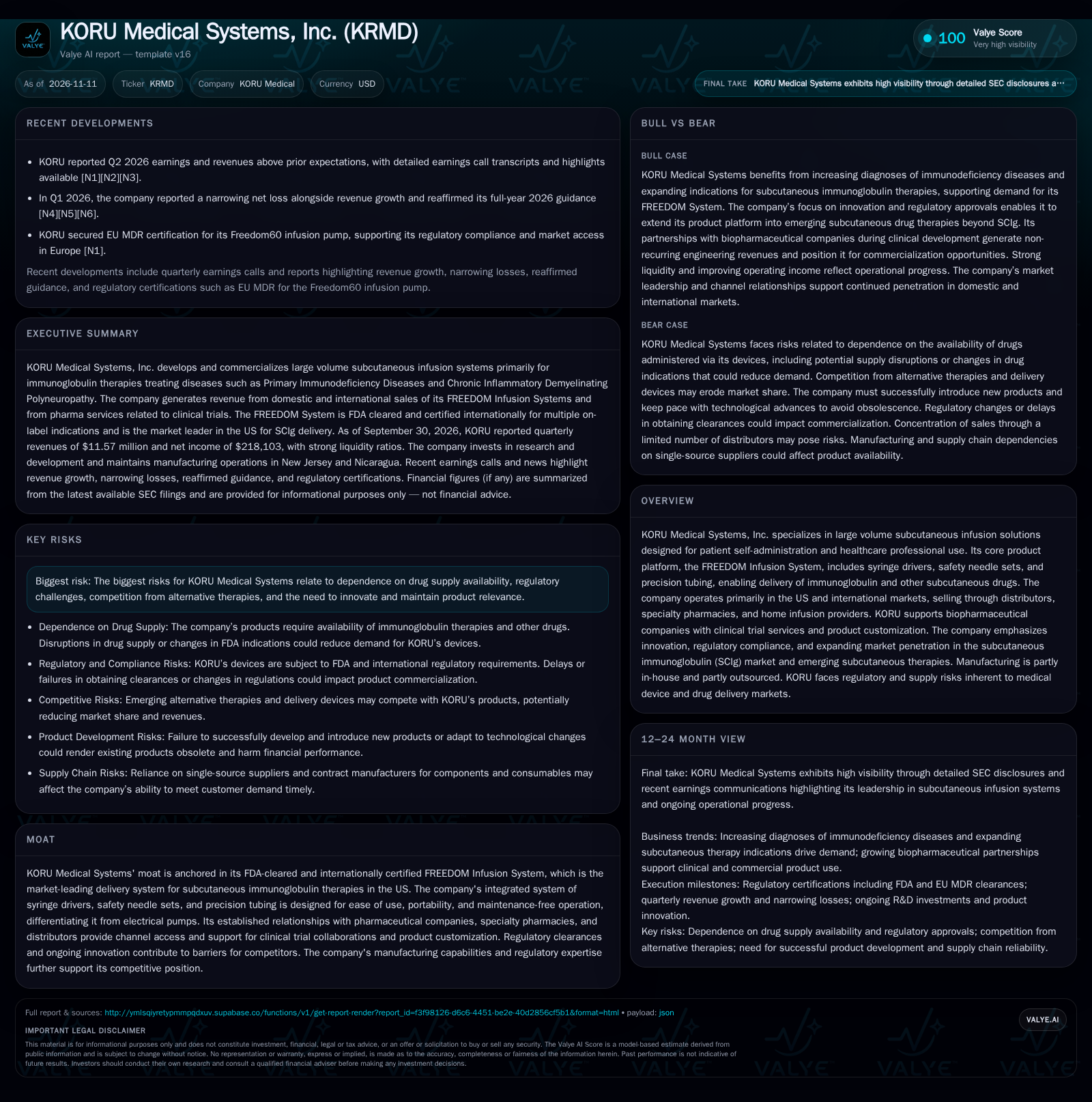
KORU Medical Systems reported $11.57 million in Q3 2026 revenue and net income of $218,103, reflecting operational improvement and reaffirmed guidance. Its FREEDOM Infusion System remains the leading platform for subcutaneous immunoglobulin delivery in the US, supported by strong relationships with specialty pharmacies and biopharma partners. The company’s growth outlook depends on expanding SCIg indications, partnerships for new therapies, and navigating supply chain and regulatory risks. Key watchpoints include drug availability, competitive device innovation, regulatory progress, and the pace of new product adoption. [S2] [N1] [N2] [N4]
KORU Medical Systems, Inc. stands at a pivotal moment in the evolution of subcutaneous drug delivery. The company has demonstrated notable financial progress in 2026, with both revenue growth and a return to profitability, underpinned by its FREEDOM Infusion System’s entrenched leadership in the US SCIg market. As new immunoglobulin indications and emerging subcutaneous drug therapies drive secular demand, KORU’s ability to innovate, secure regulatory approvals, and partner with biopharma will determine whether its recent momentum can translate into sustained, defensible growth—or whether exposure to drug supply, regulatory, and competitive risks will limit its upside. [S2] [N1] [N2] [N4]
Q3 2026 Financial Results and Regulatory Milestones Define the Near-Term Landscape
KORU Medical reported $11.57 million in revenue and $218,103 in net income for Q3 2026, reversing prior period losses and signaling operational improvement as the company reaffirmed full-year guidance. Net operating income of $187,118 further marked a shift from previous loss-making quarters. The company’s liquidity ratios as of September 30, 2026, included a current ratio of 2.97 and cash and cash equivalents of $7.36 million. In parallel, KORU secured EU MDR certification for its Freedom60 infusion pump, which expands its regulatory footprint in Europe. These developments represent both financial stabilization and increased regulatory credibility, at a time when the market for subcutaneous immunoglobulin (SCIg) delivery is broadening. [S2] [N1] [N2] [N4]
How KORU Generates Returns: Device Sales, Consumables, and Pharma Collaboration
KORU Medical monetizes its FREEDOM Infusion System through a combination of hardware sales (syringe drivers), consumables (needle sets, tubing), and pharma services, including revenue from clinical trials and customization projects. The core revenue stream is driven by repeat sales of consumables for SCIg and other subcutaneous therapies—a model that, if sticky, can yield recurring revenue as long as the installed base grows and patient adherence remains high. Pharma services, while less predictable, provide near-term revenue and strategic access to emerging drug pipelines.
The company's cost structure likely features moderate gross margins on device hardware and higher margins on proprietary consumables, consistent with industry norms for infusion therapy platforms. Manufacturing is a hybrid of in-house pump production (Mahwah, NJ) and outsourced consumables (Nicaragua), balancing control over IP-sensitive components with cost efficiency for high-volume parts. R&D expenditures of $4.4 million in 2025 and $5.3 million in 2024 indicate ongoing investment in new indications and platform enhancements. The business model’s scalability is tied to both the volume of drug therapies administered via KORU’s system and the company's ability to expand into adjacent indications.
Working capital needs are meaningful given inventory and regulatory requirements, but recent operating income improvements suggest that incremental revenue may increasingly fall to the bottom line, creating operating leverage if growth persists. However, the dependence on a small number of distributors for a large share of revenues introduces potential channel concentration risk. [S2] [S1]
Defending the SCIg Delivery Niche: Differentiation, Risks, and Substitution Threats
KORU’s FREEDOM Infusion System is positioned as the leading US platform for at-home SCIg therapy, offering ease of use, portability, and a maintenance-free mechanical design that differentiates it from electrical infusion pumps. The system’s FDA and international clearances for major SCIg drugs, as well as for RYSTIGGO in generalized myasthenia gravis, reinforce its regulatory moat and channel access.
The company’s competitive advantages include established distributor and specialty pharmacy relationships, biopharma partnerships for clinical trial customization, and a track record of regulatory compliance. However, these strengths are counterbalanced by several vulnerabilities: the risk of alternative delivery technologies (e.g., wearable patches, next-generation pumps), the potential for new drugs to be launched with proprietary delivery systems, and the reality that a small number of distributors account for a disproportionate share of sales.
Switching frictions for providers and patients may be moderate, given the training and familiarity required for infusion therapy, but not insurmountable—especially if a competitor introduces a device with superior user experience, reimbursement support, or integration with digital health platforms. The underlying market is also subject to substitution if alternative therapies (such as gene therapy or new biologics) reduce the long-term need for immunoglobulin infusions.
Broader Adoption of Subcutaneous Therapies Drives Platform Expansion
KORU could see outsized growth if several positive forces converge: an acceleration in SCIg diagnoses and at-home treatment, expansion of drug indications for subcutaneous delivery, and successful partnership-driven customization for new therapies. If KORU continues to win biopharma collaborations early in the clinical development cycle and secures regulatory clearances alongside new drug launches, it could embed its platform as the default delivery device for a growing portfolio of therapies.
Evidence supporting this scenario would include sustained above-market revenue growth, a rising share of pharma services income (signaling pipeline engagement), and expanding gross margins as consumable volumes scale. Additional confirmation would come from new regulatory clearances, successful launches in Europe and other geographies post-EU MDR certification, and public announcements of partnerships with leading biopharma companies for next-generation subcutaneous drugs. Conversely, if KORU fails to extend its platform beyond current indications or loses share in the US SCIg market, the upside scenario would be undermined.
Incremental Growth Anchored in Core SCIg Markets with Selective Diversification
The most plausible outlook is for KORU to maintain its leadership in US SCIg delivery, generating modest organic growth as the patient base expands and new indications are gradually added. Revenue from pharma services and clinical trials may fluctuate, but the core business should be defensible if KORU continues to support existing therapies and maintain regulatory compliance.
Confirmation of this scenario would be continued quarterly revenue growth in line with historical trends, stable or improving operating income, and periodic product enhancements or regulatory wins. Base case risks include slower-than-expected adoption of new therapies, delays in regulatory approvals, or minor competitive share loss. Falsification would occur if KORU’s core device volumes stagnate or if a major distributor materially reduces purchases.
Supply Disruption, Regulatory Delays, or Device Substitution Erode Core Revenues
Material downside could emerge if the supply of immunoglobulin drugs is disrupted, new FDA or international regulatory requirements delay product approvals, or a competitor launches a superior or more cost-effective delivery device. Because KORU’s platform is tightly linked to the availability of specific drugs and reimbursement pathways, any significant shift in drug supply, therapy guidelines, or payer policy could quickly reduce device and consumable demand.
Downside evidence would include a sharp drop in core revenue, loss of major distributor relationships, or public disclosure of adverse regulatory or supply chain events. Further risk would be signaled by rising R&D costs without corresponding new product traction, or if alternative therapies begin to displace SCIg as the standard of care.
Tracking KORU’s Progress: Metrics That Will Shape the Competitive Thesis
Quarterly core device and consumables revenue growth, both in the US and internationally, would help test the resilience and expansion of KORU’s installed base.
The rate of new biopharma partnerships and the pipeline of pharma services/customization contracts, if disclosed, will indicate success in embedding the FREEDOM System with emerging therapies.
Regulatory progress, such as additional FDA 510(k) clearances and international certifications, will determine the pace of new product launches and geographic expansion.
Any changes in the concentration of distributor or specialty pharmacy revenue would reveal potential channel risks or diversification.
Gross margin trends—especially as international and pharma services revenue grows—would provide insight into operating leverage and product mix evolution.
Updates on drug supply continuity and any industry-wide changes in SCIg or subcutaneous therapy reimbursement would signal external risks to device demand.
Progress on new product development or entry into adjacent subcutaneous indications (e.g., autoimmune, rare diseases) would help validate the innovation thesis.
Disclosure of patient adherence or retention rates for KORU-administered therapies, if available, would clarify the platform’s stickiness and recurring revenue potential.
Disclaimer: This is research-only, informational analysis and not investment advice. It may include AI-generated interpretation and general industry context. Always verify important details using primary sources.

Comments