
The company reported cash and liquidity metrics for the period; these figures do not by themselves establish operating runway, investment capacity, financial flexibility, or financing capacity.
The company’s path forward hinges on commercial expansion, execution by newly appointed leadership, and its ability to navigate ongoing financing and operational risks in a competitive healthcare market.
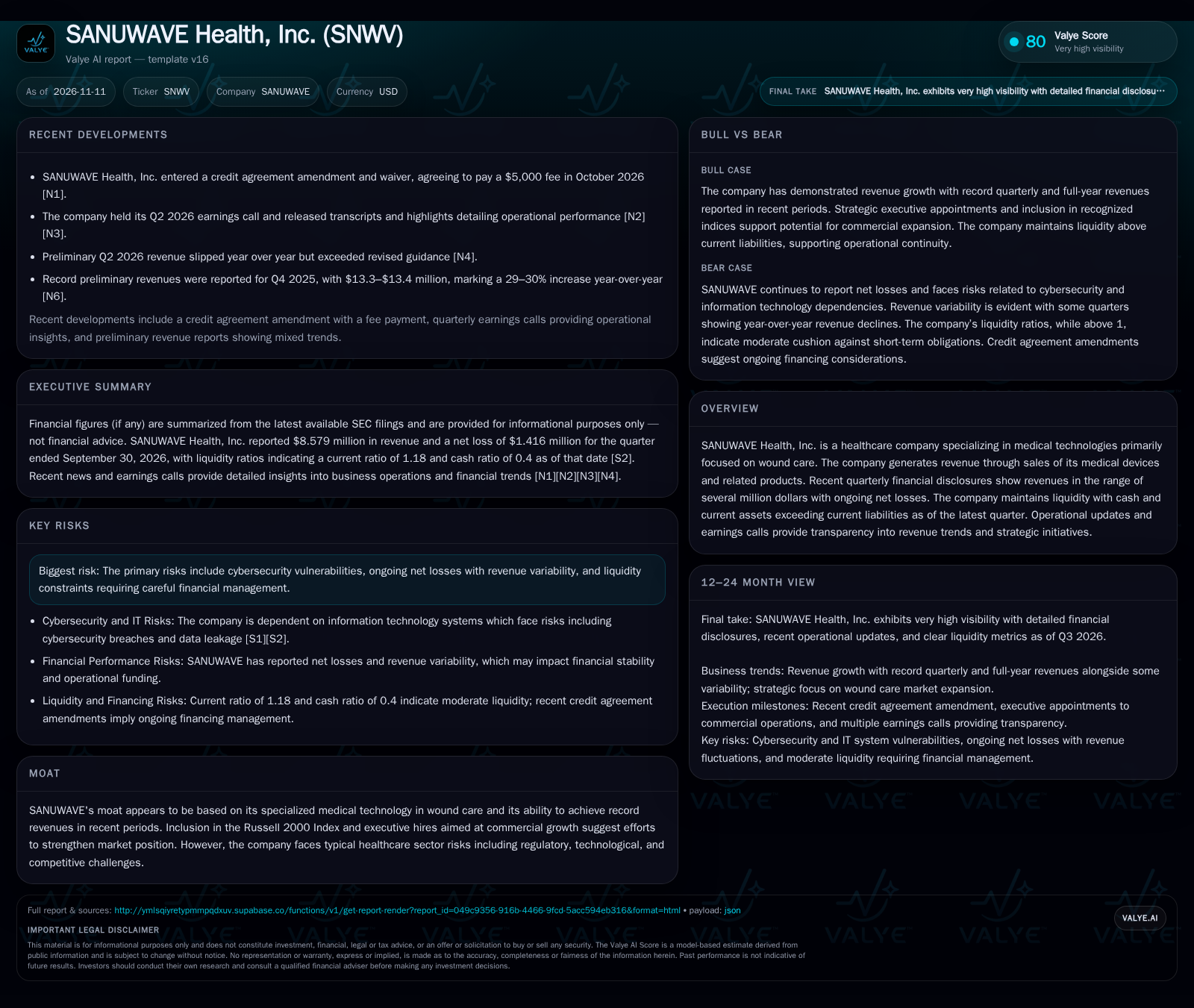
SANUWAVE Health posted $8.6 million in Q3 2026 revenue and a $1.4 million net loss. Liquidity remains above current liabilities, but a recent credit agreement amendment signals active financial management. Executive hires and Russell 2000 inclusion point to strategic growth efforts, yet persistent losses and sector risks highlight the need for improved commercial traction and operational discipline. The company’s ability to scale, achieve sustained profitability, and mitigate IT/cybersecurity risks will drive its medium-term outcome. [S2] [N1]
SANUWAVE Health, Inc. operates at the intersection of medical technology innovation and the complex realities of commercializing wound care solutions. The company’s strategic direction—marked by new leadership appointments and index inclusion—will be tested by execution risks, sector competition, and the ability to turn specialized technology and market access into durable operating leverage.
Recent Results Show Revenue Momentum, Persistent Losses, and Tight Liquidity Management
For the quarter ended September 30, 2026, SANUWAVE Health reported revenue of $8.579 million and a net loss of $1.416 million, or -$0.16 per share. Cash and equivalents were $6.569 million, with current assets of $19.299 million against current liabilities of $16.394 million, yielding a current ratio of 1.18 and a cash ratio of 0.4. [S2] These figures indicate that while the company maintains liquidity above its immediate obligations, the margin is thin and ongoing losses continue.
The company amended a credit agreement in October 2026, paying a $5,000 fee, which signals active engagement with lenders and the need to manage financing terms closely. [N1] SANUWAVE’s inclusion in the Russell 2000 Index and recent executive appointments, such as naming Dustin Libby EVP of Commercial Operations, suggest a focus on commercial execution and market visibility.
Notably, preliminary Q2 2026 revenue slipped year-over-year but still topped revised guidance, while Q4 2025 marked record revenues, up nearly 30% year-over-year. [N4] [N6] This revenue pattern highlights both the company’s ability to achieve spikes in growth and the challenge of sustaining upward momentum.
How SANUWAVE’s Revenue Model and Cost Structure Shape Its Path to Profitability
SANUWAVE’s core business is the sale of medical devices and wound care technologies, a sector characterized by lumpy purchasing cycles, reimbursement complexity, and a mix of capital equipment and consumables revenue. Revenue is generated from device sales, and potentially from recurring consumable or service streams if the installed base grows, but the report does not specify the mix or contract structure.
The company’s ability to scale recurring revenue is likely dependent on device adoption among clinics, hospitals, and wound care centers, followed by ongoing demand for consumables or maintenance. Pricing in wound care is typically constrained by reimbursement rates, and margins can vary widely depending on product mix and channel. Fixed costs related to R&D, regulatory compliance, and sales infrastructure are significant, while variable costs reflect manufacturing and distribution. This dynamic means that operating leverage is only achieved with sustained volume growth and high utilization of the installed base.
SANUWAVE’s ongoing net losses and reported liquidity position suggest that it is not yet at a scale where fixed costs are sufficiently covered by gross profit.
Specialization in Wound Care Technology: Differentiation and Sector Headwinds
SANUWAVE operates in a highly competitive segment of the healthcare industry, facing established medical device manufacturers as well as emerging technology firms. Its specialization in wound care could provide differentiation, particularly if its technology delivers superior clinical outcomes or workflow advantages. However, the sector is marked by rapid innovation, frequent product launches, and the necessity of strong clinical validation and reimbursement support.
Barriers to entry include regulatory approvals, clinician adoption curves, and integration with hospital IT systems. Switching costs for providers depend on clinical evidence, ease of use, and the degree to which SANUWAVE’s solutions are embedded in care protocols. However, unless the company can establish robust clinical data and preferred vendor status, it remains vulnerable to substitution by larger firms with broader product portfolios, deeper sales channels, and stronger payer relationships.
Inclusion in the Russell 2000 may improve visibility among institutional investors, but does not by itself confer a commercial or technological moat. Recent executive hires could help sharpen go-to-market execution, but the ultimate test will be sustained growth in device placements and utilization.
Cascading Adoption: How Commercial Execution Could Unlock Operating Leverage
If SANUWAVE’s new commercial leadership successfully accelerates device adoption and drives recurring utilization, the company could move toward positive operating leverage. A favorable scenario would involve successful clinical studies validating efficacy, expanded hospital and clinic penetration, and growing consumable demand from a larger installed base.
Revenue growth would outpace fixed cost increases, potentially converting net losses to profitability as the business scales. Confirmation of this scenario would come from successive quarters of accelerating revenue growth, improvement in gross margins (indicating better mix or pricing), and a shrinking net loss or positive EPS. In addition, evidence of expanded payer coverage or new large health system contracts would signal traction.
Falsification would occur if revenue stagnates or declines, margins compress due to pricing pressure, or if new executive hires do not translate into commercial gains.
Commercial Progress Offset by Cost Pressure and Episodic Revenue
The most probable outcome is continued moderate growth in revenue, punctuated by quarters of volatility depending on order timing and customer adoption rates. Operating losses may persist as the company invests in sales infrastructure and product development to remain competitive, while reimbursement and regulatory constraints limit pricing expansion.
Liquidity remains above minimum thresholds but requires ongoing management, as reflected in recent credit agreement amendments. The company could maintain operations and grow its installed base, but without a step-change in adoption or margin profile, the transition to profitability may be slow.
This scenario would be confirmed by stable or gradually improving revenues, continued net losses of similar magnitude, and periodic financing activity to support working capital. Falsification would occur if either sustained revenue acceleration or a step-change in cost structure enables a rapid move to profitability.
Financing Constraints and Competitive Pressures Undermine Operating Stability
In an adverse scenario, SANUWAVE could face tightening liquidity as net losses persist without sufficient revenue growth. If credit terms become more restrictive, or if the company is unable to raise additional capital, it may be forced to cut back on R&D, sales, or support, undermining its ability to compete.
Competitive pressures from larger firms or new entrants with more advanced or cost-effective technologies could erode market share, especially if SANUWAVE’s products struggle to gain or retain reimbursement and clinical adoption. Cybersecurity or IT system failures could disrupt operations or damage reputation, given the company’s disclosed risk factors.
This scenario would be confirmed by declining revenues, widening losses, additional or unfavorable credit amendments, or indications of customer churn. Falsification would require visible improvement in cash flow, margin expansion, and evidence of growing commercial traction.
Milestones That Will Shape SANUWAVE’s Wound Care Commercialization Trajectory
Quarterly revenue growth rates and the mix between device sales and recurring consumable/service revenue, if disclosed.
Gross margin trends, which would indicate whether the company is achieving pricing power or facing cost pressure.
Net cash used in operating activities, as a direct measure of underlying cash burn and sustainability.
Progress on executive-led commercial initiatives, such as new customer wins, expanded distribution, or payer coverage announcements.
Disclosures on clinical study outcomes or new regulatory approvals relevant to expanding addressable markets.
Material cybersecurity or IT system incidents, given the company’s stated risk profile.
Disclaimer: This is research-only, informational analysis and not investment advice. It may include AI-generated interpretation and general industry context. Always verify important details using primary sources.

Comments