
Hyliion's Power Play: Can KARNO’s Modular, Fuel-Agnostic Generators Break Through in Distributed Energy?
Hyliion’s Q3 2026 results showcase a company transitioning from R&D to commercialization, leveraging government contracts and advanced generator technology. The next phase hinges on scaling the KARNO Power Module beyond pilot deployments, navigating steep competition and proving recurring value in demanding markets like data centers and defense.
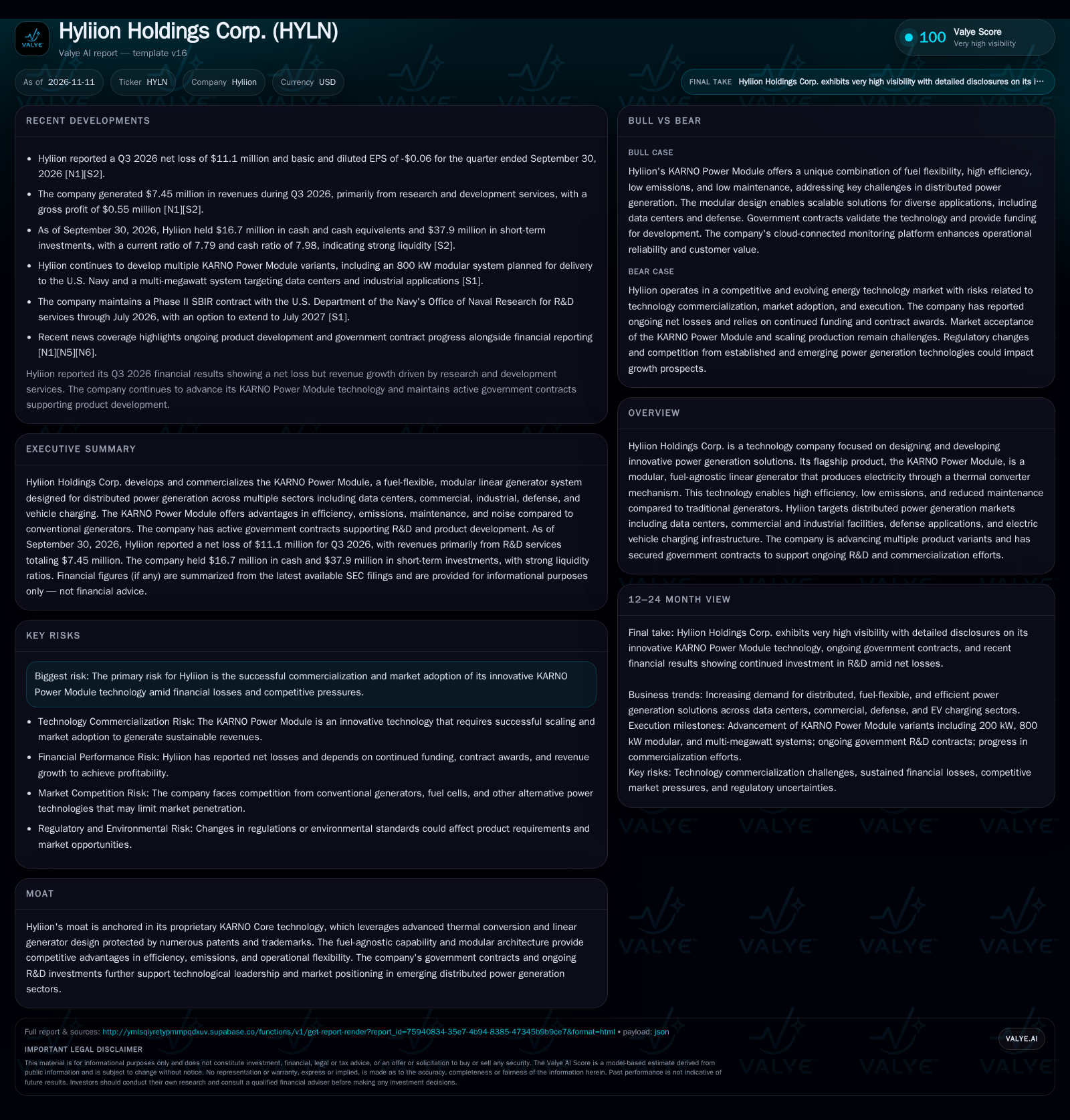
Hyliion is betting on its KARNO Power Module—a modular, fuel-flexible linear generator—for distributed power markets. Q3 2026 revenue is still mostly from R&D, with losses persisting, but government contracts and product development milestones point to commercialization efforts. Success will depend on real-world adoption, cost competitiveness, and the ability to deliver reliability and efficiency at scale [S1] [S2] [N1].
Hyliion Holdings Corp. is at a strategic crossroads: its innovative KARNO Power Module, designed to deliver efficient, fuel-agnostic power for distributed generation, is moving from development into the early stages of commercialization. Q3 2026 results show the company still generates most revenue from research contracts, notably with the U.S. Navy, and continues to post operating losses. With reported liquidity position and a diversified product pipeline, the central question is whether Hyliion can translate technical advantages into sustained commercial growth in markets crowded with both established and emerging power solutions.
Q3 2026: R&D Revenue Still Dominates as Commercialization Beckons
Hyliion reported $7.45 million in Q3 2026 revenue, almost entirely from research and development services, while posting a net loss of $11.1 million for the quarter [S2] [N1]. These figures suggest that, despite heightened visibility and ongoing product development, the company remains in a pre-commercial or early-commercial phase, with limited recurring product revenue.As of September 30, 2026, Hyliion held $16.7 million in cash and $37.9 million in short-term investments, supporting a reported current ratio of 7.79 and cash ratio of 7.98 [S2]. The company’s main product focus is the KARNO Power Module, which is being developed in multiple variants, including a planned 800 kW system for the U.S. Navy and larger multi-megawatt systems targeting data centers and industrial users [S1]. The ongoing Phase II SBIR contract with the Navy’s Office of Naval Research, running through at least July 2026, is a critical source of funding and technical validation [S1].
How the KARNO Power Module Could Reshape Distributed Generation Economics
Hyliion’s business model is designed around selling modular KARNO Power Modules to customers in distributed power markets—data centers, commercial and industrial facilities, defense, and EV charging. The system’s fuel flexibility (natural gas, hydrogen, ammonia, etc.) and low-maintenance design are potential levers for lower total cost of ownership and higher uptime versus conventional generators or fuel cells. However, current revenue is still primarily from R&D services rather than product sales, so the company’s product-margin structure, pricing model (outright sale, leasing, or service contract), and cost base at commercial scale remain largely unproven [S2].
If Hyliion succeeds in commercial sales, the economics could shift meaningfully: modular hardware often carries high upfront costs but, if paired with service/maintenance contracts or remote monitoring, could yield recurring revenue streams and better operating leverage over time. The capital intensity of scaling manufacturing—especially for multi-megawatt systems—could be significant, likely requiring further investment or partnerships. Gross margin for Q3 2026 was modest ($0.55 million on $7.45 million revenue), reflecting the R&D-heavy mix [S2]. True hardware and service margin dynamics will only become clear as product deployments ramp.
Evaluating Hyliion’s Edge: Technology, Flexibility, and the Battle for Market Share
Hyliion’s core competitive proposition lies in the KARNO module’s fuel-agnostic, modular design and its claims of higher efficiency, lower emissions, and lower maintenance versus incumbent generator technologies [S1]. In theory, this makes it attractive for customers seeking resilient, clean, on-site power—especially in applications where grid reliability or emissions constraints are critical (e.g., data centers, military bases, remote industrial sites).
However, the distributed generation market is intensely competitive. Traditional diesel and gas generators are entrenched, while fuel cells, microturbines, and battery-backed systems are advancing rapidly. Major industrial OEMs and energy-tech incumbents have scale, service networks, and established customer relationships. Hyliion’s government contracts provide initial credibility but do not guarantee broader commercial adoption. The ability to prove real-world reliability, deliver on cost and emissions promises, and integrate into customer environments will determine whether Hyliion can carve out a defensible niche.
If KARNO Delivers: Pathways to Scalable Adoption and Recurring Value
The upside scenario hinges on Hyliion successfully transitioning from R&D and pilot deployments to repeatable, scalable product sales. If the KARNO Power Module performs as promised—delivering reliable, low-emissions, fuel-flexible power with materially lower maintenance—the company could secure anchor customers in data centers, industrial operations, or defense, leading to follow-on orders and potentially multi-year service agreements.
Confirmation would come from disclosed commercial contracts, initial fleet deployments, and customer testimonials attesting to superior uptime and economics. Margins should improve as product revenue overtakes R&D services, and recurring revenue from maintenance or monitoring contracts could emerge. Evidence of manufacturing scale-up (factory expansion, supply chain deals) would further support the case. If Hyliion wins a multi-megawatt deployment in a highly visible data center or industrial project, it could catalyze broader market interest.
Commercialization Proceeds Incrementally Amid Competitive and Technical Hurdles
The most plausible trajectory is that Hyliion continues to advance product development and pilot projects, supported by government contracts and select early adopters, but faces a gradual ramp in commercial sales. R&D services and milestone payments remain a meaningful revenue source into 2027, with initial product deployments generating modest but growing hardware and service revenue.
Commercial traction may be slow as customers demand extensive validation, reliability data, and total cost-of-ownership proof points. Gross margins may remain compressed until volume scales. Evidence for this scenario would include continued reliance on government or demonstration contracts, incremental product revenue growth, and cautious guidance from management regarding ramp timelines. Falsification would require a sudden surge in commercial orders or a major strategic partnership with a scaled industrial or energy player.
Potential Pitfalls: Delays, Cash Burn, and Competitive Displacement
The adverse scenario is characterized by persistent delays in commercial adoption, cost overruns in product development or manufacturing, and inability to demonstrate compelling advantages over entrenched or emerging alternatives. If the KARNO Power Module encounters performance or reliability issues in pilot deployments, or if customers balk at high upfront costs, market traction could stall.
Continued net losses and cash burn could force Hyliion to seek dilutive equity financing or scale back R&D. Loss of key government contracts or failure to convert pilots into commercial orders would be strong negative signals. If established generator OEMs or fuel cell companies outpace Hyliion on cost, emissions, or reliability, the company could struggle to secure a foothold.
Milestones and Metrics That Will Reveal Hyliion’s Commercialization Trajectory
Commercial contract announcements for KARNO Power Module sales to non-government customers would signal market traction.
Evidence of initial multi-megawatt deployments—especially in data centers or industrial sites—would help validate scalability and customer acceptance.
Gross margin evolution: improvement as product sales scale would indicate better unit economics.
Breakdown of revenue mix: an increasing share from hardware and services (versus R&D) would reflect commercial progress.
Updates on manufacturing scale-up, such as capacity expansions or supply chain partnerships, would clarify readiness for volume production.
Customer retention or follow-on order disclosures (if provided) would test the stickiness and value proposition of the KARNO platform.
Cash burn rate and capital raise activity: sustained high losses or new financings would affect the path to self-sufficiency.
If disclosed, field performance data (uptime, emissions, maintenance intervals) from real-world deployments would be critical for competitive differentiation.
Disclaimer: This is research-only, informational analysis and not investment advice. It may include AI-generated interpretation and general industry context. Always verify important details using primary sources.

Comments