
Resideo Technologies After the ADI Spin-Off: Strategic Narrowing, Customer Exposure, and the Search for Margin Expansion
With the ADI Global Distribution segment spun off, Resideo is now a more focused but less diversified provider of sensing, controls, and smart home solutions. The company retains a broad product portfolio and substantial professional installer network, but faces increased leverage, customer concentration, and supply-chain risk. The path forward hinges on margin improvement, navigating demand volatility, and capitalizing on secular smart home and energy management trends.
Resideo Technologies has transitioned to a single-segment, product-focused company following the ADI Global Distribution spin-off. While it maintains a large connected user base and deep installer relationships, the company now faces greater leverage, customer concentration, and supply chain pressures. Future performance will depend on its ability to expand margins, manage volatility, and leverage its smart home platform.
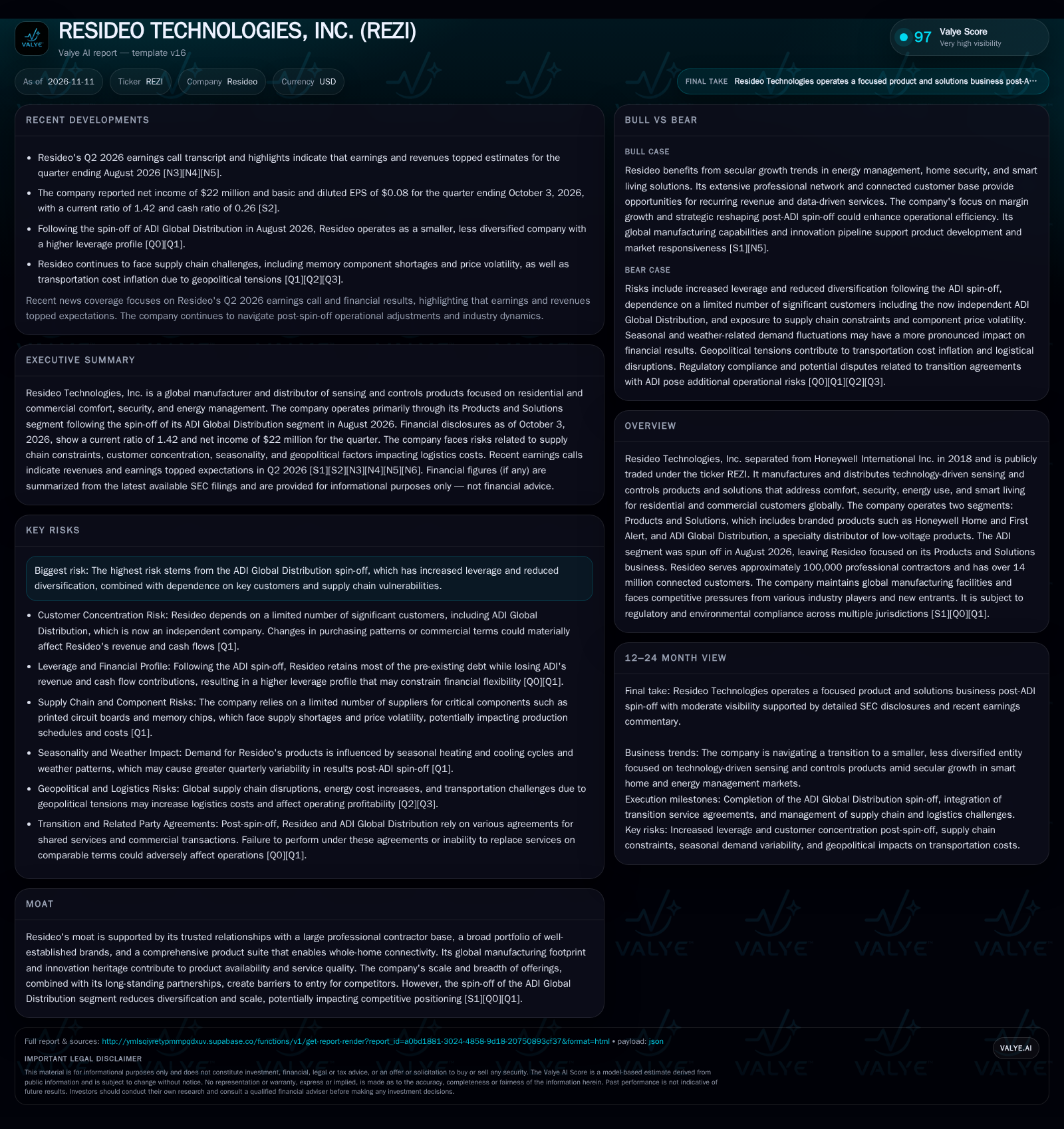
Resideo Technologies is navigating a pivotal transition after spinning off its ADI Global Distribution arm in August 2026. Now operating as a more focused provider of branded comfort, security, and energy management solutions, Resideo faces a markedly higher leverage profile and sharper exposure to single-customer and supply chain risks. While the company retains a substantial professional installer base and a growing installed base of connected devices, its future will be shaped by its ability to expand margins, manage demand volatility, and execute on product and service innovation in a competitive, rapidly evolving smart home landscape.
A Smaller, More Focused Resideo Faces New Exposures After the ADI Spin-Off
The August 2026 spin-off of ADI Global Distribution is the defining recent event for Resideo, transforming the company into a single-segment provider of sensing, control, and smart home solutions [S1]. While Resideo retains a broad branded product portfolio—including Honeywell Home, First Alert, and others—it is now less diversified, with revenue and cash flow streams more tightly linked to its core offering.
As of October 3, 2026, Resideo reported $229 million in cash, current assets of $1.239 billion, and a current ratio of 1.42. However, with a cash ratio of just 0.26, the company’s liquidity position is relatively tight, especially given the higher leverage profile resulting from retaining most pre-spin debt [S2]. Net income for the quarter was $22 million, with EPS of $0.08 [S2].
Customer concentration is now more pronounced. ADI, now an independent entity but still a major channel partner, accounted for $43 million of sales in the third quarter of 2026. Other distributors, retailers, and OEMs also represent significant portions of revenue, amplifying the impact of any changes in purchasing patterns or commercial terms.
Supply chain and logistics remain top-of-mind risks: Resideo is exposed to shortages and price volatility for critical components (notably memory and PCBs) and continues to face cost inflation and disruptions from geopolitical tensions.
How Resideo’s Product-Centric Model Drives Revenue and Margin Opportunities
Resideo’s business model is now centered on the manufacture and distribution of branded sensing, control, and safety devices, with a focus on professional installation channels. The economics of this model are shaped by a mix of upfront hardware sales (thermostats, detectors, controllers, sensors) and, in some cases, recurring revenue streams from connected devices (e.g., cloud-enabled monitoring, software updates, or subscription-based services). However, the commercial terms and magnitude of recurring revenue are not fully disclosed, making it difficult to assess the extent of contractual revenue visibility or margin stability.
The company’s global manufacturing footprint offers some cost flexibility and proximity to end markets, but also creates exposure to regional wage, currency, and supply chain pressures. Gross margin is heavily influenced by product mix (higher for proprietary, branded, or connected devices; lower for commoditized hardware), input cost volatility, and channel incentives required to maintain installer loyalty.
Operating leverage is a key variable post-spin-off. With ADI’s distribution profits and scale efficiencies gone, Resideo’s fixed-cost absorption depends more directly on product volume and mix. If the company can grow its installed base of connected devices and attach higher-margin software or service offerings, incremental margin expansion is plausible. Conversely, if supply chain costs or customer pricing power erode, margin compression is likely.
Capital needs now skew toward product development, supply chain resilience, and potentially selective M&A to fill portfolio gaps or accelerate digital service capabilities. The company’s liquidity, while positive, is not abundant relative to its leverage and the risk of demand or supply shocks [S2].
Brand Strength, Installer Network, and Platform Ambitions Versus Industry Pressures
Resideo’s competitive advantages stem from a broad portfolio of established brands (including Honeywell Home, First Alert, and Braukmann), a global network of approximately 100,000 professional contractors and installers, and a substantial base of over 14 million connected customers [S1]. These assets support strong channel access, installer loyalty, and some degree of customer stickiness—particularly in regulated or safety-critical categories such as smoke and CO detection.
However, the industry is highly competitive, with established players in HVAC, security, and smart home (such as Johnson Controls, Carrier, and global electronics giants) as well as new entrants offering integrated IoT platforms and direct-to-consumer solutions. The ADI spin-off reduces Resideo’s scale and distribution reach, potentially weakening its negotiating leverage with suppliers and channel partners. Furthermore, the shift toward open standards and interoperability in the smart home ecosystem could erode proprietary platform advantages unless Resideo can deliver differentiated value through software, data, or service integration.
Switching costs for installers and end-users can be moderate to high in certain product categories—especially if devices are professionally installed, integrated with other systems, or subject to regulatory standards. However, commoditization pressure and price-based competition remain real risks, and the company’s customer concentration amplifies exposure to distributor or OEM channel shifts.
Margin Expansion and Platform Monetization Could Unlock Above-Consensus Value
A favorable scenario for Resideo would see the company capitalize on secular trends in energy management, smart living, and residential safety, driving adoption of higher-margin connected devices and subscription-based services. If Resideo can leverage its installed base and installer network to increase attachment rates for value-added software, monitoring, or analytics, recurring revenue could become a more material driver of growth and margin expansion.
Operationally, successful supply chain management—such as securing critical components and offsetting input cost inflation through pricing or product redesign—would protect gross margins. If Resideo can also execute on product innovation and maintain strong channel engagement, it could outpace peers in both revenue growth and profitability.
Confirmation of this upside would come from disclosed increases in recurring or software/service revenue, margin improvement despite input cost volatility, and sustained growth in connected device penetration. Positive commentary on installer engagement, distributor partnerships, or new long-term customer contracts would further support the thesis.
Resideo’s Most Likely Trajectory: Incremental Progress Amid Volatility
The most plausible path forward is one of modest revenue growth in the low-to-mid-single digits, as forecast in the company’s own outlook. Resideo is likely to experience continued demand for core sensing and control products, but with pronounced quarterly variability due to seasonality, weather, and macroeconomic factors [S2].
Margins may remain under pressure from supply chain costs and customer concentration, but targeted cost controls, product mix improvements, and gradual expansion of connected offerings could partially offset these headwinds.
The base scenario would be confirmed by stable or gradually improving margins, steady cash flow despite supply chain pressures, and no significant loss of key customers or installer partners. Conversely, margin erosion, working capital strain, or evidence of distributor/channel disintermediation would challenge this outlook.
Heightened Leverage and Customer Concentration Expose Resideo to Disruption
In a negative scenario, Resideo’s increased leverage and dependence on a handful of large customers—especially ADI and major distributors or OEMs—could become acute vulnerabilities.
Simultaneously, persistent supply chain disruptions (such as continued component shortages or transportation bottlenecks) could drive up input costs and squeeze gross margins. If Resideo is unable to pass through these costs or rapidly redesign products, profitability would erode.
Confirmation of this downside would include sudden revenue declines tied to customer loss or reduced orders, worsening gross margins, liquidity strain (such as a deteriorating current or cash ratio), or negative commentary regarding supply chain or channel stability.
Evidence That Will Determine if Resideo Can Outperform or Underperform Post-Spin
Trends in recurring or software/service revenue, if disclosed, would clarify the extent to which platform monetization is offsetting hardware margin pressure.
Gross margin evolution in the face of ongoing input cost and supply chain volatility will test the company’s pricing power and operational agility.
Retention, growth, or loss of major distributor, OEM, and installer relationships would directly impact revenue stability and channel leverage.
Supply chain and component availability metrics—such as lead times, inventory levels, or supplier diversification—would help gauge operational risk.
Evidence of product innovation or new offerings in connected devices, analytics, or energy management would support the thesis of margin expansion.
Installer and channel partner engagement levels—potentially measured by installer adoption rates or satisfaction surveys, if disclosed—would indicate the stickiness of Resideo’s ecosystem.
Regulatory, environmental, or cybersecurity incident disclosures could alter the risk profile, given Resideo’s exposure to multiple global compliance regimes.
Disclaimer: This is research-only, informational analysis and not investment advice. It may include AI-generated interpretation and general industry context. Always verify important details using primary sources.

Comments