
Abacus Global Management Leverages Analytics to Navigate Life Settlements and Asset Management Growth
Q2 2026 results show adjusted EBITDA growth despite revenue pressure, highlighting strengths in proprietary analytics and diversified offerings amid refinancing considerations.
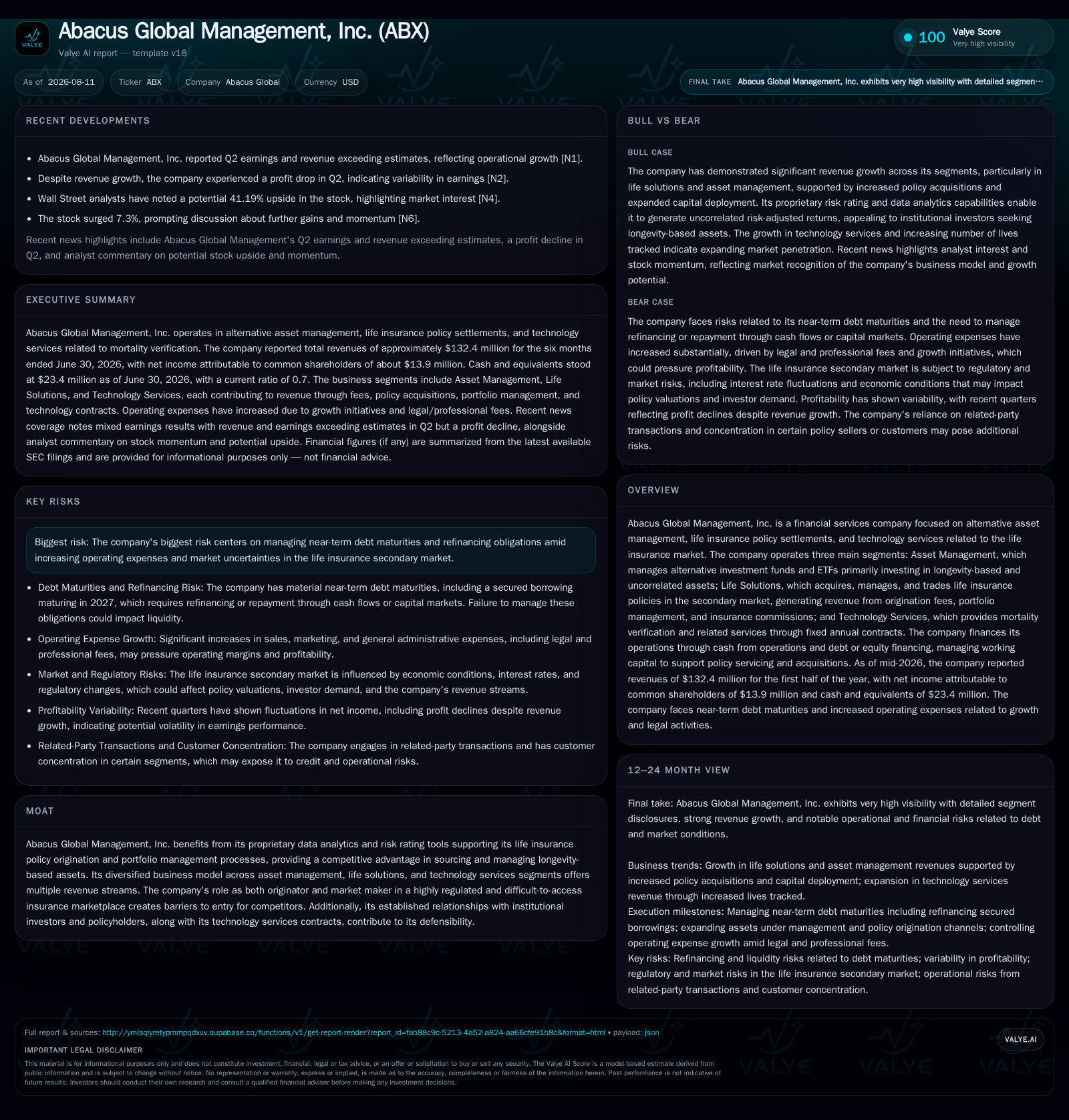
Abacus Global Management reported Q2 2026 adjusted EBITDA of $39.9 million on $73 million revenue, reflecting strong operating profitability despite a 5.2% revenue decline year-over-year for the six months ended June 30. The company’s diversified business model—spanning alternative asset management funds focused on longevity risk, life insurance policy settlements in a niche secondary market, and technology services delivering recurring contracts—positions it uniquely among peers. Proprietary data analytics offer a competitive moat in sourcing and managing longevity-based assets, although near-term debt maturities and refinancing remain watchpoints. Growth is driven by rising institutional interest in uncorrelated alternative investments and expansion of secondary life settlement markets supported by evolving mortality forecasts. Financial flexibility hinges on sustained operating cash flow generation to manage working capital needs and servicing obligations.
Recent Operating Update
ash generation underpins Abacus’s liquidity profile amid significant debt obligations.
Business Model Analysis
Abacus operates through three distinct but complementary segments that collectively address niche opportunities at the intersection of alternative asset management and life insurance settlements:
Asset Management: Via subsidiaries like Carlisle and FCF, Abacus manages specialized alternative investment funds and ETFs targeting longevity-based contracts alongside thematic equity strategies. Revenues derive mainly from management fees pegged to assets under management (AUM) as well as performance fees contingent on hurdle rate exceedance [S1]. This segment capitalizes on institutional desire for uncorrelated returns tied to demographic trends rather than traditional market cycles.
Life Solutions: This core segment focuses on life insurance policy settlements where Abacus originates policies directly from holders or through agents/brokers using stringent eligibility criteria supported by proprietary risk rating heat maps [S1]. Revenue sources include origination fees (~2% of face values), portfolio management fees linked to traded policies’ spread capture or held-maturity realization, plus insurance commissions [S1]. Post-acquisition decisions—to hold or trade policies—aim at optimizing capital deployment balancing yield against portfolio turnover rates.
Technology Services: Through ABL Intel, Abacus provides mortality verification and related services under fixed-annual contracts emphasizing recurring revenues [S1]. Though currently smaller with widening gross losses due partly to compensation cost rises [S24], this segment represents a scalable adjunct leveraging proprietary data analytics supporting underwriting efficiency across the value chain.
The interplay among these segments illustrates a vertically integrated approach spanning origination through portfolio management combined with enabling technology—an arrangement less common among pure-play life settlement firms or traditional asset managers.
Industry Structure and Competitive Positioning
Abacus sits within an industry combining alternative investment managers specializing in niche asset classes like longevity risk (akin to certain Blackstone or Apollo high-touch strategies) with life settlement providers active in secondary markets (comparable qualitatively to firms such as Coventry or GWG Holdings). However, its additional foothold in proprietary insurance data technology distinguishes it further toward an integrated ecosystem model.
The company's proprietary analytics tools—including the risk rating heat map—are crucial differentiators enabling enhanced mortality forecasting accuracy that affects both origination quality and portfolio valuation reliability—a major challenge industry-wide given inherent unpredictability of insured lives’ longevity [S1]. This advantage supports better pricing discipline versus competitors reliant more heavily on external estimates.
Additionally, Abacus's role as both a direct originator of policies and as a market maker trading these contracts facilitates stronger control over inventory acquisition costs and execution spreads, creating notable market entry barriers especially under licensing/regulatory constraints prevalent in US life settlements [S1]. Established relationships with brokers and institutional investors further cement its market position.
Growth Drivers
Several secular trends underpin Abacus's growth prospects:
- The aging global population coupled with increasing longevity drives demand for risk transfer solutions addressing longevity risk—creating natural expansion opportunities for life settlements portfolios.
- Growing institutional investor interest seeking uncorrelated return streams into alternative assets spurs inflows into dedicated funds and ETFs oriented around insurance-linked securities.
- Advances in data science and mortality modeling enhance asset valuation precision facilitating deeper secondary market liquidity—a key enabler of higher policy origination volumes.
- Regulatory acceptance evolving toward clarity on life settlements encourages greater transparency supporting transactional throughput.
- Expansion of technology contracting outside core proprietary fund activities extends recurring fee streams complementing transactional revenue exposure.
Together these factors drive increases not only in AUM but also policy acquisition counts while improving risk-adjusted portfolio yields—the KPIs closely monitored internally as well as by external analysts.
Risks and Watchpoints
Despite multiple advantages, Abacus faces several risks:
- Refinancing Risks: Total net debt stands near $313 million with significant near-term maturities including a secured borrowing due June 2027 [F1], necessitating successful refinancing during evolving credit markets [S20].
- Valuation Uncertainty: Accurate life expectancy forecasting remains challenging; errors could materially impact returns particularly on held-to-maturity policies where timing volatility compresses yields [S1].
- Origination Constraints: Limited market availability of eligible policies constrains volume growth; increased competition from insurers or brokers could exacerbate sourcing hurdles [S1].
- Operational Complexity: Managing premium payments on diverse portfolios requires flawless servicing capabilities; lapses can lead to forfeited policy values harming financial results [S1].
- Regulatory Scrutiny & Reputation: Life settlements historically carry negative perceptions which could affect liquidity or invite regulatory challenges impacting business expansion trajectories [S1].
- Technology Segment Profitability: Elevated compensation costs have widened gross losses recently; achieving scale profitably here remains critical for maintaining diversified earnings stability [S24].
These markers will clarify whether current growth themes sustain amid balance-sheet pressures.
Financial Profile Discussion
Abacus’s financial position reflects both opportunity and constraint typical of asset-heavy financial service firms serving illiquid alternative niches. Cash & equivalents stood at approximately $23.4 million as of June 30, 2026 versus total debt around $336.8 million yielding a net debt approximating $313.4 million—a significant leverage ratio putting pressure on free cash flow allocation priorities [F1]. The current ratio sits at a conservative ~0.7 indicating limited near-term working capital cushion given liabilities tallying around $91.7 million against roughly $64.6 million current assets [F1].
Overall financial health depends critically on continued scaling of high-margin fee revenues notably from asset management fees alongside sustaining premium origination volumes ensuring stable servicing fees—these drive long-term cash conversion capacity needed for deleveraging amid cautious capital allocation.
-- This analysis synthesizes Abacus Global Management’s latest quarterly disclosures with industry sector insights focusing on company-specific competitive advantages and risks without providing any investment advice or research views.
Disclaimer: This is research-only, informational analysis and not investment advice. It may include AI-generated interpretation and general industry context. Always verify important details using primary sources.

Comments