
American Clean Resources Group: Asset Ambitions, Financing Constraints, and the Hurdles of Permitting in Toll Milling
American Clean Resources Group, Inc. is attempting to launch a custom mineral processing business in Nevada, but faces acute execution and financial risks: it has no revenue, nearly $5 million in short-term liabilities, minimal cash, and must secure permitting and capital before construction can begin. The company's fate hinges on its ability to convert land assets and historic tailings into a viable toll milling operation—under the shadow of majority-owner dependency and persistent going concern uncertainty.
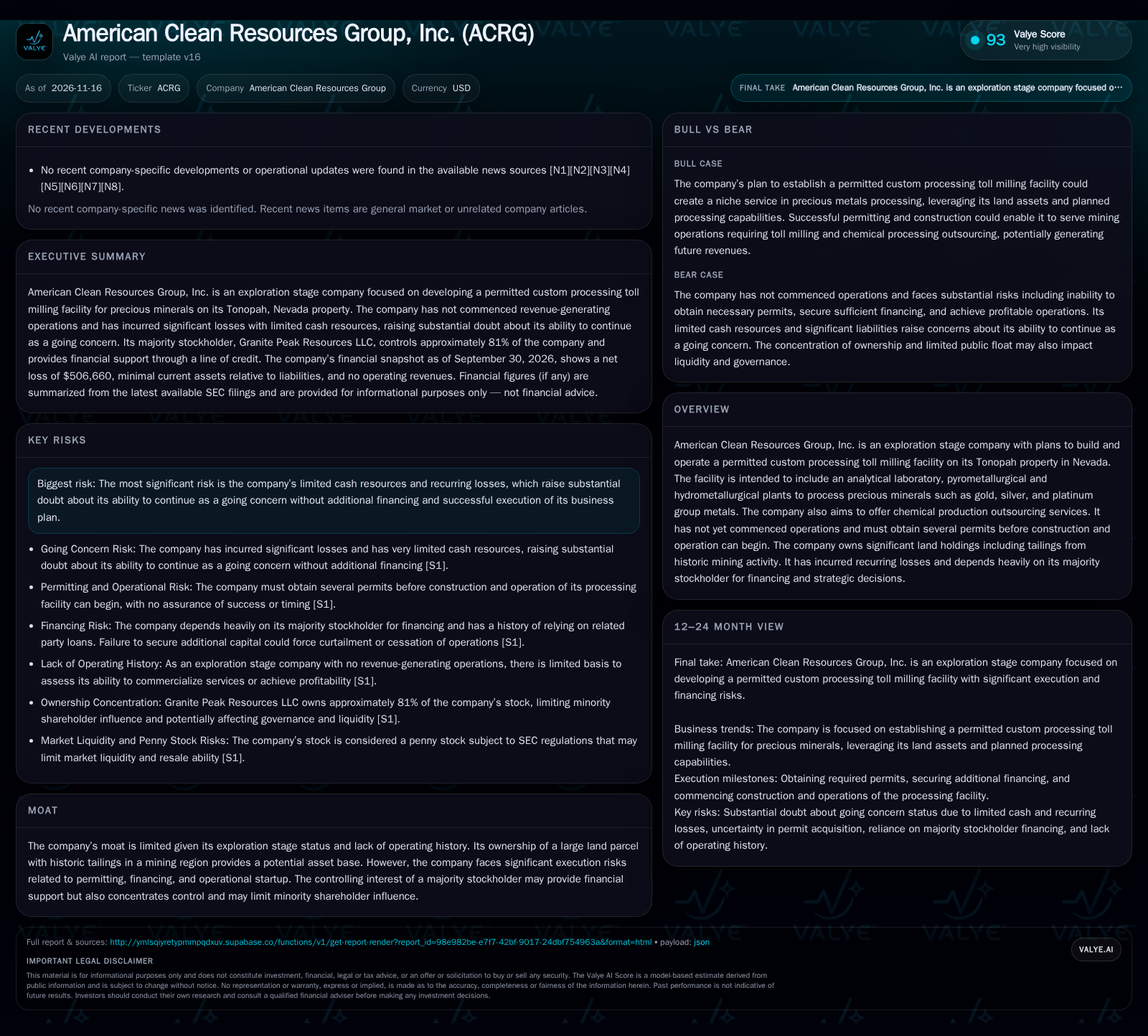
American Clean Resources Group owns historic mining land and plans a custom mineral processing facility in Nevada, but has not started operations, holds almost no cash, and faces substantial doubt about its ability to continue as a going concern without new financing and successful permit acquisition. The company’s future depends on overcoming regulatory, capital, and execution hurdles to launch its toll milling business model. [S1] [S2]
American Clean Resources Group, Inc. is at a critical juncture: it owns valuable mining land and historic tailings in Nevada and proposes to build a custom toll milling facility to process precious metals—a potentially lucrative niche if executed correctly. Yet as of late 2026, the company has not begun operations, has no revenue, and faces an acute liquidity crisis, with less than $30,000 in current assets and nearly $5 million in current liabilities. Its entire future rests not only on securing permits and financing but also on successfully navigating the complex regulatory and operational landscape of mineral processing. The fundamental question is whether ACRG can translate its asset base and business plan into a sustainable operation before financial pressures force a strategic reset or worse.
Liquidity Crisis and Operational Inertia Define ACRG’s Present Reality
As of September 30, 2026, American Clean Resources Group had just $28,294 in current assets and $4,986,769 in current liabilities, with a reported cash balance so low that its cash ratio rounds to zero. The company posted a net loss of $506,660 for the quarter and continues to have no operating revenue. Its business plan—to construct and operate a permitted custom processing toll milling facility on its Nevada property—remains entirely pre-operational, with all permitting and construction milestones still unmet. The company’s majority stockholder, Granite Peak Resources LLC, controls approximately 81% of the common stock and provides a $35 million revolving line of credit, but this dependence highlights persistent going concern risks and governance concentration. [S1] [S2]
How a Toll Milling Model Could Generate Cash—If It Can Get Off the Ground
Toll milling is a capital-intensive business in which a facility processes ore for third parties—typically junior miners or operators lacking their own processing infrastructure. Revenue would be generated by charging per-ton or per-batch fees for crushing, grinding, and extracting precious metals from client-supplied material. The economics hinge on volume throughput, pricing power, and operational efficiency: high fixed costs (permitting, construction, equipment, and regulatory compliance) mean that the facility must operate at or near capacity to cover overhead and generate positive cash flow. Variable costs include reagents, utilities, labor, and waste management, with margins sensitive to input volatility and process yields.
ACRG’s planned facility would serve as both a custom processor and a provider of chemical production outsourcing for industrial clients—a potentially attractive adjacency if the company can secure contracts. However, significant upfront capital is required to build and permit such a facility, and ongoing working capital needs would be substantial given the chemical and metallurgical inputs involved. The company’s reported balance sheet suggests it is currently unable to fund even the initial construction or permitting steps without external capital. [S1] [S2]
Potential Niche Advantages Offset by Market Entry Barriers and Substitution Risks
If operational, ACRG could fill a gap in Nevada’s mining ecosystem by offering toll processing to smaller miners and operators who lack their own plants. Its historic tailings could provide a source of feedstock for early-stage operations, potentially reducing ramp-up risk. However, barriers to entry in mineral processing are high: regulatory scrutiny, environmental permitting, capital requirements, and the need for technical expertise all pose significant hurdles.
The competitive landscape includes established toll processors, vertically integrated mining companies with captive plants, and mobile processing solutions. Substitution risk is real: miners may opt to truck ore to existing facilities, partner with competitors, or invest in modular on-site processing. Without demonstrated operational capability, ACRG’s value proposition is theoretical—and the company’s penny stock status and lack of operational history could make it challenging to win contracts or attract skilled personnel.
Permitting Success and Capital Influx Could Unlock Asset Leverage
The most favorable scenario is one in which ACRG secures all necessary permits, closes on construction and working capital financing, and rapidly brings its Tonopah facility online. Early contracts with mining or industrial clients—especially those seeking to process historic tailings or outsource chemical production—could provide initial throughput and validate the business model. If the facility operates near capacity, fixed-cost leverage could drive margin expansion, and the company could reinvest cash flow to expand capacity or add services.
Evidence confirming this scenario would include: public announcements of permit approvals, successful financing rounds (equity or debt), construction commencement and completion milestones, and signed customer agreements. Demonstrated throughput and early revenue would further validate the model. Falsification would come from delays or failures in permitting, inability to secure capital, or lack of customer interest.
Protracted Pre-Revenue Phase with Periodic Restructuring Pressures
The most plausible outcome, given current facts, is that ACRG remains in a capital- and permit-seeking limbo for an extended period. The company may announce incremental progress—such as permit applications or preliminary engineering work—but without substantial new financing, construction and operational milestones continue to slip. Ongoing losses and negligible liquidity force periodic renegotiation with Granite Peak Resources or attempts at dilutive equity raises.
This scenario would be confirmed by continued absence of revenue, persistent going concern warnings, and a lack of tangible construction or permitting progress. Evidence to the contrary would include material balance sheet improvement, regulatory breakthroughs, or the onboarding of credible strategic partners. A sudden strategic reset—such as asset sales or pivoting to a different business line—would also be consistent with prolonged operational delays.
Liquidity Exhaustion and Regulatory Setbacks Trigger Strategic Crisis
In an adverse scenario, ACRG fails to secure permits or new capital, exhausts its reported liquidity position, and breaches covenants or defaults on obligations to Granite Peak Resources or other creditors. Regulatory agencies could deny or significantly delay permitting due to environmental or technical concerns, further eroding stakeholder confidence. In this case, the company could be forced into asset liquidation, debt restructuring, or even bankruptcy proceedings.
Evidence confirming this scenario would include negative regulatory actions, auditor going concern qualifications escalating to material event disclosures, or the announcement of asset sales under duress. Falsification would require clear signs of operational progress, new funding, or regulatory breakthroughs.
Milestones and External Events That Will Determine ACRG’s Viability
Permit application submissions, review progress, and approvals for the Tonopah processing facility—both environmental and operational—would directly affect the project’s viability.
Announcements of construction commencement, equipment procurement, or site development would signal tangible movement toward operational status.
Financing events: new equity raises, debt placements, or expanded credit facilities beyond the majority shareholder’s line would test market confidence and provide runway.
Customer contract signings (if disclosed), especially with regional miners or industrial chemical clients, would validate demand and provide early revenue visibility.
Quarterly updates on current asset and liability balances—especially any material changes in cash position or working capital—would highlight short-term solvency risks.
Any changes to the terms or utilization of the Granite Peak Resources line of credit, including covenant amendments or drawdowns, would affect both control dynamics and liquidity.
Evidence of progress or setbacks in processing historic tailings from the company’s land holdings would serve as a proxy for early operational capability.
A useful metric would be the facility’s designed and actual throughput (tons processed per month) once operational—this would test the scalability of the business model.
Disclaimer: This is research-only, informational analysis and not investment advice. It may include AI-generated interpretation and general industry context. Always verify important details using primary sources.

Comments