
Adia Nutrition’s Regenerative Ambition: Integration, Clinical Expansion, and the Realities of Early-Stage Stem Cell Commercialization
Adia Nutrition, now operating beyond its former shell status, is building a vertically integrated regenerative medicine platform centered on stem cell therapies and biologic products. While FDA registration, accredited labs, and proprietary trademarks provide initial barriers to entry, the company faces the dual challenge of scaling commercial adoption and maintaining potential financial flexibility amid net losses and a competitive, evolving market.
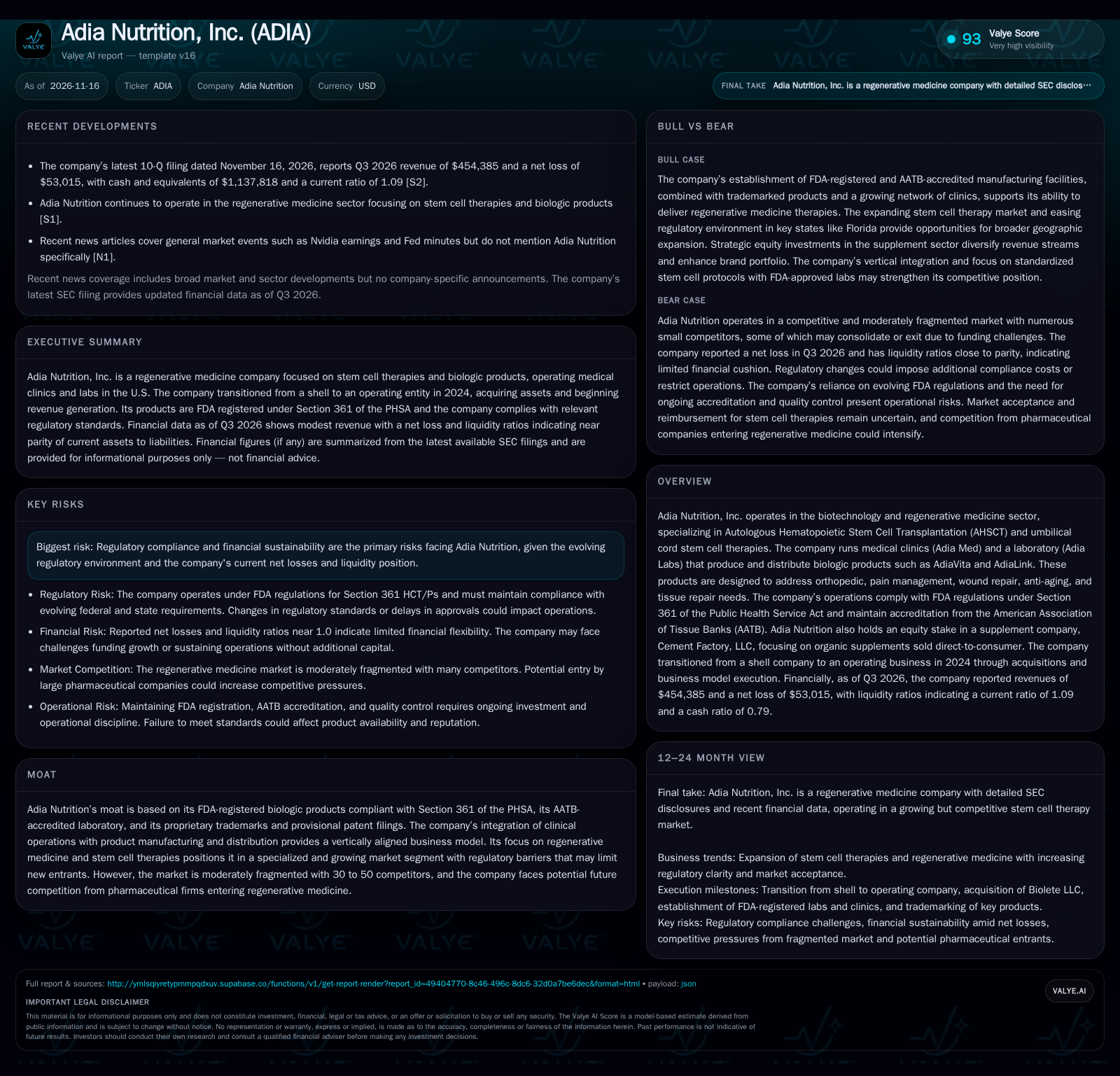
Adia Nutrition is transitioning from a shell company into a vertically integrated regenerative medicine business, focusing on FDA-registered stem cell therapies and biologic products. With modest Q3 2026 revenue and a near-parity liquidity profile, the company’s prospects hinge on successful clinical adoption, regulatory compliance, and competitive positioning in a fragmented market. Ongoing net losses and limited financial cushion heighten the importance of execution and market validation over the next several quarters. [S2]
Adia Nutrition, Inc. is attempting a classic regenerative medicine playbook—vertically integrating clinical delivery, biologic manufacturing, and product branding around stem cell therapies and exosome products. Having only recently emerged from shell status via the acquisition of Biolete LLC in 2024, Adia now claims FDA registration, AATB accreditation, and a small but operational network of clinics and labs. The company’s Q3 2026 financials show initial commercial traction but also the persistent losses and liquidity tightness typical of early-stage biotech operators. The next phase will test whether Adia can achieve clinical and commercial scale before competitive and financial pressures intensify.
From Shell Status to Revenue-Generating Operator: Adia’s 2026 Financial and Strategic Reset
Adia Nutrition’s transformation into a revenue-generating regenerative medicine business is marked by its Q3 2026 results: $454,385 in revenue and a net loss of $53,015. The company’s liquidity is tight, with a current ratio of 1.09 and a cash ratio of 0.79 as of September 30, 2026. These figures reflect an early-stage business that has only recently transitioned from a shell company, following the acquisition of Biolete LLC in January 2024. The company operates FDA-registered and AATB-accredited labs and clinics, offering proprietary stem cell and exosome products (AdiaVita, AdiaLink) and holding an 18% equity stake in a supplement business. The regulatory environment appears modestly favorable, especially in Florida, where state-level easing supports expansion. [S2]
How Adia’s Vertical Integration Could Shape Economics in Regenerative Medicine
Adia Nutrition’s business model blends high-value clinical services, proprietary biologic manufacturing, and product sales to third-party healthcare facilities. This vertical integration enables potential margin capture at multiple points—direct patient therapies via Adia Med clinics, and B2B supply of AdiaVita and AdiaLink to other providers. The laboratory’s adherence to FDA Section 361 and AATB standards may support premium pricing and facilitate reimbursement if therapies gain broader acceptance. However, the company’s early-stage scale means fixed costs for lab operations, compliance, and accreditation likely dominate the cost structure, with variable costs tied to patient volume and product units. If Adia achieves higher patient throughput or secures broader distribution for its products, operating leverage could improve, but expansion will likely require additional capital given the small revenue base and ongoing net losses. The supplement equity stake provides some diversification but is unlikely to materially offset the core business’s capital needs in the near term.
The interplay between fixed and variable costs in Adia's vertically integrated model underscores the importance of achieving sufficient scale to approach profitability. Fixed costs such as lab facility maintenance, regulatory compliance, and specialized staffing create a high operational baseline that must be spread over increasing patient volumes and product sales to improve margins. If patient demand or B2B product uptake grows slowly, the company risks operating in a suboptimal cost structure for an extended period, which may necessitate strategic prioritization of higher-margin service lines or selective geographic focus. Conversely, successful scaling could enable incremental investment in research and development to enhance product differentiation, potentially unlocking premium pricing or expanded reimbursement opportunities.
Barriers, Fragmentation, and the Threat of Scale Entrants in the Stem Cell Arena
Adia Nutrition operates in a specialized but moderately fragmented segment of regenerative medicine, with 30–50 active competitors ranging from independent clinics and small labs to emerging biotech platforms. Its FDA-registered, AATB-accredited lab and proprietary product trademarks (AdiaVita, AdiaLink) offer initial regulatory and intellectual property barriers, and vertical integration may enable clinical protocol standardization. However, these advantages are not insurmountable. Larger pharmaceutical and biotech companies could enter the space if regulatory clarity and reimbursement pathways improve, bringing scale, distribution, and clinical trial resources. For now, Adia’s differentiation depends on maintaining compliance, quality, and speed to market, but the threat of consolidation or displacement by better-capitalized entities looms as the market matures.
The fragmented nature of the stem cell therapy market offers both opportunities and risks for Adia. While a diverse competitive landscape may allow a nimble operator to capture niche segments or establish early clinical protocols, it also means that differentiation must be continually reinforced through quality, compliance, and clinical evidence. The potential entrance of larger pharmaceutical or biotech players could reshape market dynamics by introducing advanced clinical trial capabilities, broader distribution networks, and deeper capital resources. Adia's ability to maintain its foothold may depend on developing proprietary manufacturing processes or intellectual property that are difficult to replicate, as well as fostering strategic partnerships that extend its reach without diluting operational focus.
Clinical Validation and Geographic Expansion Unlock Leverage and Brand Value
If Adia Nutrition demonstrates strong clinical outcomes and patient demand for its stem cell and exosome therapies, it could leverage its FDA-registered, AATB-accredited infrastructure for geographic expansion—particularly in states with favorable regulatory environments like Florida. Successful standardization of protocols and third-party lab partnerships could drive product sales beyond Adia’s clinics, increasing volume and improving fixed-cost absorption. Evidence confirming this scenario would include accelerating revenue growth, improved gross margins, new clinic openings, and third-party adoption of AdiaVita and AdiaLink. Additional regulatory approvals, insurance reimbursement wins, or multi-site clinical study results would further validate the commercial model and support brand extension.
Expanding beyond initial geographic markets hinges on Adia's capacity to demonstrate replicable clinical outcomes and operational consistency across multiple sites. If the company can standardize treatment protocols and ensure quality control through its accredited labs, it may attract third-party clinics seeking to outsource complex biologic manufacturing or adopt proven therapies under license. This B2B channel expansion could diversify revenue streams and reduce reliance on direct patient services, enhancing overall resilience. Additionally, positive clinical validation may facilitate engagement with payers and insurers, potentially unlocking reimbursement pathways that significantly improve patient access and financial sustainability.
Incremental Adoption and Persistent Capital Constraints Define the Near-Term Outlook
The most plausible scenario is one where Adia Nutrition achieves gradual clinical adoption and steady, if modest, revenue growth. The company continues to operate within existing regulatory frameworks, maintaining compliance and accreditation, but faces ongoing net losses due to high fixed costs and limited scale. Cash needs persist, requiring either external financing or disciplined cost management. The supplement equity stake provides some optionality but is unlikely to move the needle in the short term. Falsification would come from either a sharp revenue inflection (indicating breakout adoption) or a deterioration in compliance or liquidity (forcing retrenchment or restructuring).
Regulatory Setbacks or Funding Gaps Could Trigger Retrenchment or Disruption
Adia Nutrition’s main vulnerabilities are regulatory risk and financial fragility. If federal or state regulators impose new restrictions, tighten Section 361 standards, or slow product approvals, Adia could face costly delays or clinical disruption. Simultaneously, persistent net losses and a thin liquidity cushion create exposure to funding gaps—potentially forcing asset sales, dilutionary capital raises, or operational cutbacks. Intensifying competition, especially from large pharmaceutical entrants or aggressive consolidation among peers, could erode market share or pressure pricing. Evidence for this scenario would include adverse regulatory developments, declining revenue, loss of accreditation, or a sharp drop in liquidity ratios. Material negative changes in working capital or disclosure of going-concern risks would also confirm a downside trajectory.
Milestones That Will Define Adia Nutrition’s Commercial Trajectory in Regenerative Medicine
Quarterly revenue growth rates, especially from new clinic openings or expanded product distribution, would help test commercial adoption and market reach.
Gross margin trends, if disclosed, would clarify whether vertical integration and product differentiation are translating into economic leverage.
Updates on regulatory compliance (FDA, AATB) and any changes to Section 361 guidance or state-level rules will be crucial for operational continuity.
Evidence of third-party adoption of AdiaVita or AdiaLink (e.g., supply agreements with external clinics or labs) would help validate the B2B product thesis.
Disclosure of clinical outcome data or publication of peer-reviewed studies would strengthen the case for efficacy and support reimbursement efforts.
Expansion into new geographies or partnerships with established healthcare networks would indicate strategic progress and market acceptance.
If disclosed, patient volume trends and retention rates at Adia Med clinics would provide insight into demand sustainability and recurring revenue potential.
Disclaimer: This is research-only, informational analysis and not investment advice. It may include AI-generated interpretation and general industry context. Always verify important details using primary sources.

Comments