
Guided Therapeutics: Regulatory Milestones and Financial Constraints Shape the Path Forward for LuViva
The company’s near-term trajectory hinges on capital access, regulatory outcomes, and execution in emerging markets.
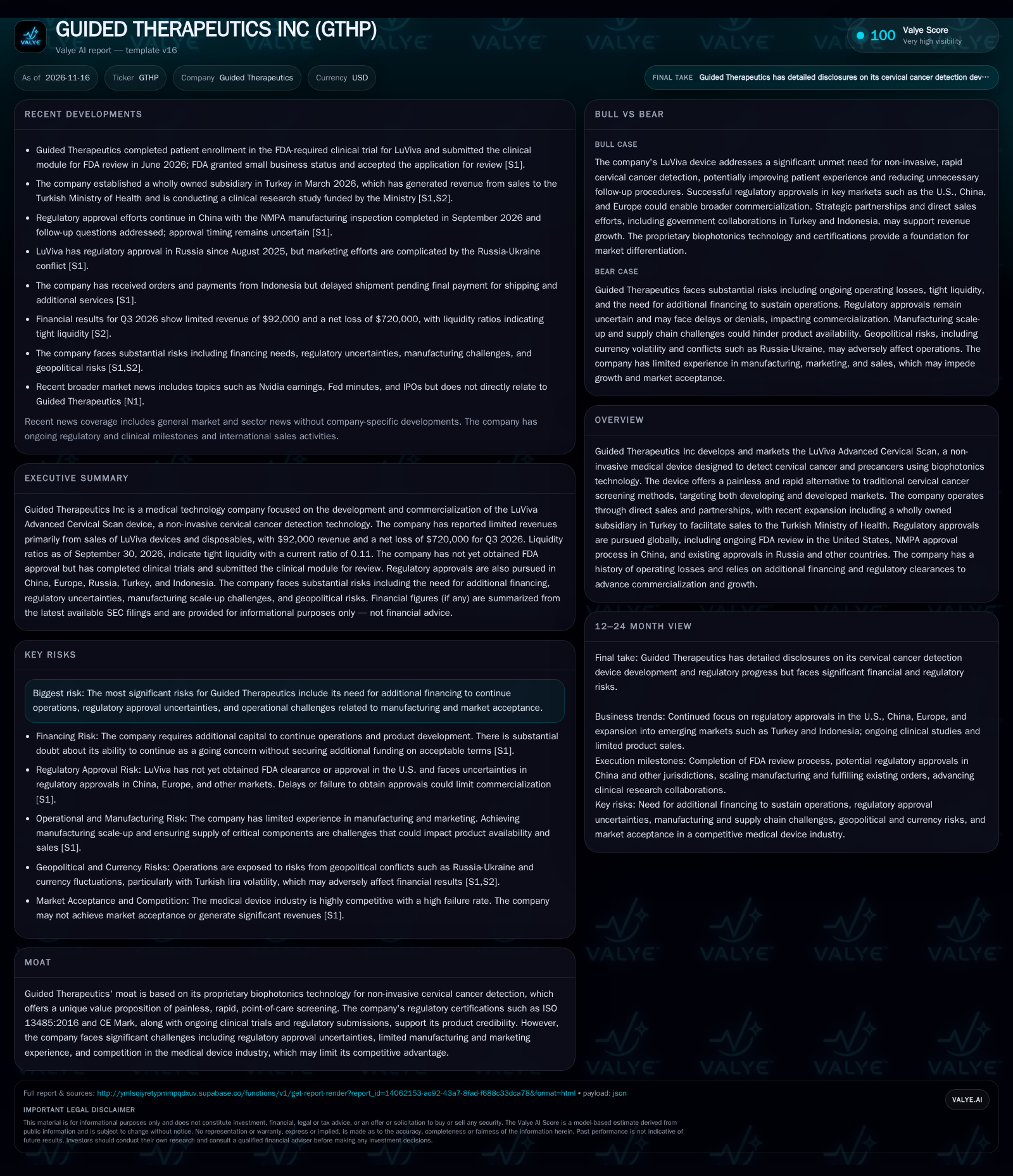
Guided Therapeutics has progressed its LuViva cervical cancer screening device into late-stage regulatory review in the U.S. and China, and generated modest revenue from direct sales in Turkey. However, ongoing operating losses, a severely constrained cash position, and the absence of FDA approval mean that further commercialization and survival depend on both successful regulatory outcomes and securing new funding [S1] [S2].
Guided Therapeutics stands at a pivotal juncture as it pursues regulatory clearance for its LuViva Advanced Cervical Scan, a non-invasive biophotonics device for cervical cancer detection. The company has completed clinical trial enrollment and submitted its FDA application, while also pushing for regulatory footholds in China, Turkey, and other emerging markets. Despite these advances, revenue remains limited and the company’s liquidity is critically constrained. The strategic question is whether Guided Therapeutics can bridge the gap to commercial viability through successful approvals and new capital before financial resources are exhausted.
Recent Regulatory Progress and Financial Strain Define the Moment
Guided Therapeutics has completed patient enrollment in its required clinical trial for the LuViva device and submitted the clinical module to the FDA in June 2026, with no adverse events reported [S1]. The FDA granted small business status, reducing the user fee and enabling the review process to proceed. Meanwhile, the company generated $92,000 in Q3 2026 revenue, primarily from direct sales to the Turkish Ministry of Health, and reported a net loss of $720,000 [S2]. Liquidity is now extremely limited: as of September 30, 2026, the company had $731,000 in cash against $6.9 million in current liabilities, resulting in a current ratio of 0.11 [S2]. Efforts to expand into China and Indonesia are ongoing but have yet to yield significant commercial traction, and the Russian market remains disrupted by geopolitical conflict [S1]. These facts underscore that the company’s future hinges on regulatory outcomes and urgent capital needs.
LuViva’s Commercial Model: Device Sales, Disposable Revenue, and the Funding Gap
Guided Therapeutics’ business model is centered on the sale of LuViva cervical scanning devices and recurring revenue from single-use disposables required for each test [S1]. In principle, this razor-and-blade model can generate attractive margins if the installed base scales, as disposables offer recurring, higher-margin revenue streams once devices are placed. However, the economics depend critically on reaching sufficient device adoption to drive disposable pull-through and cover high fixed costs in R&D, regulatory, and manufacturing scale-up.
Currently, revenue is minimal and lumpy, with government tenders (such as the Turkish Ministry of Health) providing episodic device sales rather than broad market adoption [S2]. The path to profitability is further complicated by the need to invest in clinical trials, regulatory submissions, and market development, all of which require significant upfront capital. The company’s accumulated deficit of $159.4 million and ongoing losses highlight the lack of operating leverage at current scale [S2]. Without FDA approval and a robust U.S. launch, or sustained multi-country adoption, the economics are likely to remain unfavorable. The company reported cash and liquidity metrics for the period; these figures do not by themselves establish operating runway, investment capacity, financial flexibility, or financing capacity.
Technology Differentiation Versus Incumbent Entrenchment in Cancer Screening
LuViva’s core competitive proposition is its non-invasive biophotonics platform, which offers painless, rapid cervical cancer screening at the point of care—potentially reducing the need for follow-up biopsies and enabling use in settings where conventional cytology is impractical [S1]. This could provide real-world advantage in both resource-limited emerging markets and as a triage tool in developed healthcare systems. The device has achieved ISO 13485:2016 certification and a CE Mark, supporting its technical credibility.
However, the medical device landscape for cervical cancer screening is dominated by established modalities (Pap smear, HPV testing, and colposcopy), with deep integration into clinical practice and reimbursement systems. Entrenched competitors, including large diagnostics and medical device companies, offer comprehensive product portfolios, established distribution, and large-scale manufacturing—advantages that Guided Therapeutics currently lacks. Regulatory hurdles, especially in the U.S. and China, are significant barriers to entry, and market acceptance requires not just technical approval but also evidence of improved outcomes, cost-effectiveness, and workflow compatibility. The company’s limited experience in manufacturing, marketing, and sales further constrains its ability to displace or complement incumbent solutions at scale [S1].
Regulatory Wins and Emerging Market Adoption Unlock a Commercial Inflection
The most optimistic scenario for Guided Therapeutics is a near-term FDA approval of LuViva, followed by NMPA approval in China and expanded orders from government or institutional buyers in emerging markets like Turkey and Indonesia. Successful U.S. clearance would enable entry into the world’s largest medical device market, potentially catalyzing distributor relationships, reimbursement pathways, and broader clinical adoption. If the company can secure bridge financing to fund operations through the regulatory review period, it could accelerate manufacturing, fulfill existing orders, and leverage successful reference sites (such as Turkish Ministry of Health collaborations) to drive further uptake.
Confirmation of this scenario would require: timely FDA and NMPA approvals; substantial new device placements (especially with repeat orders for disposables); clear evidence of reimbursement traction in one or more major markets; and a successful capital raise or non-dilutive funding to support scale-up. Early signals would include positive regulatory feedback, new government contracts, and a marked increase in recurring disposable sales.
Incremental Progress, Ongoing Losses, and the Strain of Capital Scarcity
The most plausible path for Guided Therapeutics is a slow advance: regulatory reviews in the U.S. and China may stretch out, with modest device sales continuing in Turkey and possibly Indonesia, but material revenue remains elusive. Without a major regulatory or commercial breakthrough, revenues are likely to remain below the threshold needed for profitability, and recurring cash burn continues.
Evidence supporting this scenario would be continued low quarterly revenues, extended timelines for regulatory decisions, and piecemeal financing arrangements. Absence of large-scale distributor deals, recurring government contracts, or significant disposable sales would confirm that the business is not yet achieving commercial traction. If the company can maintain operations through small international contracts and bridge financing, it may survive to see later regulatory outcomes—but the risk of running out of cash remains acute.
Delayed Approvals, Funding Shortfall, and Loss of Commercial Momentum
The adverse scenario is defined by regulatory setbacks—such as FDA or NMPA rejection or protracted review—combined with failure to raise additional capital. In this case, Guided Therapeutics may be forced to sharply curtail operations, delay shipments, or even wind down without achieving meaningful commercialization. The company’s inability to maintain CE Mark status, meet manufacturing requirements, or fund necessary post-market studies would further erode credibility and customer confidence. External shocks, such as currency devaluation in key markets or escalation of geopolitical conflicts, could compound these pressures.
Confirmation of this scenario would include negative or inconclusive regulatory feedback, disclosure of going-concern uncertainty without new financing, missed payroll or supplier payments, and the inability to fulfill even existing international orders. If the company ceases regular reporting or discloses asset sales or layoffs, it would strongly suggest that liquidity constraints have become insurmountable.
Milestones and Metrics That Will Determine LuViva’s Prospects
Progress and timing of FDA regulatory review for LuViva, including any feedback or requests for additional data.
Updates on bridge financing, capital raises, or non-dilutive funding events that could extend runway.
Device shipment volumes and confirmed payments, especially in Turkey, Indonesia, and new emerging market contracts.
Growth in recurring disposable sales, if disclosed, as a proxy for installed base utilization.
NMPA (China) regulatory milestones: approval, additional data requests, or delays.
Ability to maintain ISO 13485:2016 and CE Mark certifications, or disclosure of lapses.
Disclosure of new distributor relationships, government tenders, or reimbursement wins in major markets.
Any clinical study outcomes or publications that could support adoption and strengthen regulatory submissions.
Disclaimer: This is research-only, informational analysis and not investment advice. It may include AI-generated interpretation and general industry context. Always verify important details using primary sources.

Comments