
Global Asset Management Group: Financial Stress and Information Gaps Define the Outlook
With sharply constrained liquidity, ongoing net losses, and a restatement cloud over recent reporting, Global Asset Management Group faces immediate operational uncertainty. The lack of business model disclosure—and the absence of public information on its sector, customers, or strategy—leaves investors with little visibility into potential levers for recovery or sources of resilience.
The absence of detail on business activities, sector, or strategy materially limits any assessment of competitive positioning or turnaround potential. Remediation of financial controls and restoration of reporting credibility are necessary prerequisites for any future operational stability or investor confidence. [S2]
With virtually no public information on the underlying business model, sector, or customer base, the company offers investors little basis for assessing its prospects or even its core activities.
Liquidity Crisis, Restatement, and Opaque Operations Shape the Present Reality
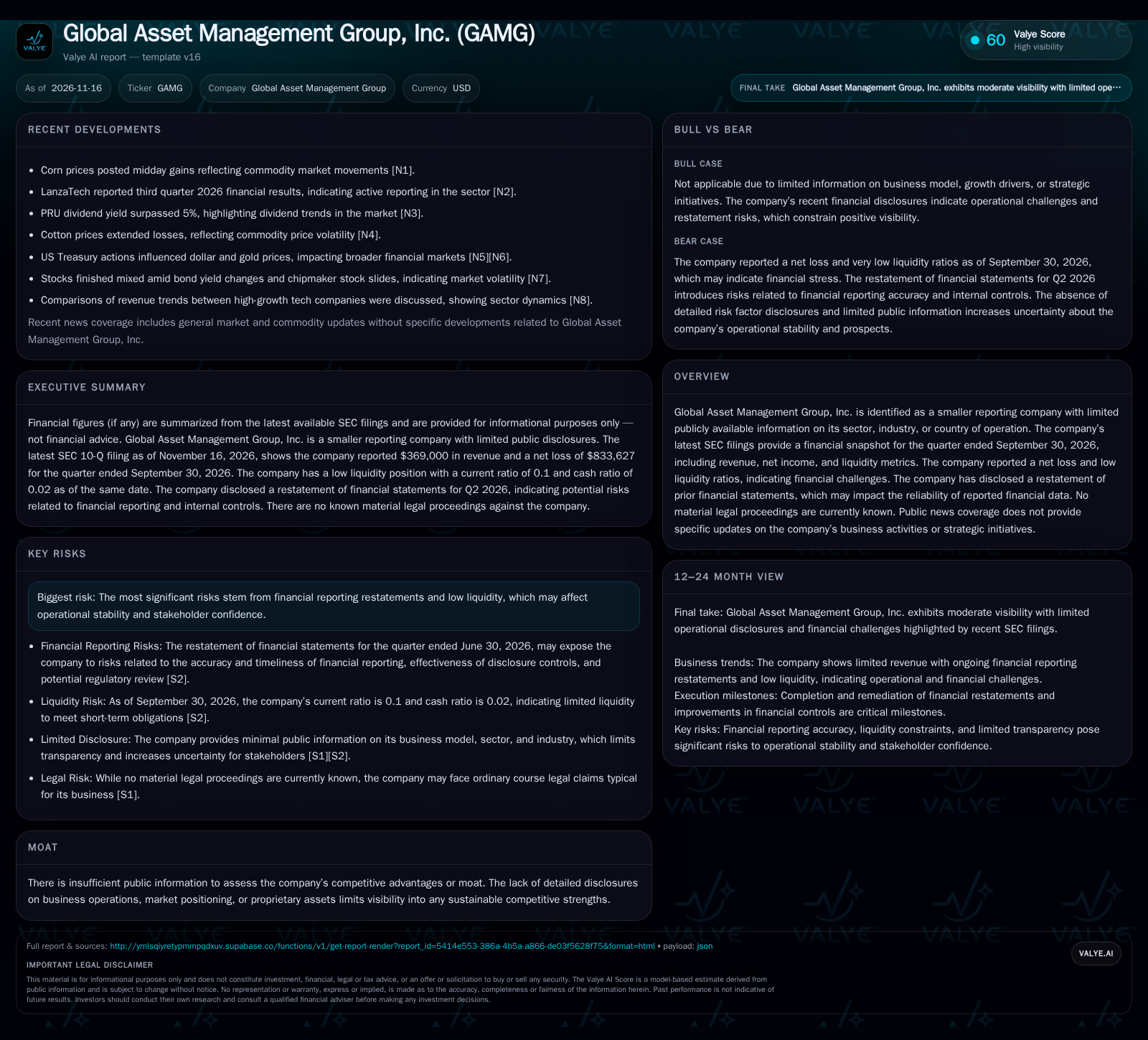
Three facts sharply define Global Asset Management Group’s current condition. The company reported cash and liquidity metrics for the period; these figures do not by themselves establish operating runway, investment capacity, financial flexibility, or financing capacity. Second, the company continues to operate at a loss, with $369,000 in revenue and a net loss of $833,627 for the quarter ended September 30, 2026. Third, a financial statement restatement for Q2 2026 signals internal control weaknesses and raises doubts about the reliability of reported numbers. Combined, these factors point to material uncertainty over both continuity and credibility, with no offsetting evidence of operational momentum, business model strength, or strategic repositioning. [S2]
The interplay between liquidity constraints and the restatement issue is particularly critical. Liquidity shortages limit the company's ability to invest in necessary operational improvements or to bridge periods of negative cash flow, while the restatement undermines stakeholder trust and raises the cost of capital. This dual challenge creates a feedback loop where financial opacity exacerbates liquidity pressures, and liquidity pressures hinder efforts to resolve reporting deficiencies. Understanding this dynamic is essential for assessing the immediacy and depth of the company’s financial stress, as well as the potential timing and effectiveness of any remedial actions.
Unclear Revenue Model and Negative Operating Leverage Dominate Financial Profile
The company’s economics are fundamentally opaque. With no disclosure of sector, business model, or customer mix, it is impossible to determine whether revenue is generated from asset management fees, commissions, proprietary trading, or other services. The reported $369,000 in quarterly revenue is dwarfed by the net loss, suggesting a high fixed-cost base or structurally negative unit economics. If the business is capital intensive (as the name may imply), the inability to access additional capital could force asset sales, operational retrenchment, or restructuring. Any path to sustainability would require either a dramatic improvement in revenue scale/margin or a fundamental reduction in operating expenses—both difficult to evaluate without further disclosure.
The negative operating leverage observed suggests that the company’s fixed costs significantly outweigh its variable costs, meaning that revenue declines or stagnation disproportionately worsen profitability. If the company’s revenue streams are highly concentrated or dependent on volatile market conditions, this could amplify the risk of sustained losses. Moreover, without clarity on the cost structure—such as personnel expenses, technology investments, or regulatory compliance costs—it is difficult to evaluate the flexibility or scalability of operations. A critical question is whether the company has the capacity to implement cost rationalization measures without impairing its core revenue-generating activities.
Competitive Standing Obscured by Lack of Sector and Strategic Disclosure
No public information is available on Global Asset Management Group’s sector, target customers, or strategic positioning, making it impossible to benchmark the company against peers or substitutes. If it operates in asset management or financial services, it would face well-capitalized incumbents, regulatory scrutiny, and pressure on fees—while smaller players often struggle with scale and client retention. Alternatively, if the business is in a different financial niche or operates as a holding company, the relevant competitive set and sources of advantage could be completely different. The absence of detail on proprietary offerings, distribution channels, or technology adoption precludes any assessment of switching costs, network effects, or pricing power. In this informational vacuum, the company’s potential for differentiation or resilience cannot be credibly addressed.
The absence of strategic disclosure also obscures the company’s ability to respond to competitive threats or market shifts. If the company lacks differentiated products, proprietary technology, or strong client relationships, it may face commoditization risks and pricing pressure. Conversely, if it operates in a niche or underserved market segment, there may be latent opportunities for growth or consolidation. The competitive environment’s regulatory intensity is another factor that could materially impact operational costs and strategic options. Without transparency, investors cannot assess whether the company’s competitive position is a liability or a potential source of resilience.
Turnaround Could Hinge on Disclosure, Controls Remediation, and Credible Liquidity Plan
A plausible favorable scenario would require the company to (1) restore confidence in its financial reporting by completing the restatement process and demonstrating robust internal controls, (2) secure new sources of liquidity—either via asset sales, external financing, or operational improvements, and (3) provide clear disclosure on business activities, customer segments, and strategic roadmap. Evidence for this scenario would include timely and unqualified filings, announcement of new financing or capital infusions, and detailed, credible communication of a turnaround plan. Confirmation would come from sequential improvements in liquidity ratios, narrowing losses, and evidence of stabilizing or growing revenue. Falsification would be signaled by delayed filings, further restatements, or default on obligations.
Continued Strain as Liquidity and Reporting Limit Recovery Prospects
Given the current facts, the most plausible outcome is continued operational and financial strain. The company is likely to remain constrained by inadequate liquidity and credibility challenges from its restatement, with limited ability to invest in growth or execute strategic pivots. Without clear disclosure or access to new capital, operations may be limited to bare-minimum maintenance, with the possibility of creditor negotiations or restructuring if obligations cannot be met. Confirmation of this scenario would come from further deterioration in liquidity metrics, persistently negative cash flow, and a lack of substantive new disclosures or investor communications.
Acute Liquidity Event or Regulatory Intervention Could Force Restructuring
In a more negative scenario, the combination of near-zero liquidity and restatement-related control risks could precipitate an acute liquidity crisis—potentially triggering creditor action, regulatory intervention, or forced asset sales. If the company fails to remediate internal controls or provide timely, accurate reporting, it could face delisting, legal challenges, or loss of access to any remaining credit lines. Confirmation of this downside would include missed payments, default notices, resignation of key personnel, or further regulatory scrutiny. Falsification would require concrete evidence of new funding, successful restatement completion, and stabilization of cash flows.
Testing the Thesis: Disclosures and Financial Milestones That Could Reshape the Story
Completion and auditor sign-off of the Q2 2026 financial statement restatement, with clear remediation of identified control weaknesses.
Announcements of new financing, equity infusions, or asset sales that materially improve the current and cash ratios—if disclosed.
Disclosure of business model details, sector focus, and customer composition to allow assessment of revenue durability and market positioning.
Quarterly trends in revenue and operating expenses, especially any narrowing of net loss or improvement in operating leverage—if disclosed.
Evidence of creditor negotiations, restructuring efforts, or covenant waivers, which would signal deeper financial distress.
Any regulatory filings, delisting notices, or legal proceedings that could impact operational continuity or market access.
Management turnover or board changes that might reflect a strategic reset or response to ongoing financial and reporting challenges.
Disclaimer: This is research-only, informational analysis and not investment advice. It may include AI-generated interpretation and general industry context. Always verify important details using primary sources.

Comments