
Luvu Brands: Retail Expansion, Cost Pressures, and the Challenge of Achieving Sustainable Profitability
Luvu Brands’ recent revenue growth and margin improvements reflect operational discipline and selective retail expansion, yet persistent cost headwinds and a history of operating losses underscore the company’s ongoing vulnerability to competitive and supply chain shocks.
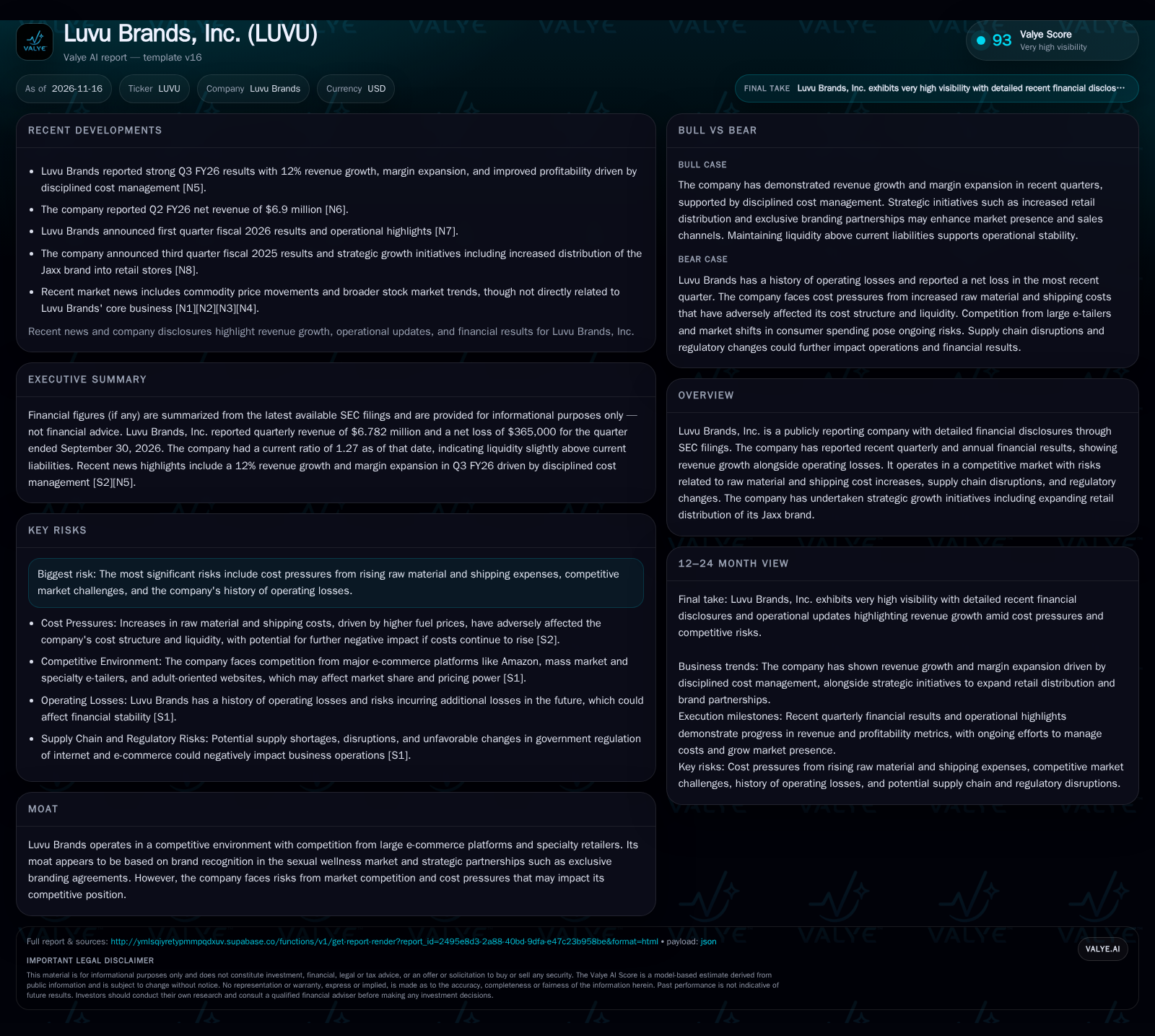
Luvu Brands has reported notable revenue growth and recent margin expansion, driven by disciplined cost management and strategic moves like broader Jaxx brand retail distribution. However, ongoing net losses, exposure to volatile input and shipping costs, and intense competition from e-commerce giants limit the visibility of a sustained profitability inflection. The company’s ability to translate growth initiatives into durable earnings and defend margins against external pressures remains the central question for investors and operators alike. [S2] [N5] [N8]
Luvu Brands, Inc. stands at a pivotal juncture: recent quarters have showcased the company’s capacity for revenue growth and margin improvement through tighter cost controls and targeted retail expansion. Yet, despite these operational highlights, persistent net losses, razor-thin liquidity, and exposure to volatile input costs threaten to undermine momentum. With competitive threats from major e-commerce and specialty retailers growing, the company’s ability to convert top-line momentum into sustainable profitability—and ultimately, resilience—remains the defining challenge.
Recent Performance: Growth, Margin Gains, and Persistent Losses
Luvu Brands reported $6.782 million in revenue for the quarter ended September 30, 2026, coupled with a net loss of $365,000 and earnings per share of $0. While revenue grew 12% in the preceding quarter, and margin expansion was attributed to disciplined cost management, this has not yet translated into sustained profitability. The company reported cash and liquidity metrics for the period; these figures do not by themselves establish operating runway, investment capacity, financial flexibility, or financing capacity. These facts highlight a business that is growing but remains unprofitable and financially constrained, with recent gains vulnerable to reversal if cost pressures or demand shocks intensify. [S2] [N5]
How Luvu Brands’ Economics Are Shaped by Channel Mix and Cost Headwinds
Luvu Brands’ business model blends branded product sales—such as the Jaxx line—through both direct-to-consumer (DTC) e-commerce and third-party retail channels. Revenue growth has recently been supported by expanding retail distribution, which could offer higher volume but often at lower per-unit margins due to retailer discounts and slotting fees. DTC channels, while potentially more profitable per sale, require higher marketing outlays and may be more vulnerable to customer acquisition cost inflation in a competitive online landscape.
The company’s cost structure is materially exposed to raw material and shipping expenses. Rising fuel costs have directly increased both production and logistics outlays, compressing gross margins and straining liquidity. The business exhibits some operating leverage, as seen in recent margin expansion during periods of growth, but this effect is fragile if top-line momentum stalls.
Capital needs for inventory, retail rollout, and ongoing marketing are likely to remain material, and the company’s history of operating losses suggests dependence on ongoing cash generation or external funding to maintain growth initiatives. Without durable improvements in gross margin or a sustained shift to positive net income, the economics are vulnerable to even modest external shocks.
Brand, Shelf Space, and the Realities of Competing with E-Commerce Giants
Luvu Brands faces competition from two primary fronts: mass-market e-commerce platforms (notably Amazon), and specialized adult-oriented websites and retailers. Competing on these platforms exposes the company to intense price transparency, frequent discounting, and the risk of commoditization—where branded differentiation may be eroded by private-label or imported alternatives. While the company’s exclusive branding partnerships and increased retail presence for Jaxx offer some insulation, these advantages are not structural moats but rather execution-dependent levers.
Retail distribution expansion, while a potential source of growth and brand visibility, subjects Luvu Brands to retailer bargaining power and shelf-space competition. Retailers may demand promotional allowances or flexible terms, compressing margins and increasing working capital requirements. The company’s ability to maintain shelf presence and avoid delisting depends on consistent sell-through and strong end-customer demand—both of which can be volatile in discretionary categories.
Switching frictions for consumers in sexual wellness and lifestyle categories are generally low, making customer loyalty contingent on continuous innovation, quality, and brand resonance. In the absence of proprietary technology, patents, or locked-in recurring revenue streams, Luvu Brands’ competitive position is best described as dynamic but exposed to both price and channel volatility.
Unlocking Durable Profitability Through Retail Scale and Margin Discipline
The most favorable scenario for Luvu Brands hinges on the company successfully leveraging its expanded retail footprint and disciplined cost controls to achieve sustained revenue growth and margin improvement. If the Jaxx brand’s expanded presence in retail stores leads to higher volumes without a commensurate increase in promotional costs, the company could achieve operating leverage, turning incremental sales into disproportionately higher profits.
Confirmation of this scenario would come from several quarters of continued double-digit revenue growth, steady or expanding gross margins despite industry cost pressures, and a clear inflection to positive net income. Additional supporting evidence would include increased cash generation, a reported liquidity-ratio trends, and announcements of further retail partnerships or exclusive brand deals. Conversely, if margin gains prove fleeting or retail expansion stalls, the upside case would be falsified.
Incremental Growth Amid Cost Volatility and Competitive Pressure
The most plausible path for Luvu Brands is continued incremental revenue growth through a mix of retail expansion and direct sales, but with persistent exposure to cost and competitive pressures that prevent a decisive break into sustained profitability. Margins may fluctuate quarter-to-quarter based on input cost volatility and promotional activity, while net income remains near breakeven or modestly negative.
Evidence supporting this scenario would include ongoing revenue increases, but with margins and net income bouncing within a narrow band. Retailers could remain cautious, adjusting orders based on category performance, and the company may need to selectively invest in marketing or promotions to maintain shelf space. A lack of significant improvement in liquidity or balance sheet strength would further confirm the base case.
Cost Shocks and Demand Weakness Expose Structural Vulnerabilities
An adverse scenario would see Luvu Brands’ fragile cost structure and liquidity buffer undermined by a combination of rising raw material or shipping costs and a slowdown in consumer demand, possibly triggered by broader economic weakness or category-specific shifts. In this situation, gross margins would contract, net losses would widen, and the company could face working capital constraints that force cutbacks in inventory, marketing, or even retail partnerships.
Evidence for this outcome would include declining margins despite stable or rising revenues, negative operating cash flow, and any moves to seek external financing or restructure operations. Announcements of retailer delistings, inventory write-downs, or strategic withdrawals from underperforming channels would further confirm the downside scenario.
What Will Determine Whether Luvu Brands Converts Growth Into Enduring Value?
Gross margin trend: Sustained improvement or stability in gross margin, especially in the face of raw material and shipping cost volatility, would help validate progress toward profitability.
Net income and operating cash flow: Persistent positive net income and strong cash generation, if achieved, would confirm a durable shift in financial performance.
Retail expansion velocity: Announcements of new retail partnerships, expanded shelf space, or increased Jaxx brand store count would indicate momentum in channel diversification.
Sell-through rates and retail reorder patterns: If disclosed, these metrics would reveal whether retail partners are seeing healthy consumer demand and are likely to maintain or grow their orders.
Promotional and marketing expense as a percent of sales: Monitoring whether margin improvements are sustainable or reliant on reduced promotional spending would test for real operating leverage.
Inventory and working capital turns: Faster inventory turnover and efficient working capital management would support liquidity and reduce balance sheet risk.
External capital needs: Any new debt or equity financing, or public statements about liquidity constraints, would be critical warning signs for operational stability.
Disclaimer: This is research-only, informational analysis and not investment advice. It may include AI-generated interpretation and general industry context. Always verify important details using primary sources.

Comments