
Lithium Corp: Exploration Ambition Meets Structural Constraints in a Competitive Critical Metals Landscape
Lithium Corp remains in the exploration stage, holding a portfolio of lithium and critical metals properties in Nevada and British Columbia. With no revenue, ongoing net losses, and a reliance on option agreements and external partners, the company’s future hinges on its ability to convert early-stage assets and retained royalties into tangible value amid sector competition and regulatory hurdles.
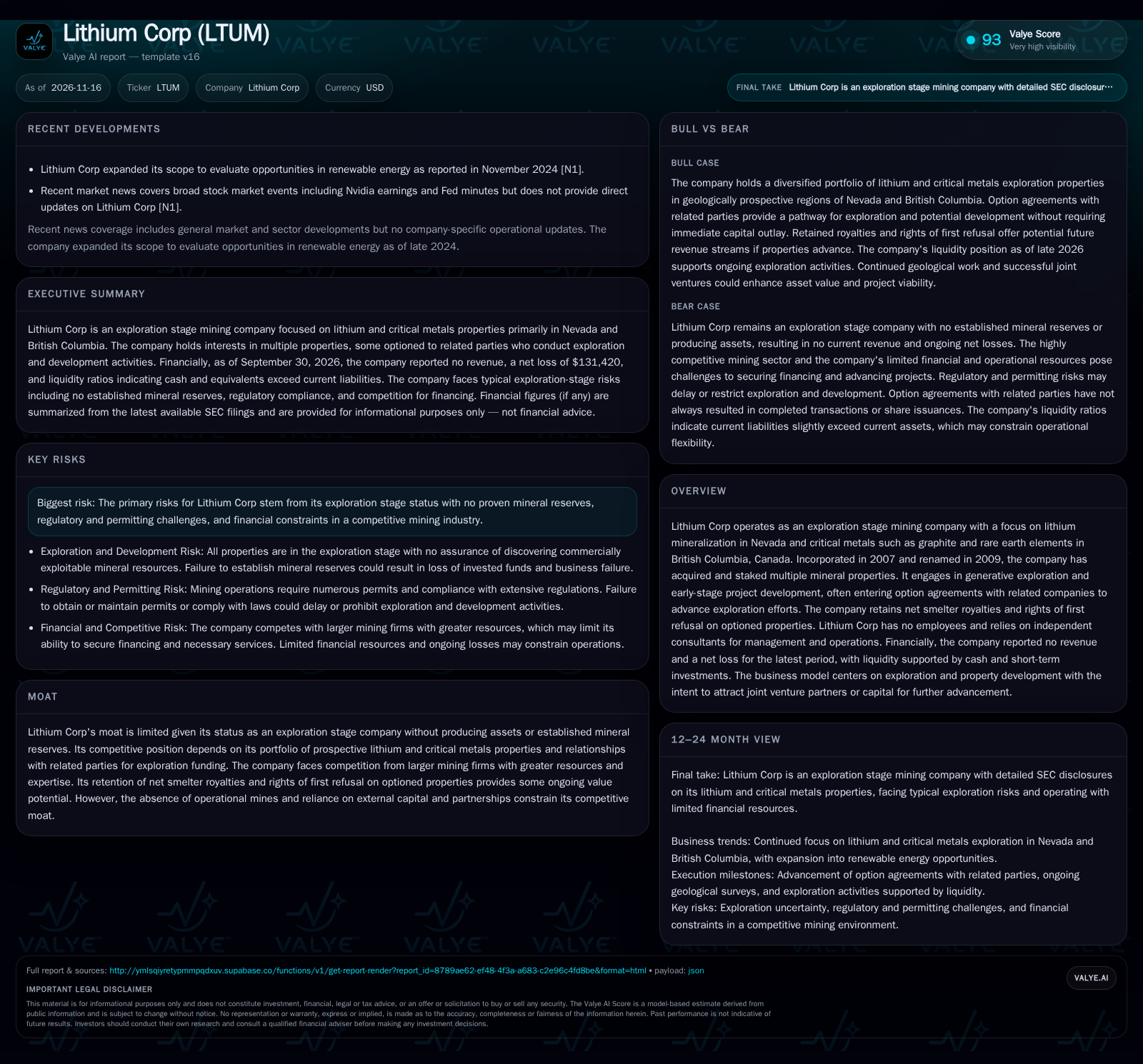
Lithium Corp is an exploration-stage mining company focused on lithium and critical metals in North America. The company holds interests in properties optioned to related parties, retains royalties, and operates without revenue, employees, or established mineral reserves. Its prospects depend on successful exploration outcomes, capital access, and the advancement of joint venture or partnership deals in a highly competitive, regulated industry. [S2]
Lithium Corp stands as a prototypical exploration-stage mining company, with all its properties—including the flagship Fish Lake Valley in Nevada—still in the early phases of geological assessment. Lacking revenue, proven reserves, or production, the company’s value proposition rests on its ability to secure and advance prospective lithium and critical metals assets, primarily through optioning arrangements and retained royalty interests. [S2]
Where Lithium Corp Stands: Exploration-Stage Realities and Financial Snapshot
As of September 30, 2026, Lithium Corp reported zero revenue and a net loss of $131,420, reflecting its status as an early-stage exploration company with no producing assets. The company maintains a 100% interest in the Fish Lake Valley property in Nevada and holds additional claims in British Columbia, including for lithium, graphite, and rare earth elements. Its business model relies on optioning properties to related parties, retaining net smelter royalties and rights of first refusal, but these have not yet translated into recurring cash flows. These facts highlight a business still searching for a commercial foothold, with its ability to continue operations dependent on prudent cash management and the success of exploration and partnership efforts. [S2]
How Value Could Be Created: Exploration, Royalties, and Option-Driven Economics
Lithium Corp’s economic model is typical of junior mining explorers: it generates value by acquiring, staking, and advancing early-stage mineral properties, then seeking to joint venture, option, or sell these assets to other companies with the capital and expertise to fund further development. The company’s lack of employees—relying on consultants—keeps its fixed overhead low, but also limits internal technical and operational depth.
Revenue, if achieved, is most likely to come from staged option payments, potential milestone payments, and net smelter royalties on properties that eventually reach production under third-party operators. However, these revenue streams are highly uncertain and contingent on successful exploration outcomes, the willingness of partners to advance projects, and eventual commercial viability. The absence of established mineral reserves means there is no basis for projecting future production, and thus no near-term path to operating cash flow.
Operating leverage is minimal at this stage; costs are mostly variable and tied to exploration activity, claim maintenance, and administrative expenses. The capital needs for actual mine development would be far greater than current resources, necessitating either substantial outside investment, successful asset sales, or the ability to attract larger partners. The company’s reported cash and short-term investments as of September 30, 2026, provide a snapshot of available resources, but do not by themselves establish the company’s ability to fund large-scale development or absorb sustained losses. [S2]
Competitive Constraints: Asset Quality, Partner Leverage, and Sector Dynamics
Lithium Corp operates in an intensely competitive sector, where the most valuable assets are advanced-stage projects with defined reserves, permitting progress, and proximity to infrastructure. As an explorer with no established mineral reserves or production, its primary competitive lever is early access to geologically promising ground in lithium-rich regions such as Nevada’s Fish Lake Valley and select areas of British Columbia.
However, the company’s ability to retain value depends on both the geological merit of its properties and its success in structuring favorable option or joint venture terms. Larger mining and exploration companies—potential partners or acquirers—typically have superior technical, financial, and regulatory resources, often dictating terms in any partnership. Lithium Corp’s retention of net smelter royalties and rights of first refusal provides a potential future upside but does not guarantee near-term cash flow or bargaining power.
The risk of property option lapses or under-exploration by related parties is material, as is the threat of losing promising claims due to insufficient spending or shifting market priorities. Regulatory hurdles and permitting timelines represent additional competitive friction, particularly in North American jurisdictions where environmental and social review processes can be protracted.
What a Breakthrough Would Look Like: Discovery, Partner Funding, and Royalty Realization
The most favorable scenario for Lithium Corp would involve a significant mineral discovery—such as a commercially viable lithium deposit—on one of its key properties, most plausibly Fish Lake Valley. This would likely trigger greater interest from larger mining companies or strategic partners, potentially resulting in lucrative option payments, joint venture funding, or outright asset sales with retained royalties.
In this scenario, the company could convert its early-stage exploration work and land position into meaningful value, either through direct cash inflows or by establishing a stream of royalty income if a property advances to production. Confirmation of this upside would require public disclosure of a maiden resource estimate, a major joint venture deal with a credible partner committing substantial exploration or development capital, or the announcement of commercial-scale drilling results indicating high-grade mineralization.
Falsification of this scenario would occur if exploration results consistently fail to identify economically viable mineralization, if optioned partners withdraw or fail to advance properties, or if the company is forced to relinquish claims due to lack of funding or regulatory setbacks.
Most Likely Trajectory: Incremental Progress, Option Dependence, and Ongoing Losses
The most plausible outlook for Lithium Corp is continued incremental exploration and administrative activity, with periodic optioning of properties to related parties but no near-term transition to revenue-generating operations.
In this scenario, Lithium Corp remains dependent on external parties to fund and advance projects, with its primary value tied to the optionality embedded in its property interests and retained royalties. Ongoing net losses are likely unless a partner commits to a major funding milestone or a property is sold outright. The absence of established mineral reserves or commercial-scale discoveries means that the company’s shares and prospects will remain highly speculative.
Evidence confirming this scenario would include continued reporting of zero revenue, small net losses, and updates on option agreements without disclosure of resource estimates or production plans. Falsification would require a material change—such as the announcement of a significant mineral discovery, a major funding event, or a strategic transaction with a credible industry partner.
Funding Shortfalls and Asset Attrition: When Exploration Ambition Fails to Deliver
The adverse scenario for Lithium Corp would see its remaining cash depleted without any commercial discovery or major partnership, forcing the company to relinquish claims, allow options to lapse, or dilute existing shareholders through unfavorable capital raises. In this outcome, the company’s inability to secure new funding or advance projects could result in the gradual erosion of its property portfolio—a common fate for junior explorers in prolonged downturns or unfavorable commodity cycles.
Regulatory delays, adverse permitting decisions, or persistent failure to attract credible partners would exacerbate the downside, leaving the company with stranded assets and no path to self-sustaining operations. Evidence confirming this scenario would include a sharp decline in cash and short-term investments, asset impairments, relinquishment of key claims, or disclosures of going-concern risks in SEC filings. Falsification would require a turnaround in exploration results, a successful capital raise on favorable terms, or a strategic transaction that stabilizes the balance sheet.
What Will Test the Lithium Corp Thesis in the Next Phase
Updates on option agreements: Announcements of new or expanded option deals, particularly with credible, well-capitalized partners, would be a critical sign of potential future value.
Exploration milestones: Public disclosure of significant drilling results, resource estimates, or technical reports (if disclosed) would directly test the company’s asset quality.
Retention or relinquishment of claims: News regarding the lapse, sale, or expansion of mineral claims would signal management’s assessment of property prospectivity and financial discipline.
Progress on regulatory and permitting fronts: Updates on permit applications, regulatory approvals, or environmental reviews could be pivotal for advancing properties toward development.
Nature and timing of any capital raises: If disclosed, the terms and structure of future financings will show market confidence and the company’s ability to avoid excessive dilution.
Disclosure of net smelter royalty income or milestone payments: Actual realization of royalty streams or option milestone payments would be a key indicator of the transition from pure exploration to revenue participation.
Management and consultant continuity: Any turnover or changes in the independent consultants managing operations may affect project momentum and continuity.
Disclaimer: This is research-only, informational analysis and not investment advice. It may include AI-generated interpretation and general industry context. Always verify important details using primary sources.

Comments