
AppTech Payments: Platform Transformation, Cross-Border Ambitions, and the Realities of Fintech Scaling
AppTech Payments has restructured itself into a cloud-native fintech platform provider targeting smaller banks and embedded finance use cases.
AppTech Payments has pivoted to offer modern, integrated digital banking and payment infrastructure, leveraging its newly acquired cross-border capabilities and patented text-to-pay technology. Execution on integration, customer acquisition, and revenue diversification will determine whether the business can overcome industry headwinds and secure a defensible position.
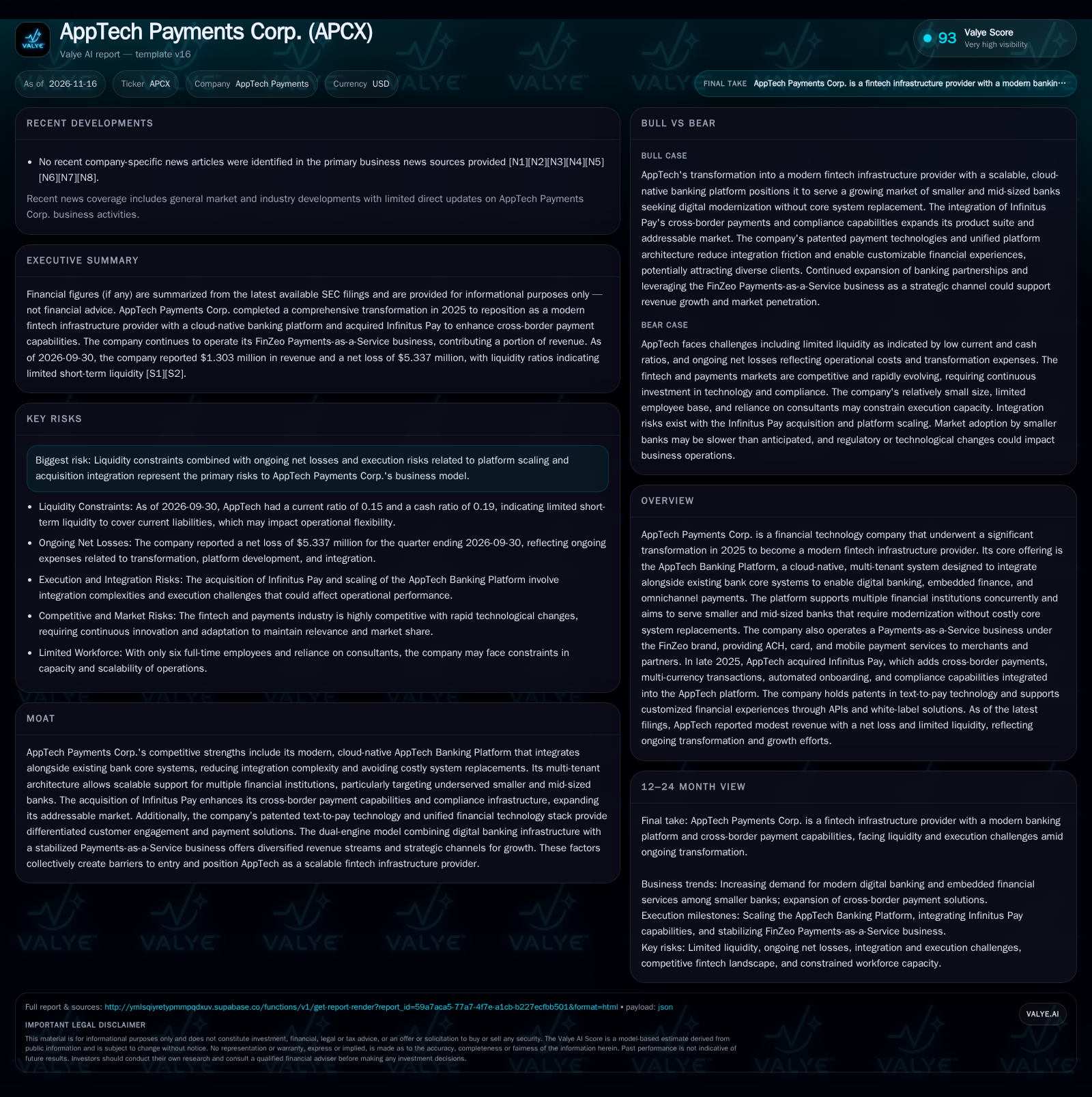
AppTech Payments has undergone a significant transformation since 2025, repositioning itself as a modern fintech infrastructure provider with a focus on digital banking, embedded finance, and omnichannel payments. The company’s launch of the AppTech Banking Platform and acquisition of Infinitus Pay have expanded its product suite to include cross-border and compliance features, aiming to serve the modernization needs of smaller financial institutions.
Transformation Completed, but Financial Strains Persist
AppTech Payments undertook a foundational transformation in 2025, launching its cloud-native, multi-tenant AppTech Banking Platform and acquiring Infinitus Pay for cross-border and compliance capabilities [S1]. The company’s first partner bank is now fully operational on this platform, offering digital banking and payment services under the bank’s regulatory oversight [S1]. This validates the technical and commercial integration of AppTech’s core product. [S2] The combination of strong product ambition and acute liquidity constraints sets the current stage, making platform scaling and commercial adoption critical to the company’s near-term outlook.
Platform Economics: Integration, Margins, and the Funding Equation
AppTech’s business model now centers on providing digital banking infrastructure and payments capabilities to financial institutions and fintech partners. The company’s multi-tenant, cloud-native approach enables it to serve multiple banks concurrently, potentially benefiting from economies of scale if customer adoption grows. Revenue streams may include platform licensing, usage-based transaction fees, white-label service arrangements, and professional services for integration and customization. The acquisition of Infinitus Pay adds higher-margin cross-border and compliance services, which typically command premium pricing in the payments sector—but integrating these features and demonstrating commercial traction will require additional investment and operational discipline.
The FinZeo Payments-as-a-Service business continues to contribute 10-15% of revenue, primarily through ACH, card, and mobile payments, which are generally lower-margin and volume-driven. The company’s limited scale and modest customer base mean that fixed platform costs and ongoing development expenses are not yet offset by revenue, resulting in persistent losses. Operating leverage could improve if the company can efficiently onboard additional banks and partners without proportional increases in support and development costs.
The scalability of AppTech’s platform economics is highly contingent on its ability to reduce marginal costs per additional customer while maintaining or improving service quality. Given the multi-tenant cloud-native architecture, incremental onboarding of banks and fintechs should theoretically lower the average cost per client over time, assuming efficient automation of onboarding processes and standardized integration protocols. However, the heterogeneity of smaller banks’ legacy systems and compliance requirements may necessitate bespoke customization, which could erode these economies of scale. Therefore, the company’s margin expansion will depend on balancing customization demands with standardized platform offerings, as well as optimizing operational workflows to minimize manual interventions.
Another critical factor influencing the funding equation is the timing and magnitude of revenue recognition from cross-border and compliance services. These higher-margin offerings often involve complex regulatory and operational dependencies, which can delay monetization despite upfront integration costs. If AppTech can accelerate the deployment and adoption of these features, it may unlock a more predictable and recurring revenue stream that supports longer-term financial sustainability. Conversely, prolonged integration cycles or regulatory uncertainties could prolong the cash burn phase, increasing reliance on external capital and potentially diluting shareholder value.
Differentiation Through Integration, But Intense Competition Remains
AppTech is targeting a segment of the market—smaller and mid-sized banks—that often lack the resources or risk tolerance to replace legacy core systems, offering integration alongside existing infrastructure rather than requiring disruptive rip-and-replace projects. This approach could lower adoption friction and appeal to a broad base of banks seeking digital capabilities with minimal operational risk. The company’s patented text-to-pay technology and expanded cross-border functionality provide additional differentiation, especially for institutions and fintechs seeking omnichannel payment experiences and international reach.
However, the fintech infrastructure and payments market is highly fragmented, with established core banking vendors, payments processors, and cloud-native fintech platforms all vying for share. Larger competitors can often outspend AppTech on product development, compliance, and go-to-market efforts. Moreover, switching costs for banks may be lower than in traditional core banking due to the rise of API-first and modular fintech architectures, making customer retention a challenge unless AppTech can demonstrate superior reliability, integration, or economics. The company’s small full-time workforce and reliance on consultants may hinder its ability to execute quickly at scale compared to better-capitalized peers.
Accelerated Bank Adoption and Cross-Border Uptake Drive Self-Sustaining Growth
AppTech’s upside scenario centers on the successful onboarding of additional partner banks and fintechs onto its platform, driving recurring revenue from platform licensing, transaction fees, and value-added services. If the integration of Infinitus Pay’s cross-border and compliance features proves seamless and market demand for these capabilities grows, AppTech could capture a lucrative niche among smaller banks and fintechs seeking turnkey digital modernization. Expansion of the FinZeo PaaS channel could serve as a feeder for upselling full platform services.
Evidence that would confirm this scenario includes a meaningful increase in the number of partner banks onboarded, sustained revenue growth above current levels, narrowing operating losses, and new commercial announcements or integrations with fintech partners. A falsification would be continued stagnation in customer wins, persistent or widening losses, or delays in the rollout of integrated cross-border features.
Incremental Adoption with Ongoing Funding Needs Defines the Next Phase
The most plausible near-term path is one where AppTech achieves incremental adoption among a handful of smaller banks and fintechs, generating modest revenue growth but remaining reliant on external funding or capital raises to support operations and ongoing platform development. The integration of Infinitus Pay capabilities may proceed, but at a measured pace as the company balances product enhancement with resource constraints. The FinZeo PaaS business continues to provide some baseline revenue, though its contribution is not sufficient to cover the company’s fixed and variable expenses at current scale.
Confirmation of this scenario would include slow but steady growth in customer numbers, regular but modest revenue increases, and periodic fundraising or working capital actions. Falsification would come from either a step change in customer traction (supporting the upside case) or from deteriorating liquidity and inability to meet obligations, tipping the company into a distressed situation.
Liquidity Crunch and Execution Gaps Threaten Continuity
Delays in onboarding new banks, integration setbacks with Infinitus Pay, or unanticipated compliance hurdles could further erode confidence and stall revenue growth. In this case, the company may be forced to pursue dilutive capital raises, asset sales, or strategic alternatives to remain viable.
Downside confirmation would include missed payroll or vendor payments, default on obligations, sudden management turnover, or negative going-concern disclosures.
Milestones That Will Clarify AppTech’s Platform Trajectory
Number of new banks and fintech partners onboarded to the AppTech Banking Platform, and the associated revenue contribution (if disclosed).
Progress and timeline for full technical and commercial integration of Infinitus Pay’s cross-border and compliance features into the core platform.
Recurring revenue growth rate and mix between platform, cross-border, and FinZeo Payments-as-a-Service businesses.
Gross margin trends as higher-value services (cross-border, compliance, white-label) scale versus lower-margin payment processing.
Cash burn rate and timing/magnitude of any new capital raises or working capital infusions.
Churn and retention rates among existing partners and customers—a useful metric if disclosed.
Product reliability, uptime, and customer satisfaction scores, which would demonstrate operational maturity.
Any new regulatory developments or compliance hurdles that could affect scaling or onboarding of financial institutions.
Disclaimer: This is research-only, informational analysis and not investment advice. It may include AI-generated interpretation and general industry context. Always verify important details using primary sources.

Comments