
MarineMax: Merger, Margin Pressures, and the Future of Integrated Boating Services
MarineMax, the world’s largest recreational boat and yacht retailer, is set to be acquired by Safe Harbor Marinas for $1.5 billion following recent losses and revenue headwinds. As the company transitions, the interplay between its diversified operations, economic sensitivity, and integration risks will shape its post-merger trajectory.
MarineMax faces a pivotal moment as it completes a $1.5 billion merger with Safe Harbor Marinas amid mounting financial losses and softening demand. The company’s broad portfolio—spanning retail, superyacht services, manufacturing, and marinas—offers both resilience and complexity. The outcome depends on successful integration, the evolution of luxury consumer demand, and the ability to manage geographic and macroeconomic risks while leveraging scale and service breadth for future growth.
MarineMax stands at a strategic crossroads as it prepares to join forces with Safe Harbor Marinas in a $1.5 billion deal following a year marked by net losses and revenue shortfalls. As the world’s largest recreational boat and yacht retailer, MarineMax’s business spans retail sales, manufacturing, superyacht brokerage, and marina operations—a breadth that provides both strategic opportunity and operational complexity. The company’s heavy reliance on luxury spending and regional concentration intensifies its exposure to economic swings, while its acquisition-driven growth model now faces the ultimate test: can scale and integration deliver sustainable profitability under new ownership?
Merger Approval and Recent Losses Define the 2026 Backdrop
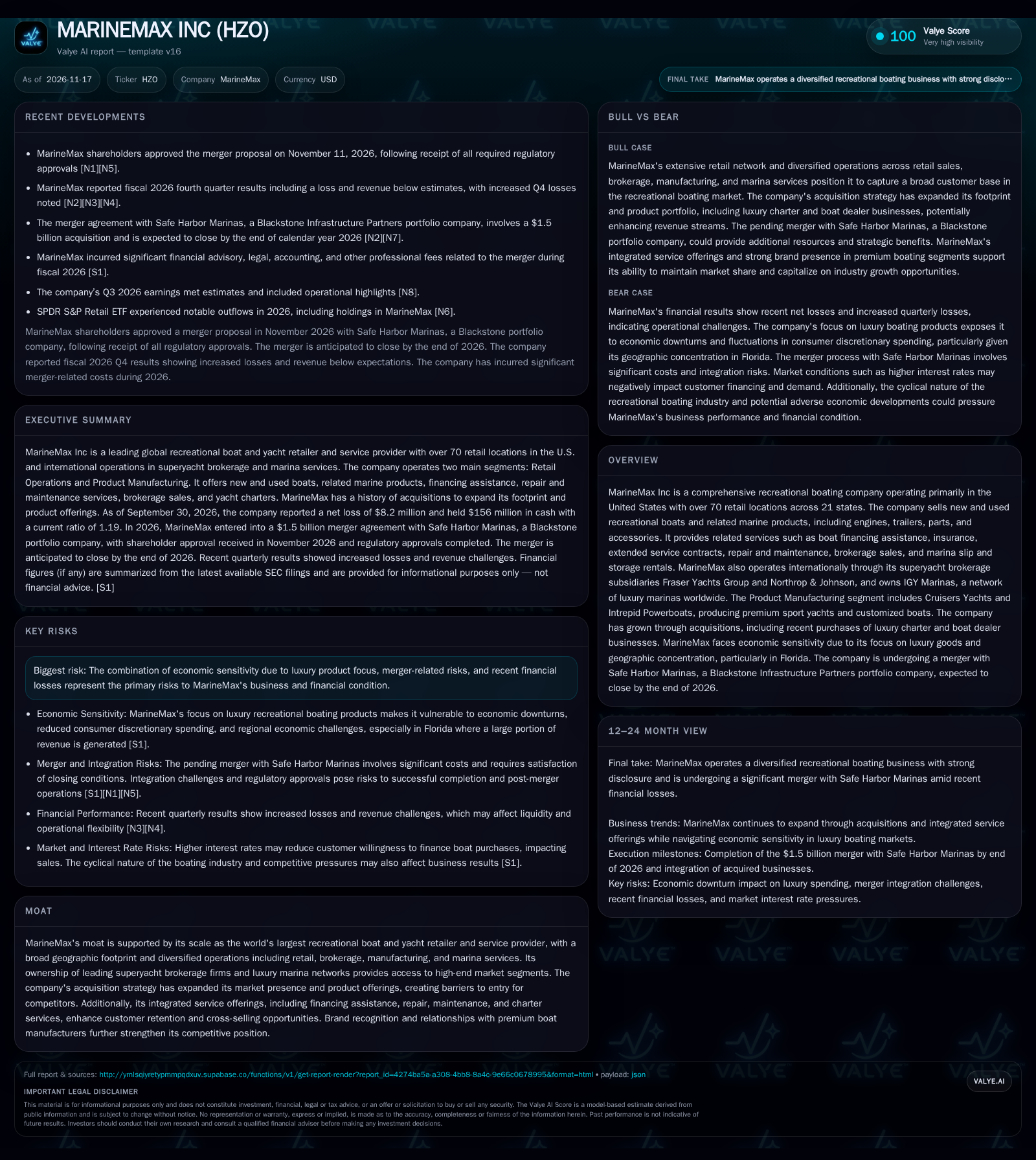
MarineMax’s strategic landscape is dominated by its pending $1.5 billion acquisition by Safe Harbor Marinas, a Blackstone Infrastructure Partners portfolio company. The deal received shareholder approval on November 11, 2026, and cleared all regulatory hurdles, with closing anticipated by year-end [N1] [N5]. This transaction follows a challenging fiscal year: MarineMax reported a net loss of $8.2 million for fiscal 2026, including a disappointing fourth quarter with revenue below expectations and increasing losses [S1] [N3] [N4]. The company’s cash position stood at $156.4 million with a current ratio of 1.19 as of September 30, 2026 [S1], but these metrics are overshadowed by the operational and merger-related expenses incurred during the period. Recent acquisition activity—ranging from luxury charter services to dealership and marina assets—has expanded the company’s portfolio but added to its integration and cost burdens [S1]. The interplay between these factors sets the stage for MarineMax’s future under new ownership.
How MarineMax’s Integrated Model Drives (and Complicates) Value Creation
MarineMax’s business economics hinge on a multi-segment structure encompassing retail boat sales, superyacht brokerage, marina operations, and in-house manufacturing of premium vessels. The company’s revenue mix is weighted toward new and used boat sales, which are recognized upon transfer of control, while services such as repairs, storage, and charters provide recurring, albeit less material, streams [S1]. Brokerage and superyacht services generate commissions and fees with generally higher margins but are highly sensitive to luxury demand cycles.
Manufacturing (via Cruisers Yachts and Intrepid Powerboats) introduces capital intensity, inventory risk, and exposure to supply-chain volatility. Vertical integration may enable margin capture and product differentiation, but it also raises fixed costs and working capital needs, especially in downturns. The company’s scale in retailing enables purchasing leverage and branding advantages, but also amplifies exposure to inventory markdowns if sales slow.
MarineMax does not directly finance customers but earns commissions from third-party financing and insurance [S1]. This limits credit risk but means its sales volumes are sensitive to rising interest rates, which can dampen discretionary purchases of high-ticket boats. The company’s high Florida concentration—over 50% of dealership revenue—further intensifies sensitivity to regional economic swings and weather events [S1]. The recent spate of acquisitions increases operational leverage and cross-selling potential, but also adds layers of integration risk and overhead, especially as synergies may take time to materialize.
Scale, Brand Partnerships, and Service Breadth Shape the Competitive Landscape
MarineMax’s competitive position is anchored by its status as the world’s largest recreational boat and yacht retailer, with a network spanning more than 70 U.S. locations and global superyacht brokerage reach [S1]. Exclusive dealership agreements with leading brands—notably Sea Ray, Boston Whaler, and Azimut—provide access to top-tier inventory and brand-driven customer demand. The company’s integrated offering—from boat sales and financing assistance to service, storage, and charters—creates multiple customer touchpoints and opportunities for cross-selling.
However, the competitive environment remains fragmented, with regional dealers, independent brokerages, and marina operators vying for market share. The cyclical and discretionary nature of boating demand means that customer loyalty can be challenged during downturns, and digital platforms are beginning to disrupt traditional sales channels. While MarineMax’s acquisitions of marina assets and digital platforms (like Boatzon) may help defend share, the company’s breadth also increases complexity and integration risk. Manufacturer relationships are critical: loss or renegotiation of key exclusive agreements could quickly erode differentiation and pricing power. Additionally, while MarineMax’s scale provides some purchasing and marketing leverage, it also exposes it to larger inventory swings and operational inertia in a rapidly shifting market.
Strategic Integration and Market Recovery Unlock Margin Expansion
In a favorable scenario, the merger with Safe Harbor Marinas catalyzes operational synergies and capital investment, allowing MarineMax to leverage Blackstone’s resources to streamline costs, expand marina capacity, and deepen customer relationships. Successful integration of acquired assets—especially in marinas, charters, and digital platforms—could create a seamless customer journey from purchase to service to vacation, boosting retention and lifetime value.
A rebound in luxury discretionary spending, perhaps driven by macroeconomic stabilization or generational wealth transfer, would lift both boat sales and higher-margin brokerage/charter activity. If MarineMax can extract cost efficiencies from its manufacturing operations and maintain exclusive supplier agreements, margin improvement could be meaningful. Evidence supporting this upside would include post-merger cost reductions, sequential improvement in gross and operating margins, stable or growing sales of premium brands, and increased cross-segment revenue per customer.
Integration Complexity and Economic Headwinds Limit Near-Term Gains
The most plausible path forward is one of incremental operational improvement, but constrained by ongoing integration costs and a tepid luxury spending backdrop. The Safe Harbor acquisition closes as planned, providing access to greater capital and a broader marina footprint, but realizing full synergies takes time. Revenue growth is modest, as higher interest rates and consumer caution weigh on boat sales, particularly in Florida.
Manufacturing and retail margins remain pressured by inventory carrying costs and competitive discounting. While the breadth of MarineMax’s service offering provides some resilience, cross-segment synergies are slow to materialize, and cost savings are offset by the overhead of managing a sprawling, acquisitive platform. This scenario would be confirmed by continued margin compression, sluggish top-line growth, steady but unspectacular performance in superyacht and charter segments, and disclosures of ongoing integration and restructuring expenses.
Luxury Demand Falters and Integration Stumbles Amplify Losses
A negative scenario unfolds if economic or regional shocks sharply curtail luxury discretionary spending—whether due to recession, interest rate spikes, or adverse weather events in Florida. Boat sales decline more steeply than anticipated, forcing MarineMax to discount inventory and absorb writedowns. Manufacturing operations become a drag, with excess capacity and high fixed costs outpacing revenue. Integration of acquired businesses proves more difficult than expected, leading to disruptions, customer attrition, and failure to capture intended synergies.
Supplier renegotiations or loss of exclusivity with key brands could further erode pricing power and differentiation. In this case, the company’s scale becomes a liability rather than an advantage, with overhead and debt burdens overwhelming cash flow. Confirmation would come from sequential increases in net losses, inventory write-downs, negative operating cash flow, and management disclosures of integration setbacks or supplier contract changes.
Milestones and Metrics That Will Define MarineMax’s Post-Merger Reality
Monitor the closing and initial integration progress of the Safe Harbor Marinas merger, including any disclosed cost synergies or restructuring charges.
Track sequential margin trends—gross, operating, and segment-level—to assess whether integration and scale are delivering improved profitability.
Follow boat sales volumes (new and used), especially in Florida, to gauge consumer demand sensitivity to macroeconomic and weather-related events.
Watch for changes in exclusive supplier agreements with key brands such as Sea Ray, Boston Whaler, and Azimut, as loss or renegotiation could signal competitive shifts.
Assess inventory levels and any disclosed write-downs or discounting activity as indicators of excess supply or soft demand.
Look for evidence of cross-segment revenue per customer growth, which would suggest successful bundling and retention strategies (if disclosed).
Evaluate the performance and integration of recently acquired digital platforms (e.g., Boatzon), as digital adoption could alter sales channel economics.
Monitor ongoing merger-related costs and any management commentary on the pace of synergy realization or unexpected integration hurdles.
Disclaimer: This is research-only, informational analysis and not investment advice. It may include AI-generated interpretation and general industry context. Always verify important details using primary sources.

Comments