
Creative Realities: Revenue Growth, Liquidity Pressure, and the Challenge of Digital Market Integration
Despite delivering $26.2 million in Q3 2026 revenue and completing a strategic acquisition, Creative Realities remains under acute financial strain, with negative working capital and substantial doubt about its ability to continue as a going concern. The company’s future hinges on successful integration of CDM, technology innovation, and its capacity to stabilize cash flows in a volatile digital marketing landscape.
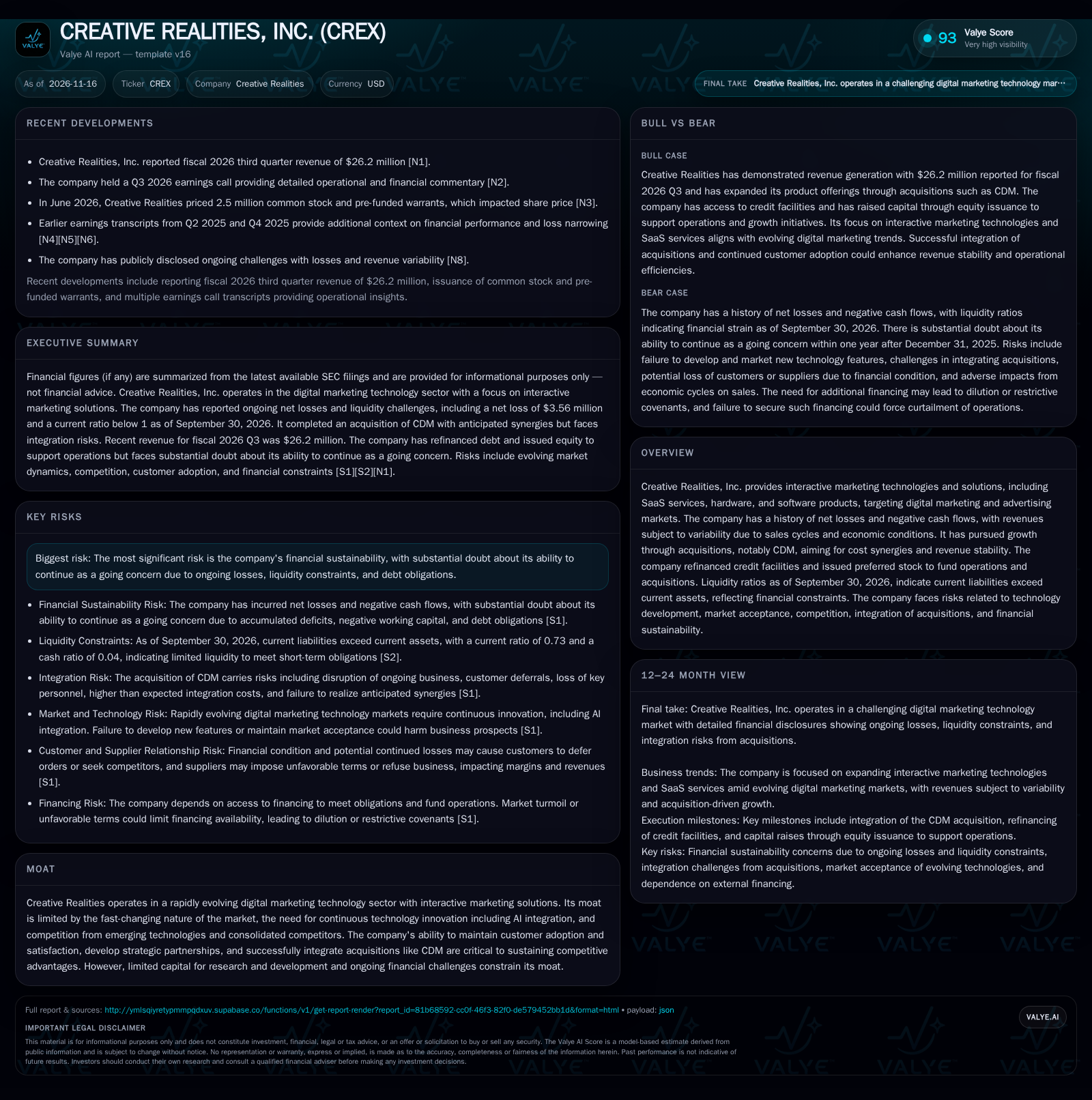
Creative Realities, Inc. reported $26.2 million in Q3 2026 revenue and completed the acquisition of CDM to pursue cost and revenue synergies. However, persistent net losses, negative working capital, and a current ratio of 0.73 raise significant doubts about its financial sustainability. The company’s ability to integrate new businesses, innovate in digital marketing technologies, and maintain customer and supplier confidence will determine whether it can transition from survival mode to sustainable growth. [S1] [S2] [N1]
Creative Realities, Inc. faces a pivotal moment as it attempts to navigate the unforgiving economics of digital marketing technology. While the company reported $26.2 million in revenue for Q3 2026—demonstrating some customer traction—it remains dogged by persistent net losses, a razor-reported cash balance, and a current ratio well below 1. The recent acquisition of CDM is intended to unlock operational synergies and revenue stability, but the integration process introduces new risks just as the company’s survival is in question. Whether Creative Realities can stabilize its finances, deliver technological innovation, and rebuild market confidence will define its trajectory in the coming year. [S1] [S2] [N1]
Revenue Growth and Acquisition Activity Collide with Financial Distress
Creative Realities, Inc. reported $26.2 million in revenue for the third quarter of 2026, signaling continued demand for its digital marketing solutions even as the industry faces economic headwinds [N1]. Despite this top-line performance, the company posted a net loss of $3.56 million for the same period, with basic and diluted EPS of -$0.29 [S2]. As of September 30, 2026, the company’s cash and cash equivalents stood at only $1.81 million, while current liabilities totaled $41.71 million, yielding a current ratio of 0.73 and a cash ratio of just 0.04—metrics that underscore severe liquidity pressure [S2].
In an effort to stabilize operations and diversify its revenue streams, Creative Realities completed the acquisition of CDM, with management expecting synergies in cost reduction and revenue stabilization. However, the company faces substantial doubt about its ability to continue as a going concern within one year after December 31, 2025, reflecting an urgent need to address accumulated deficits and negative working capital [S1].
How the Business Model Faces Margin Pressure and Working Capital Strain
Creative Realities’ business model spans SaaS services, software and hardware product sales, and AdTech/Media Networks. This portfolio exposes the company to a mix of recurring and project-based revenues, but also amplifies exposure to sales cyclicality and customer budget variability. SaaS offerings could, in theory, provide more predictable revenue and higher gross margins due to software scalability and lower incremental costs. However, hardware sales are typically lower margin and may require significant up-front capital outlays or working capital to support inventory and deployment.
The company reported cash and liquidity metrics for the period; these figures do not by themselves establish operating runway, investment capacity, financial flexibility, or financing capacity. Refinancing activity and equity issuance (including the June 2026 offering of 2.5 million common shares and pre-funded warrants) indicate a reliance on external funding to bridge operational shortfalls rather than internally generated cash flow [N3].
Operating leverage could be favorable if revenue growth accelerates or if cost synergies from the CDM acquisition materialize as planned. However, persistent liquidity constraints may force the company to defer growth investments, limit R&D, or accept unfavorable terms from suppliers—each scenario potentially eroding margin structure or future competitive positioning.
Competitive Landscape and the Challenge of Differentiation in Digital Marketing Tech
Creative Realities operates in a fiercely competitive digital marketing technology sector characterized by rapid innovation, short product lifecycles, and low switching costs for customers. Its competitors include diversified marketing technology firms, digital signage integrators, and SaaS providers with greater scale and capital resources. Larger competitors may be better positioned to invest in AI-driven features, integration capabilities, and customer experience enhancements.
The company’s acquisition of CDM is intended to bolster its product breadth and customer reach, but successful integration is uncertain and may be hampered by financial constraints. Without sustained investment in technology and customer service, Creative Realities risks falling behind more agile or better-funded rivals. Furthermore, the fragmented nature of the market means that price competition could intensify—especially if customers perceive the company as a higher risk due to its financial instability.
Switching costs in this sector tend to be modest unless solutions are deeply embedded in customers’ operational workflows. The company’s ability to create sticky, high-value SaaS offerings or proprietary integrations will be key to defending its customer base and improving retention.
If Integration Succeeds and Technology Investments Pay Off
A favorable scenario sees Creative Realities successfully integrating CDM, realizing cost synergies, and stabilizing or growing revenue through an expanded suite of digital solutions. If the company can leverage SaaS and AdTech platforms to drive higher-margin recurring revenue, while reducing reliance on lower-margin hardware sales, gross margins could improve and cash flow could turn positive.
Confirmation of this scenario would include evidence of improved gross and operating margins, reduced integration costs, and normalized working capital metrics. Sustained revenue growth—especially from recurring services—and reduced customer churn would also support the thesis. Additionally, positive commentary from management regarding customer wins, technology rollouts (especially AI-driven features), and operational efficiencies would indicate progress.
Falsification would occur if integration costs remain elevated, synergies fail to materialize, or if liquidity pressures force the company to curtail investments in innovation or customer support, leading to deteriorating margins or revenue contraction.
Financial Constraints Drive Tactical Moves and Incremental Progress
The most plausible near-term path is one of incremental progress constrained by financial realities. Creative Realities may achieve moderate revenue growth from its expanded portfolio, but ongoing net losses and negative working capital force management to prioritize cost containment and cash preservation over aggressive expansion.
In this scenario, the company continues to rely on external financing—potentially through additional equity or debt facilities—to support operations and manage integration risks. Customer and supplier relationships remain sensitive to the company’s financial condition, with some risk of deferred orders or unfavorable terms.
Evidence would include continued net losses, frequent capital raises, and limited R&D or marketing spend. Falsification would be observable if the company unexpectedly generates positive cash flow from operations or secures long-term contracts that materially improve revenue visibility.
Liquidity Shock or Integration Failure Forces Retrenchment
The adverse chain of events would involve a sharp liquidity shortfall, inability to realize anticipated synergies from the CDM acquisition, and further erosion of customer and supplier confidence. In this scenario, the company could be forced to sell assets, rapidly downsize, or seek restructuring protection if it cannot secure bridge financing.
Indicators would include missed debt payments, sharply higher integration and restructuring costs, loss of major customers, or a spike in supplier disputes and unfavorable payment terms. Any delay or failure in securing additional capital—especially if market conditions tighten—would accelerate the risk of insolvency.
Falsification of this scenario would require the company to demonstrate stabilization of cash flows, successful integration of acquisitions, and renegotiation of supplier/customer terms under improved financial conditions.
Milestones and Metrics That Will Define Creative Realities’ Next Chapter
Gross margin evolution, particularly the mix of SaaS versus hardware revenue, would help clarify progress toward a more sustainable business model if disclosed.
Integration costs and synergies realized from the CDM acquisition should be tracked in quarterly disclosures or management commentary.
Working capital trends—especially changes in accounts receivable, accounts payable, and inventory—will reflect operational health and liquidity risk.
Recurring revenue metrics, such as SaaS contract renewals and customer churn rates (if disclosed), would indicate the level of revenue visibility and customer stickiness.
Debt covenant compliance and any amendments to credit facility terms should be monitored for early warning signs of financial distress.
Capital raising activity—frequency, terms, and dilution impact—will show whether the company can sustain operations without disruptive shareholder dilution.
Evidence of new technology feature launches, particularly in AI and AdTech, and customer adoption rates would help gauge competitiveness and market relevance.
Supplier and major customer disclosures regarding payment terms, order deferrals, or contract modifications would help test the resilience of commercial relationships.
Disclaimer: This is research-only, informational analysis and not investment advice. It may include AI-generated interpretation and general industry context. Always verify important details using primary sources.

Comments