
NanoViricides: Clinical-Stage Nanotech Ambition Meets Execution and Capital Hurdles
NanoViricides pursues a high-risk, high-reward path in antiviral drug development with its proprietary nanotechnology platform. While its science offers promise, the company faces acute operational and financial constraints that put clinical progress and long-term viability in question.
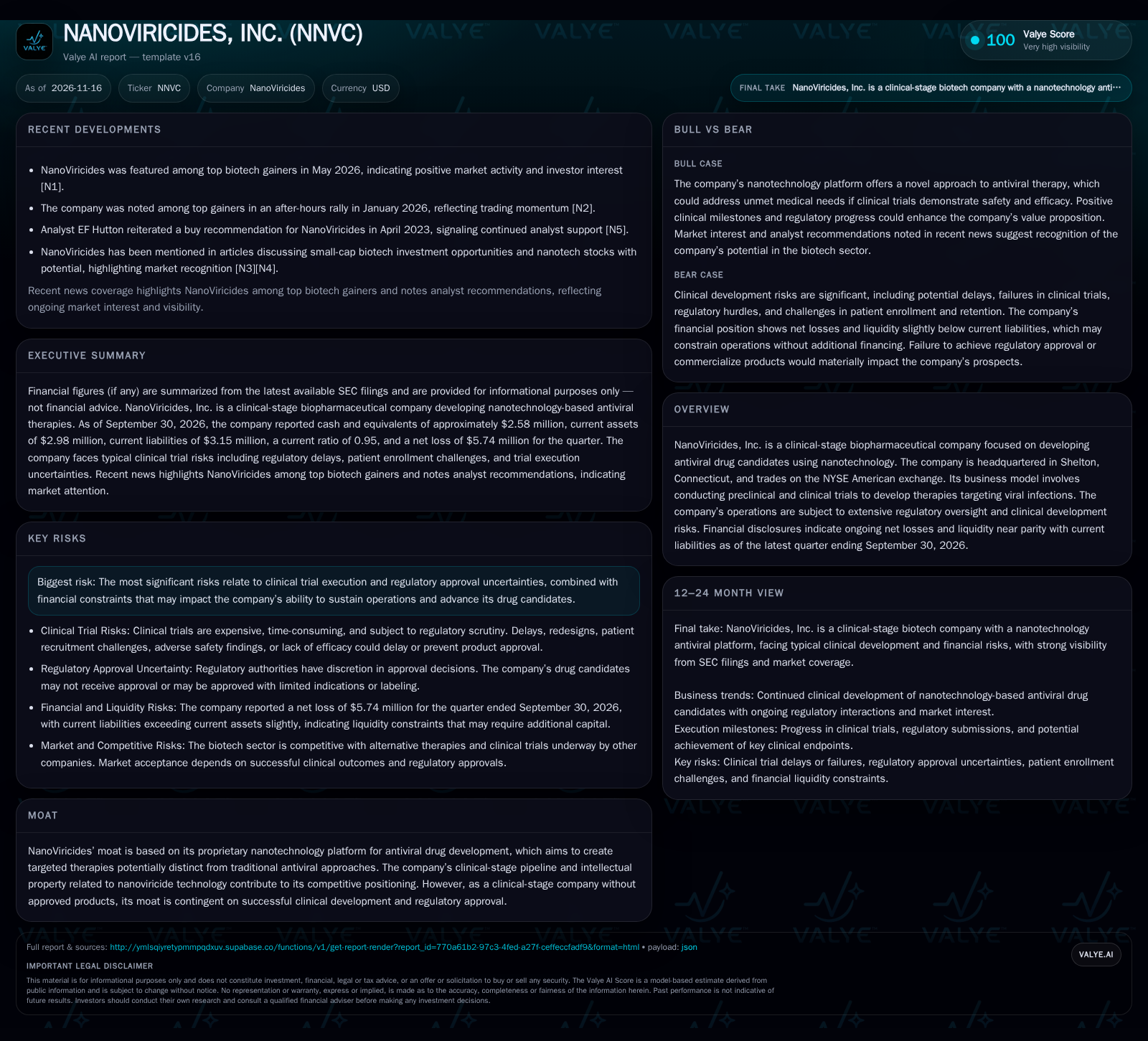
NanoViricides is developing nanotechnology-based antiviral therapies as a clinical-stage biotech. As of September 2026, it faces a net loss of $5.74 million for the quarter and current liabilities slightly above current assets, highlighting tight liquidity. Clinical trial advancement, regulatory milestones, and capital access will determine whether its innovative platform translates to commercial success or stalls due to execution and financial risks. [S2]
NanoViricides, Inc. stands at a critical juncture as it seeks to bring nanotechnology-based antiviral drugs through the clinical trial gauntlet toward potential commercialization. With a proprietary platform aiming to address unmet needs in the antiviral space, the company’s prospects depend on clinical trial outcomes, regulatory progress, and its ability to secure ongoing funding. However, as of September 2026, NanoViricides operates with current liabilities slightly exceeding current assets, and it continues to post sizable net losses. This creates a high-stakes scenario: either its platform delivers breakthrough results and attracts new capital, or operational and financial pressures could force retrenchment before commercialization. [S2]
Liquidity Limits and Clinical Progress Define Near-Term Reality
NanoViricides reported $2.58 million in cash and cash equivalents and $2.98 million in current assets as of September 30, 2026, set against current liabilities of $3.15 million—resulting in a current ratio of 0.95 and a cash ratio of 0.82. This near-parity between assets and liabilities signals a narrow margin for operational maneuvering. The company posted a net loss of $5.74 million for the same quarter, consistent with the ongoing cash burn typical of clinical-stage biotechs. The issuance of shares for consulting and director services also highlights reliance on equity-based compensation in a capital-constrained environment. While NanoViricides remains active in clinical trials and regulatory submissions, its financial position makes timely progress and additional funding urgent priorities. [S2]
How NanoViricides Could Generate Value: The Economics of Platform Therapeutics
NanoViricides’ business model is predicated on advancing proprietary nanotech-based antiviral candidates through clinical development, with the eventual goal of regulatory approval and commercialization. In the biopharma sector, the pathway to value creation rests on successful clinical data, regulatory approvals, and subsequent out-licensing, partnership, or direct commercialization. Because the company is pre-revenue and faces no product sales, its economics are currently defined by R&D spend and the capital required to sustain operations until a pivotal clinical or regulatory milestone unlocks value.
The cost structure is dominated by R&D expenses, clinical trial execution, regulatory compliance, and corporate overhead—largely fixed in the short term, but also subject to unpredictable spikes tied to trial scale, delays, or setbacks. Variable costs become material only if a product reaches commercialization. If successful, the economics could shift dramatically: novel antivirals addressing unmet needs may command premium pricing, and a platform approach could enable pipeline expansion or licensing deals. However, the need for ongoing capital infusions is acute, particularly given current liquidity. Without a near-term partnership, non-dilutive grant, or positive clinical catalyst, the company may face the prospect of further equity dilution or program delays.
Platform Potential Versus Clinical-Stage Vulnerability in the Antiviral Arena
NanoViricides’ competitive pitch is its proprietary nanotechnology platform, which aims to deliver targeted antiviral therapies distinct from conventional small molecules or biologics. If the technology demonstrates superior efficacy, safety, or resistance profiles, it could differentiate the company in a crowded antiviral landscape. However, the antiviral therapeutics market includes diverse competitors: established pharmaceutical firms with approved antivirals, other clinical-stage biotechs pursuing novel modalities, and academic consortia with access to public funding.
Switching costs and customer lock-in are not relevant until commercial approval, but intellectual property and clinical differentiation are potential sources of future moat. The sector is also characterized by fast-moving science and risk of technological obsolescence—if a competitor’s therapy outpaces NanoViricides' candidates in efficacy, safety, or time-to-market, the company’s commercial prospects could be sharply diminished. Additionally, larger competitors may have more robust capital access to weather clinical setbacks or regulatory delays.
Breakthrough Clinical Results Could Transform Capital Access and Strategic Options
If NanoViricides achieves positive interim or pivotal clinical data—demonstrating not only safety but clear antiviral efficacy in a relevant indication—the company’s risk profile could shift dramatically. Such results would likely increase visibility among strategic partners, potential acquirers, and institutional investors, enabling access to non-dilutive funding, licensing deals, or even an acquisition premium. The nanotechnology platform, if validated in human trials, could be leveraged for multiple viral targets, expanding the addressable market and justifying further investment.
Evidence confirming this scenario would include: successful completion of clinical trial phases with statistically significant efficacy, regulatory fast-track or breakthrough designations, and new strategic partnerships or licensing agreements. A positive shift in analyst coverage or a material capital raise on favorable terms would further validate the upside thesis. Conversely, lack of clinical progress or inability to secure partnership interest would falsify this scenario.
Clinical Advancement Proceeds, But Funding Remains a Persistent Hurdle
The most plausible near-term path is one where NanoViricides continues to make incremental clinical progress—advancing ongoing trials, submitting new protocols, and addressing regulatory queries—but does not achieve a major clinical breakthrough or partnership in the next 12 months. In this scenario, the company remains reliant on serial capital raises, potential equity dilution, and careful cost management to sustain operations. Clinical data may be mixed or preliminary, sufficient to maintain program momentum but not to trigger transformative strategic interest.
Confirmation would come from continued SEC filings indicating operational continuity, announcements of trial enrollment milestones, and periodic but modest capital raises. Falsification would be marked by a halt in clinical development, missed regulatory deadlines, or a sharp increase in operational delays tied to funding gaps.
Trial Setbacks or Delays Compound Financial Strain and Threaten Continuity
In the adverse scenario, NanoViricides faces significant clinical trial delays, patient enrollment challenges, or negative safety/efficacy findings. Such outcomes would raise questions about the viability of its pipeline and increase regulatory scrutiny. Given the company’s liquidity profile, operational setbacks could rapidly translate into a cash crunch, forcing the suspension of trials, workforce reductions, or asset sales. Difficulty in raising additional capital—whether due to poor market conditions or diminished investor confidence—could accelerate these pressures.
Confirmation of this downside would include public disclosure of halted or failed trials, missed regulatory milestones, inability to raise new funds, or a going concern warning in SEC filings. A dramatic increase in share issuance for operational needs without corresponding clinical progress would also be a warning sign.
Milestones That Will Determine NanoViricides’ Trajectory
Clinical trial enrollment rates and interim data readouts—successful recruitment and positive early results are critical for momentum.
Regulatory submissions and feedback—timely IND filings and positive interactions with the FDA or other agencies would signal progress.
Cash runway and capital-raising activity—frequency, terms, and dilution of new financings will shape operational flexibility.
Announcements of strategic partnerships, licensing deals, or grants—any non-dilutive funding or industry validation would materially improve outlook.
Incidence of share-based compensation for operational needs—continued reliance on equity for compensation may indicate underlying cash stress.
Updates on intellectual property protection—expansion or defense of patents would help test the durability of the company’s platform advantage.
If disclosed, retention of key scientific and clinical leadership—management continuity can be a proxy for organizational stability.
Disclaimer: This is research-only, informational analysis and not investment advice. It may include AI-generated interpretation and general industry context. Always verify important details using primary sources.

Comments