
Twist Bioscience: Scaling Synthetic DNA and Leveraging Platform Strengths Toward Profitability
Twist Bioscience’s silicon-based DNA synthesis platform underpins record 2026 revenue and broad sector reach, but persistent losses and execution risk highlight the challenge of converting technical leadership into durable economics.
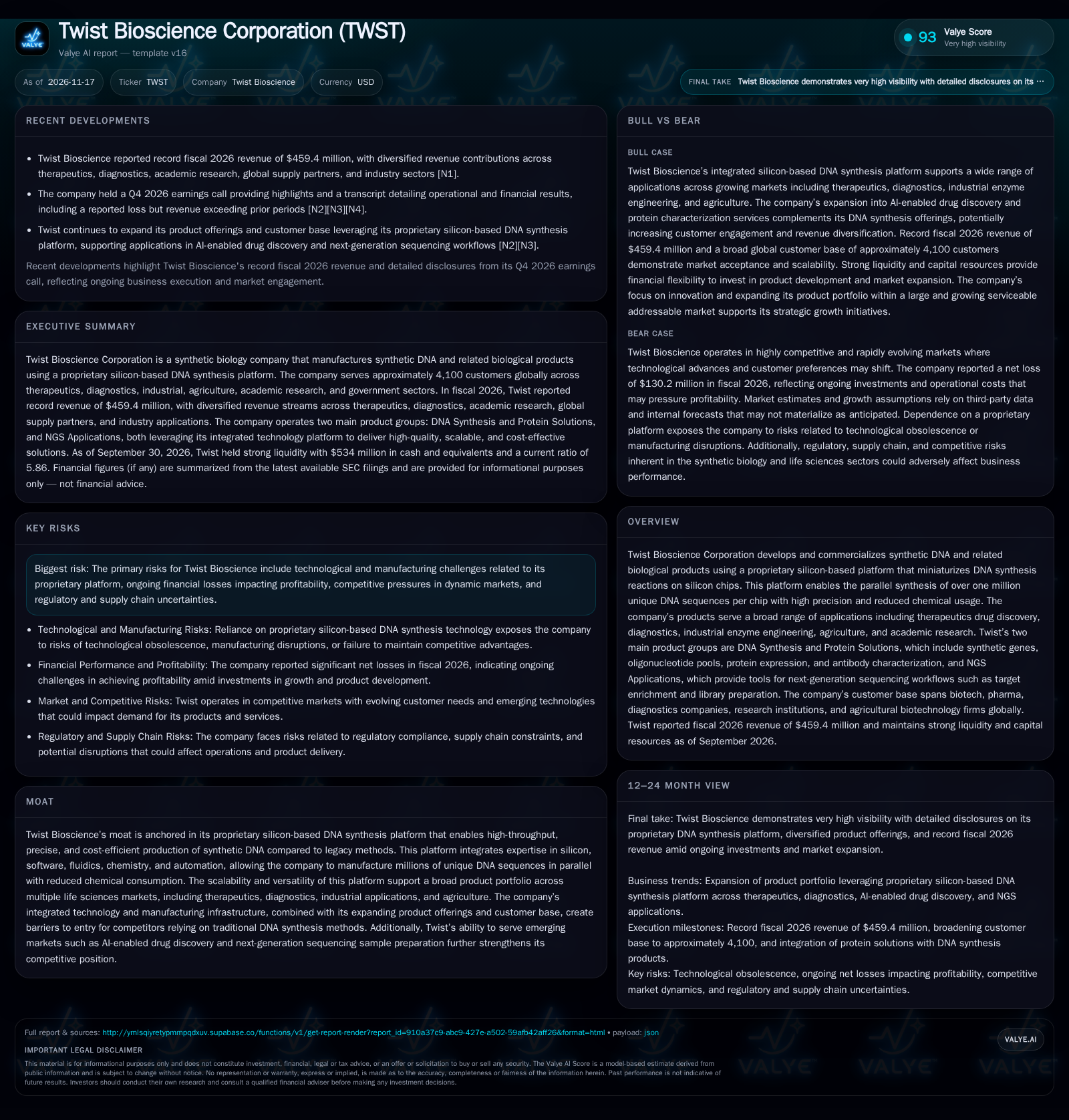
Twist Bioscience reported fiscal 2026 revenue of $459.4 million, driven by a diversified customer base spanning therapeutics, diagnostics, and research. Its proprietary silicon-based DNA synthesis platform enables high-throughput, cost-efficient production, fueling expansion into high-growth applications like AI-enabled drug discovery and next-generation sequencing. The core question is whether Twist can translate platform advantages into operating leverage and sustainable margins as synthetic biology markets mature. [S1] [N1] [N2] [N3] [N4]
Twist Bioscience sits at the intersection of synthetic biology’s promise and its commercial growing pains. With a proprietary silicon-based DNA synthesis platform, Twist reported record 2026 revenue of $459.4 million and expanded its reach into therapeutics, diagnostics, and research. The company’s technology enables high-throughput, cost-effective production of synthetic DNA, supporting both traditional and AI-enabled applications. Yet, despite robust top-line growth and a reported liquidity position, Twist remains unprofitable, posting a net loss of $130.2 million for the year. The company’s challenge now is to convert technical and market momentum into sustainable economics as competition, technology shifts, and customer needs continue to evolve. [S1] [N1] [N2] [N3] [N4]
Twist’s 2026 Performance Marked by Revenue Growth Amid Continued Losses
Twist Bioscience reported fiscal 2026 revenue of $459.4 million, an all-time high for the company, with contributions spread across therapeutics ($162.3 million), diagnostics ($164.3 million), academic research and government ($56.6 million), global supply partners ($52.0 million), and industry/applications ($24.2 million). This revenue diversification reflects broadening market acceptance and the platform’s ability to serve diverse sectors. However, the company also posted a net loss of $130.2 million for the year, indicating that investments in technology, capacity, and commercial expansion continue to outpace gross profit generation. The key tension is between the company’s clear top-line momentum and its ongoing struggle to achieve profitability. [S1] [N1] [N2] [N3] [N4]
Potential for Platform Leverage to Enhance Margins or Extend Financial Challenges
Twist’s business model is anchored in high-throughput, miniaturized DNA synthesis using silicon chips, which enables the parallel production of over one million unique DNA sequences per chip. This architecture theoretically drives down unit costs through reduced chemical usage and automated manufacturing, while supporting large, custom orders for research, diagnostics, and drug discovery. The company’s two product groups—DNA Synthesis and Protein Solutions, and NGS Applications—offer a mix of catalog products and custom solutions, serving both recurring and project-based demand.
Revenue is diversified, but gross margin expansion depends on the extent to which Twist can shift volume onto its platform without proportionally increasing variable costs. Fixed costs remain high due to R&D, manufacturing infrastructure, and commercial build-out across multiple verticals. The company’s ongoing net losses suggest that, to date, incremental revenue has not fully translated into incremental profit. [S1]
Navigating a Competitive Landscape with Evolving Customer Demands
Twist’s proprietary silicon-based synthesis platform offers clear throughput and cost advantages over legacy phosphoramidite-based DNA synthesis, enabling the company to compete on both price and customization. However, the synthetic biology and genomics markets are highly competitive, with peers ranging from established reagent suppliers to emerging automated synthesis startups and integrated drug discovery platforms. Barriers to entry are meaningful in terms of engineering, automation, and scale, but rapid advances in enzyme-based synthesis and alternative DNA writing technologies could erode Twist’s lead if the company does not continue innovating.
Customer switching costs are moderate: while integration and workflow validation can create some friction, most buyers are sophisticated and price/value sensitive, especially as synthetic DNA becomes a commodity input for many applications. The company’s ability to maintain a differentiated position may rest on expanding its product ecosystem—such as bundling NGS tools, protein solutions, and AI-driven services—to create stickier, higher-value relationships. Ultimately, Twist’s moat depends on sustaining technical leadership while moving up the value chain to defend against both low-cost entrants and vertically integrated competitors.
Margin Growth Hinges on Platform Expansion and Continuous Innovation
In a favorable scenario, Twist leverages its platform to capture a growing share of the $13 billion+ addressable market, driven by accelerating adoption in AI-enabled drug discovery, personalized diagnostics, and synthetic biology manufacturing. As order volumes increase, the company’s fixed-cost base is spread over larger revenue, enabling gross and operating margin improvement. New product launches in high-value verticals—such as advanced protein engineering and targeted NGS panels—could command premium pricing and deepen customer relationships.
Confirmation of this scenario would come from sequential improvements in gross margin, narrowing net losses (or a turn to profitability), and evidence of recurring, multi-year commercial relationships with major customers in growth markets. Announcements of partnerships that integrate Twist’s DNA synthesis with AI/ML drug discovery platforms, or successful expansion into adjacent applications with bundled solutions, would further validate this path.
Growth Outlook Influenced by Pricing Pressures and Fixed Cost Structure
The most plausible near-term trajectory is one of continued revenue growth, but with persistent margin pressure as Twist competes for share in maturing synthetic biology and genomics markets. Price competition may intensify, particularly for commoditized DNA synthesis and NGS prep products, limiting the company’s ability to fully leverage its cost advantages. Investments in R&D and manufacturing capacity will remain high as Twist seeks to stay ahead technologically and meet diverse customer needs.
This scenario would be confirmed by ongoing top-line growth—potentially at a decelerating rate—and only gradual improvement in operating losses. Gross margins may stabilize but not expand meaningfully until either market consolidation occurs or Twist successfully shifts its mix toward higher-margin, differentiated offerings. Lack of clear margin expansion or evidence of commoditization in core product lines would reinforce this base case.
Profitability Threatened if Scale and Differentiation Fail to Materialize
In a negative scenario, Twist is unable to achieve sufficient scale or pricing power to offset its high fixed costs, resulting in persistent or widening operating losses. Accelerating competitive entry—especially from enzyme-based synthesis or integrated genomics platforms—could compress prices and force Twist to compete on volume rather than value. Technological disruption or supply chain issues could further erode the cost or quality advantages of the company’s silicon-based platform.
Evidence for this downside would include stagnating or declining revenue, margin compression, and a need to raise additional capital to fund ongoing losses. Customer churn, loss of major accounts, or delays in new product launches would also signal that Twist’s differentiation is eroding. Regulatory or operational setbacks—such as quality issues or disruptions in chip supply—would compound these risks.
Factors Shaping the Long-Term Value Creation of Twist’s Platform
Sequential changes in gross margin and operating margin as revenue grows—if disclosed—would help test whether scale is translating into improved profitability.
Volume and mix of revenue from higher-value offerings (e.g., AI-enabled drug discovery, protein engineering, bundled NGS solutions) compared to commoditized DNA synthesis would clarify pricing power and product differentiation, if disclosed.
Customer concentration trends and the size and duration of commercial relationships—especially in therapeutics and diagnostics—would provide insight into revenue visibility and switching frictions.
R&D spending as a percentage of revenue and the pace of new product launches would signal Twist’s commitment to innovation and ability to stay ahead of potential substitutes.
Evidence of recurring, multi-year contracts or renewals—if disclosed—would support the case for durable, high-value customer engagement.
Competitive developments in enzyme-based or alternative DNA synthesis technologies could alter the cost and performance landscape, affecting Twist’s moat.
Any updates on supply chain resilience, especially for silicon chips and key reagents, would affect operational risk and scalability.
Management commentary or guidance on the timeline to profitability and capital allocation priorities would clarify the balance between growth investment and financial discipline.
Disclaimer: This is research-only, informational analysis and not investment advice. It may include AI-generated interpretation and general industry context. Always verify important details using primary sources.

Comments