
Bunker Hill Mining: Restart Ambition Meets Acute Refinancing and Execution Pressures
As Bunker Hill Mining approaches the restart of its historic Idaho mine, the company’s operational advances and strategic partnerships confront a stark liquidity gap and urgent debt refinancing needs—placing execution, integration, and capital access at the heart of its investment case.
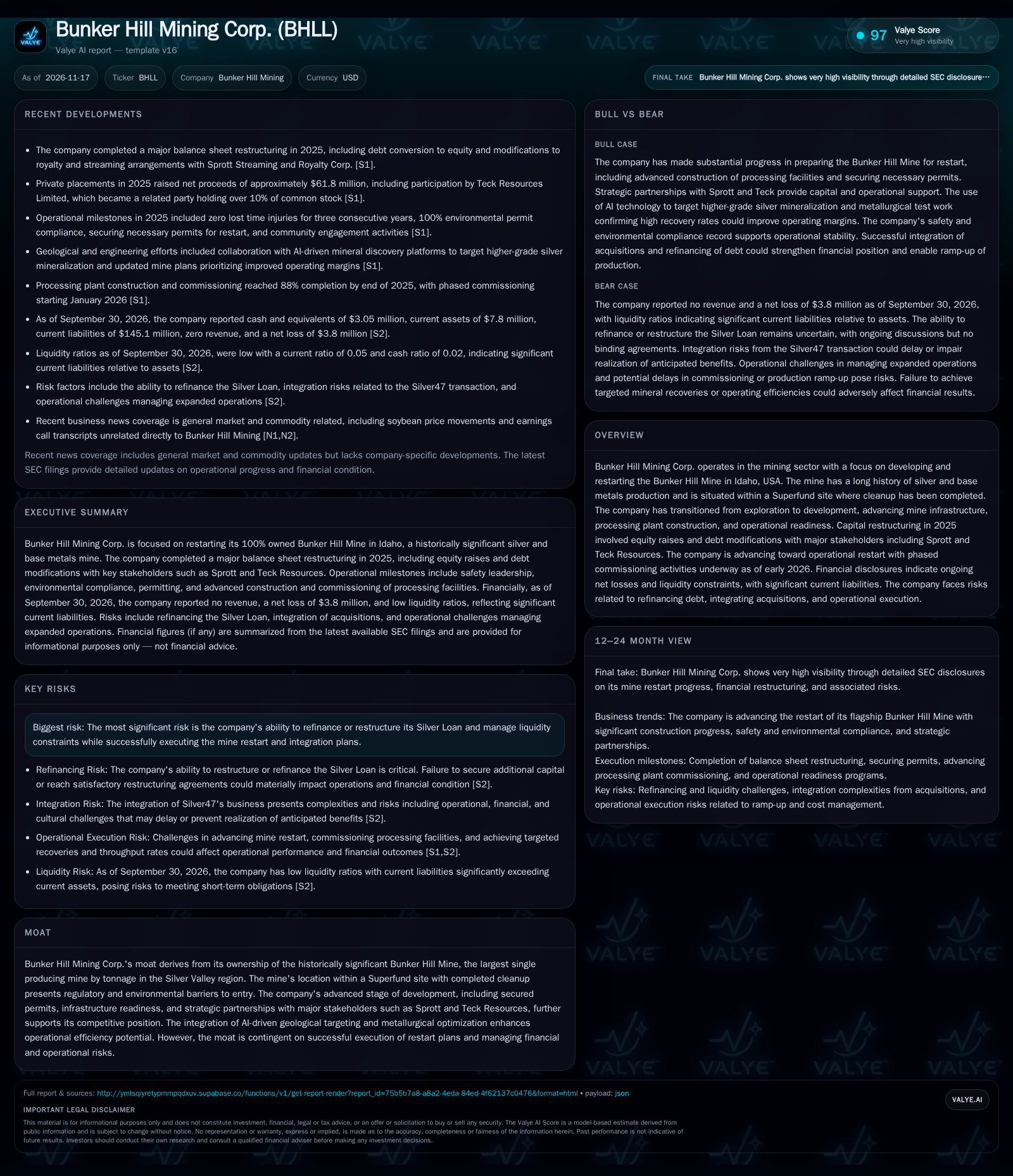
Bunker Hill Mining is nearing phased commissioning of its historic silver and base metals mine after substantial infrastructure and permitting advances. The success of debt restructuring and ramp-up execution will determine if the company can transition from development to sustainable production. [S1] [S2]
Bunker Hill Mining stands on the cusp of a rare mine-restart inflection, having completed much of the heavy lifting required to bring its storied Idaho silver and base metals asset back online. With construction and permitting milestones largely achieved and new capital partners onboard, the company is now entering the critical phase of commissioning and ramp-up. Yet, this operational progress is overshadowed by a stark liquidity shortfall and the unresolved refinancing of its Silver Loan. The next 12 months will test not only Bunker Hill’s technical execution but also its ability to secure the financial runway essential for sustainable operations.
Restart Milestones Amid Severe Liquidity Strain
By late 2025, Bunker Hill Mining had advanced its mine restart program to the brink of production, with 88% of processing plant construction completed and phased commissioning underway as of January 2026. The company achieved zero lost time injuries over three years and maintained full compliance with environmental permitting, ensuring regulatory alignment for operational launch. However, as of September 30, 2026, the company reported a cash balance of $3.05 million against current liabilities of $145.1 million, with no revenue and a net loss of $3.8 million. The company reported a current ratio of 0.05 for the period. The presence of Teck Resources as a significant new shareholder following a $61.8 million 2025 equity raise adds strategic depth, but does not resolve the immediate cash flow challenge. [S1] [S2]
Mine Restart Economics: Fixed Cost Burden and Margin Potential
The economics of a brownfield mine restart like Bunker Hill’s are defined by large up-front fixed costs—rehabilitation, plant construction, permitting, and pre-operational labor—followed by a material shift to variable costs as ore extraction and processing commence. Once operational, revenue generation will depend on metal recoveries, ore grades, and realized commodity prices for silver, lead, and zinc. Metallurgical test work showing recoveries of 89% for silver, 87% for lead, and 92% for zinc indicate robust process efficiency potential if mine plans are executed as designed. The use of AI-driven mineral targeting may allow prioritization of higher-grade zones, supporting higher early margins and cash flow.
However, the company’s current lack of revenue means it is not yet benefiting from operating leverage. The capital stack remains complex, with restructured debt, royalty and streaming obligations, and equity dilution all in play. The requirement to refinance the Silver Loan adds a critical layer of uncertainty: the terms, timing, and cost of this refinancing will directly affect free cash flow and the ability to fund both ramp-up and unforeseen operational issues. Until the mine achieves stable production, the fixed cost base and legacy financing obligations will dominate cash flow dynamics.
Barriers to Entry and the Realities of the Silver Valley
Bunker Hill’s competitive position is anchored by ownership of one of the largest historic mines in Idaho’s Silver Valley—an asset with significant scale, known geology, and existing infrastructure. The completion of Superfund remediation and full permitting status provide formidable regulatory and environmental barriers to entry for potential rivals, as new greenfield projects in the region would face lengthy and expensive approval processes.
Strategic relationships with Sprott and Teck Resources offer both financial and operational support, potentially differentiating Bunker Hill from smaller, less capitalized juniors. The integration of advanced mineral discovery technologies (including AI targeting) and strong safety/environmental records may further support operational efficiency and stakeholder trust.
However, these advantages are only durable if Bunker Hill successfully transitions to production and manages its capital structure. The mine’s competitive moat could be eroded by persistent liquidity constraints, operational missteps, or failure to deliver on integration and ramp-up milestones—especially as larger diversified miners and royalty/streaming companies continue to scan for distressed assets.
Operational Execution and Successful Refinancing Unlock Value
In the favorable scenario, Bunker Hill finalizes a refinancing of the Silver Loan on terms that preserve cash flow and minimize further equity dilution. This financial stability allows the company to complete plant commissioning, ramp up to commercial production, and demonstrate consistent throughput and recovery rates. Early mining of higher-grade silver zones—enabled by AI-driven targeting—yields attractive margins, generating positive operating cash flow within the first year of production.
The successful integration of the Silver47 transaction and smooth management of expanded operations would further support cost control and margin expansion. Evidence supporting this scenario would include a binding refinancing agreement for the Silver Loan, first shipments of concentrate, and quarterly reports showing positive operational cash flow and rising ore grades. Confirmation of production guidance and maintenance of environmental compliance would further validate the long-term investment case.
Transition Period: Ramp-Up Pains and Ongoing Capital Constraints
The most plausible trajectory is a protracted transition period in which Bunker Hill completes commissioning and begins production, but faces continued working capital tightness and operational hiccups typical of mine restarts. Refinancing of the Silver Loan is achieved, but likely on terms that reflect the company’s weak balance sheet and result in higher cost of capital or additional equity dilution. Initial production rates may fall short of nameplate capacity as the company navigates underground rehabilitation, equipment optimization, and workforce ramp-up.
Operating margins are pressured by startup inefficiencies and the need to deliver on integration and cost management targets. The company may achieve positive gross margin but remains free cash flow negative for several quarters. Evidence for this scenario would be incremental production updates, partial refinancing announcements, and ongoing net losses with gradual improvement in operating metrics.
Liquidity Squeeze and Delays Threaten Continuity
The adverse scenario is defined by an inability to secure refinancing for the Silver Loan on acceptable terms, forcing Bunker Hill into emergency capital raises, asset sales, or operational slowdowns. Commissioning and ramp-up are delayed by integration setbacks, technical issues, or cost overruns—exacerbating the working capital deficit.
Failure to achieve targeted recoveries or ore grades would further erode confidence, potentially triggering covenant breaches or forced restructuring. Evidence for this scenario would include delays in commissioning, negative going-concern language in filings, default notices, or equity raises at distressed valuations. Material slippage in safety, environmental, or community engagement metrics would compound the downside risk.
Testing the Restart Thesis: Concrete Milestones and External Triggers
Progress and terms of Silver Loan refinancing—any binding agreement, maturity extensions, or covenant changes would be pivotal.
Commissioning updates: specific milestones for first ore processed, first concentrate shipment, and ramp-up to commercial production.
Quarterly production and recovery rates for silver, lead, and zinc—if disclosed—will be essential to validate the margin thesis.
Operating cash flow generation post-restart; a transition to positive cash from operations would be a key inflection point.
Evidence of successful integration and cost control related to the Silver47 transaction, including synergy realization—if disclosed.
Updates on community relations, safety, and environmental compliance, as regulatory setbacks could threaten the operating license.
Any new equity issuances, asset sales, or changes in strategic partnerships, which may signal capital stress or shifting strategy.
Sustained engagement from Teck Resources and Sprott, including board participation or further financial support, would signal confidence in the ramp-up.
Disclaimer: This is research-only, informational analysis and not investment advice. It may include AI-generated interpretation and general industry context. Always verify important details using primary sources.

Comments