
Atmos Energy: Regulated Growth, Capital Commitments, and the Challenge of Liquidity Discipline
Atmos Energy enters fiscal 2027 with robust earnings, ongoing infrastructure investments, and regulatory-driven revenue mechanisms.
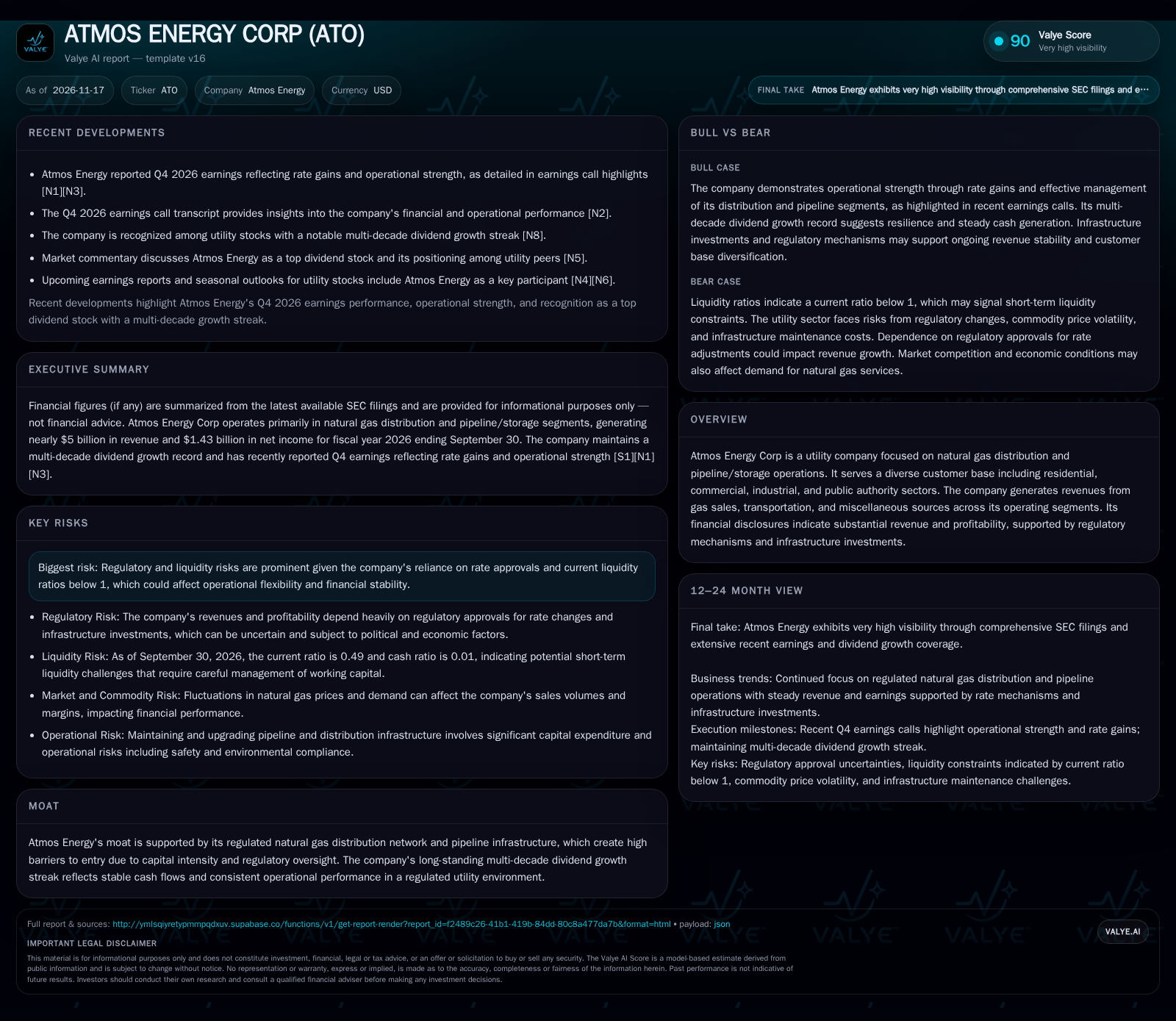
Atmos Energy reported fiscal 2026 revenue of $4.98 billion and net income of $1.43 billion, driven by regulatory rate gains and infrastructure investments. The company faces significant capital commitments—$26 billion planned through 2030—and maintains low liquidity ratios, with $28.2 million in cash and a current ratio of 0.49. The business model depends on regulatory frameworks to recover costs, making future rate approvals and cost management essential for sustaining growth and financial stability. [S1] [S2] [N1] [N3]
Fiscal 2026 results underscore the company’s capacity to translate rate gains and infrastructure spending into profit, but the path forward is shaped as much by capital discipline and regulatory outcomes as by operational execution. Understanding Atmos Energy’s future means unpacking the mechanics of regulated returns, capital intensity, and the evolving risk calculus as the natural gas sector navigates both growth and vulnerability.
Recent Earnings, Capital Commitments, and Liquidity Realities
Atmos Energy reported full-year 2026 revenue of $4.98 billion and net income of $1.43 billion, reflecting strong operational performance and the impact of recent regulatory rate gains. These results were supported by infrastructure investments and favorable outcomes in key service areas, particularly in Texas, where new legislation contributed an additional $132.4 million to results during the nine months ended June 30, 2026. [S1] [S2] [N1] [N3]
The company plans to spend approximately $26 billion between fiscal 2026 and 2030, with more than 80% focused on safety and reliability within its distribution and pipeline/storage segments. This underscores the capital-intensive nature of the business and its reliance on regulatory frameworks to recover investments. [S2]
Despite robust profitability, Atmos Energy's liquidity metrics are weak: as of September 30, 2026, the current ratio stood at 0.49 and the cash ratio at 0.01, with cash and equivalents totaling $28.2 million. These figures signal potential short-term funding challenges, especially in the context of substantial ongoing capital commitments. [S1]
How Regulated Returns and Cost Recovery Shape Utility Economics
Atmos Energy’s revenue model is anchored in regulated natural gas distribution and pipeline/storage operations, selling gas and related services to residential, commercial, industrial, and public authority customers. Pricing is largely set through multi-year rate cases with state and local regulators, aiming to deliver a fair return on invested capital while covering operating and capital costs. This regulatory structure offers revenue visibility and the potential for stable, if not growing, profits—provided investments are deemed prudent and rates are approved.
The company's economics are heavily influenced by the interplay between capital expenditures, depreciation, and rate recovery. Fixed costs dominate, with infrastructure investments leading to higher rate bases and, if approved, higher allowed earnings. Variable costs (such as gas purchases) are typically passed through to customers via cost-adjustment clauses, mitigating commodity price risk but not eliminating exposure to volume fluctuations or regulatory lag.
Atmos Energy’s significant planned capex—$26 billion through 2030—amplifies both the opportunity for earnings growth (via a larger rate base) and the need for external financing. Operating leverage is present but tempered by the regulatory environment, which can restrict near-term margin expansion if rate relief lags expense growth.
Regulatory Moat and the Limits of Competitive Protection
Atmos Energy’s primary competitive advantage lies in its regulated monopoly status within its service territories. The combination of extensive pipeline infrastructure, entrenched local relationships, and regulatory oversight creates high barriers to entry, making direct competition rare in core distribution markets.
However, this moat is not absolute. The company faces counterforces from several directions: regulatory scrutiny can limit returns or delay cost recovery; political shifts may prioritize electrification or alternative energy sources, eroding long-term gas demand; and ongoing environmental and safety requirements drive up compliance costs. While substitution risk from other fuels remains gradual, policy-driven shifts—such as city-level bans on new gas hookups or increased carbon regulation—could accelerate demand headwinds over time.
Peer companies in the regulated utility space share similar economics, with differentiation primarily in regulatory relationships, geographic mix, and capital efficiency. The ability to execute infrastructure upgrades efficiently and manage regulatory risk is more important to long-term returns than conventional competitive tactics such as pricing or marketing.
Scenario: Regulatory Alignment Unlocks Rate Base Expansion and Earnings Growth
If Atmos Energy continues to secure favorable regulatory outcomes—rapid approval of rate cases, recognition of prudent infrastructure investments, and mechanisms that minimize lag in cost recovery—the company could achieve sustained earnings growth as its rate base expands.
Upside confirmation would come from timely, favorable rate case settlements in major service areas, continued legislative support for infrastructure modernization, and evidence that incremental operating costs are efficiently passed through to customers or offset by productivity gains. Accelerated adoption of regulatory trackers or riders that allow for faster cost recovery would further reduce risk and support valuation multiples.
Falsification would be signaled by regulatory setbacks—rate case disallowances, extended lag in cost recovery, or political pushback against gas infrastructure expansion. Delays in capital deployment or inability to secure external funding on reasonable terms would also constrain upside.
Steady-State: Rate-Approved Growth Balances Capital Needs and Regulatory Headwinds
The most plausible trajectory for Atmos Energy is continued moderate growth, anchored by incremental rate base expansion and routine, if sometimes contested, rate case approvals. Earnings are likely to grow in line with prudent capital deployment and the pace of regulatory approval, while rising depreciation, property taxes, and compliance costs temper margin expansion.
In this scenario, liquidity remains tight but manageable, with ongoing reliance on external debt and equity markets to fund capex.
Evidence supporting this scenario would include a steady cadence of successful, though occasionally delayed, rate case settlements; manageable increases in leverage; and continued access to capital markets at reasonable costs. Falsification would be indicated by a pattern of significant regulatory setbacks, sustained liquidity deterioration, or a marked slowdown in infrastructure investment due to funding constraints.
Adverse Outcomes: Liquidity Squeeze Meets Regulatory or Cost Shock
A negative scenario could emerge if Atmos Energy experiences a combination of regulatory pushback (e.g., disallowed investments, stricter cost caps, or delayed rate relief) and rising operational or capital costs. With reported cash balance and a current ratio of 0.49, even minor disruptions in rate recovery or capital market access could force the company to defer projects, cut dividends, or take on expensive short-term debt.
Additional risks include unexpected safety incidents, adverse policy shifts favoring electrification, or commodity price swings that drive customer attrition or increase unrecoverable costs. Litigation or environmental liabilities, if material, could further strain cash flows.
This scenario would be confirmed by missed or delayed capex targets, credit rating downgrades, covenant breaches, or dividend cuts. Early warning signs include a rising cost of capital, growing working capital deficits, or a sharp increase in regulatory disputes.
Benchmarks for Testing Atmos Energy’s Regulatory and Financial Thesis
Progress on major rate case approvals and the speed at which new investments are incorporated into the rate base—especially in Texas and other large service territories.
Quarterly and annual capex execution versus plan, and any revisions to the $26 billion infrastructure investment commitment.
Trends in the current ratio, cash ratio, and short-term borrowing—these will indicate whether liquidity management is improving or deteriorating.
Changes in the cost of capital, credit ratings, or access to external funding as signals of balance sheet flexibility and market confidence.
Operating expense trends (depreciation, property taxes, compliance) relative to rate recovery—if disclosed, the allowed versus earned return on equity is a key metric.
Updates on regulatory or legislative developments impacting natural gas distribution, such as policy shifts toward electrification or new safety/environmental mandates.
Any disclosed customer growth/attrition rates, new connection bans, or competitive encroachment from electrification or alternative energy sources.
Material legal, safety, or environmental incidents and their impact on regulatory relationships or cost structure.
Disclaimer: This is research-only, informational analysis and not investment advice. It may include AI-generated interpretation and general industry context. Always verify important details using primary sources.

Comments