
Greenlane Holdings: Digital Asset Strategy Collides with Legacy Strain and Volatility
Greenlane’s pivot to digital asset treasury management has produced near-term accounting gains but left the company exposed to acute volatility, unresolved legal claims, and a precarious operating outlook.
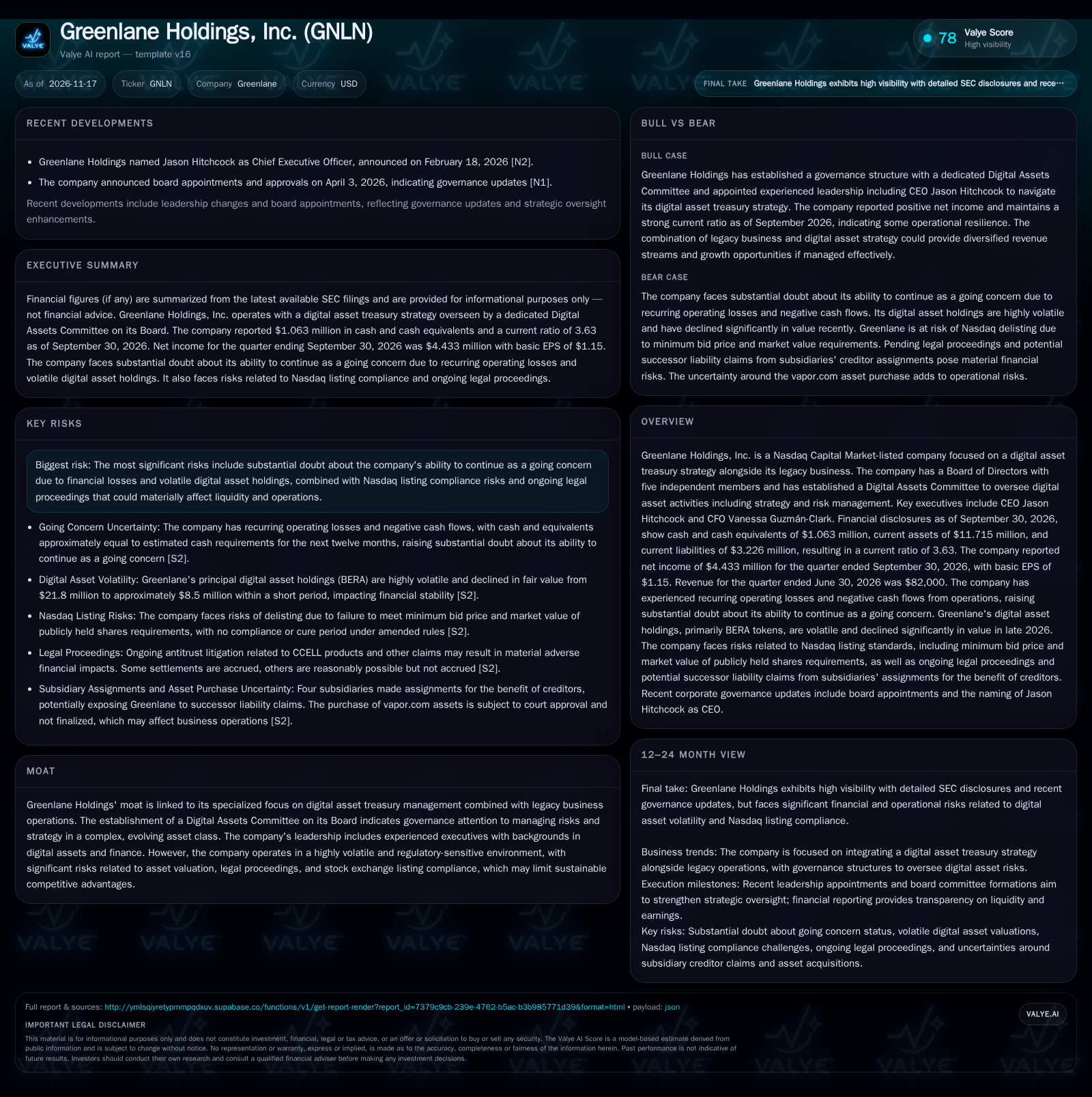
Greenlane Holdings reported a sharp swing to net income in the September 2026 quarter, but this masks deep strain: recurring operating losses, negative cash flows, and a dramatic collapse in digital asset values have intensified going concern doubts. The company’s digital asset focus may offer upside if volatility can be tamed and governance reforms bear fruit, but unresolved litigation, potential delisting, and a fragile legacy business threaten viability. The thesis hinges on Greenlane proving it can convert digital asset management into a defensible, recurring source of value before its risk factors crystallize.
Greenlane Holdings stands at a crossroads, with recent headline net income and governance reforms offering a veneer of progress even as its operating core weakens. The company's strategy—anchored around managing digital assets like BERA tokens and legacy distribution operations—has delivered only fleeting respite from persistent losses, negative cash flow, and a rapid collapse in digital asset value. The central test is whether Greenlane can convert its asset pivots and new oversight into a stable, recurring business before acute risks—especially cash burn, asset volatility, and unresolved liabilities—undermine its viability.
Recent Earnings and Asset Volatility Redefine the Playing Field
The September 2026 quarter saw Greenlane report net income of $4.433 million and basic EPS of $1.15, a marked change from its tradition of operating losses [S2]. However, this positive headline is counterbalanced by ongoing negative cash flows and explicit disclosure of substantial doubt about the company’s ability to continue as a going concern [S2]. Greenlane’s digital asset holdings—primarily BERA tokens—dropped precipitously in value from $21.8 million at September’s end to about $8.5 million by mid-November, underscoring the acute risk of relying on volatile non-cash assets for balance sheet strength [S2]. The company’s current ratio of 3.63 reflects a balance sheet heavy on current assets, but with cash at just $1.063 million, liquidity remains fragile [S2]. Meanwhile, unresolved legal proceedings, pending asset acquisitions, and potential Nasdaq delisting create a confluence of existential threats.
How Digital Asset Holdings Alter Greenlane’s Economic Equation
Greenlane’s business model has shifted from a traditional product distributor to a hybrid that aggressively incorporates digital asset treasury management. Unlike recurring-revenue businesses, this model exposes the company to sharp mark-to-market swings: digital asset appreciation can produce short-term accounting profits, but rapid declines—as seen with BERA—can quickly erode perceived value and exacerbate liquidity risk. The company’s legacy operations generated only $82,000 in revenue for the quarter ended June 30, 2026, suggesting minimal ongoing contribution from traditional sales channels [S2].
The economics of digital asset management are inherently volatile and non-recurring: realized gains depend on market timing, while unrealized losses can puncture both reported earnings and investor confidence. The company reported cash and liquidity metrics for the period; these figures do not by themselves establish operating runway, investment capacity, financial flexibility, or financing capacity. Overhead costs, legal expenses, and the capital intensity of any legacy business relaunch (such as vapor.com) could further strain limited resources. Unless the company can develop a mechanism to generate stable, recurring cash flows—either through digital asset yield strategies, fee-based services, or a revitalized legacy business—its economics will remain highly speculative.
Specialization in Digital Asset Treasuries: Advantage or Liability?
Greenlane’s attempt to carve out a niche as a digital asset treasury manager is unusual among legacy distributors, and the creation of a Board-level Digital Assets Committee signals a commitment to professionalizing this pivot [S1]. In theory, early adoption and governance focus could confer an advantage in navigating regulatory, custody, and risk management challenges that many peers may avoid or mishandle. However, this specialization is double-edged: the digital asset sector is crowded with both native crypto platforms and institutional-grade asset managers, many of which have greater scale, technology, and risk infrastructure.
Greenlane’s small size and lack of recurring operating cash flow make it especially vulnerable to digital asset volatility, and its legacy distribution business appears too diminished to provide a defensible moat. Regulatory uncertainty, legal exposure, and the threat of delisting from Nasdaq further erode any competitive advantage. Ultimately, Greenlane’s position may be more precarious than differentiated unless it can develop proprietary risk management, generate recurring digital asset-derived income, or successfully relaunch a legacy business with real customer traction.
Governance Reforms and Asset Strategy Deliver a Recurring Value Engine
The most constructive scenario for Greenlane hinges on its governance upgrades—particularly the Digital Assets Committee—translating into superior risk management and prudent digital asset allocation. If the company can stabilize its digital asset portfolio, generate yield through staking or lending, and opportunistically realize gains without incurring major losses, its treasury activities could become a recurring source of income. Successful completion and relaunch of the vapor.com asset could provide a modest but steady revenue stream, diversifying away from pure digital asset dependence.
Confirmation of this scenario would require: a sustained period of positive net income and operating cash flow, evidence of recurring digital asset yields or fee income, successful legal resolution without material new liabilities, and tangible progress on any legacy business relaunch. Falsification would come from renewed digital asset losses, further legal judgments, or persistent cash burn without new revenue sources.
Asset Volatility and Legal Overhangs Keep Greenlane in a Perpetual State of Uncertainty
The most plausible path is continued instability: Greenlane cycles between brief accounting gains and recurring losses as digital asset values fluctuate. Legal liabilities, unresolved successor claims from subsidiary creditor assignments, and the possibility of Nasdaq delisting remain persistent threats. The legacy business remains marginal or dormant, with vapor.com relaunch delayed or unable to scale meaningfully.
In this scenario, Greenlane’s financial results remain erratic, with liquidity periodically strained by negative cash flow and asset price swings. The company’s governance reforms may help avoid catastrophic missteps but are insufficient to generate durable, recurring value. Confirmation would be ongoing going concern warnings, little or no growth in operational revenue, and continued reliance on digital asset portfolio swings to drive reported results. Falsification would require a clear, durable source of recurring revenue or a successful legal and listing risk resolution.
Liquidity Shock, Adverse Judgments, or Delisting Trigger a Strategic Reset or Wind-Down
In the adverse scenario, one or more risk factors quickly crystallize: another sharp drop in digital asset values erodes the balance sheet, legal judgments or successor liability claims result in material cash outflows, or Greenlane fails to regain Nasdaq compliance, leading to delisting. Any of these could force a distressed asset sale, a wind-down of operations, or a strategic transaction at unfavorable terms.
This scenario would be confirmed by regulatory filings indicating delisting proceedings, a material adverse legal judgment, or a dramatic reduction in cash and asset balances. Falsification would require Greenlane successfully defending legal claims, stabilizing its digital asset portfolio, and demonstrating access to new capital or recurring cash flow.
Testing Greenlane’s Viability: What Will Determine Whether the Pivot Succeeds
Quarterly operating cash flow trends: sustained improvement or continued negative cash flow would clarify the real economics of the business.
Digital asset portfolio composition, valuation, and realized/unrealized gains or losses: disclosures here are critical to understanding risk and upside.
Resolution and magnitude of legal liabilities, including updates on antitrust actions and successor liability claims.
Progress and court approval status for the vapor.com asset acquisition and evidence of post-acquisition revenue, if disclosed.
Nasdaq compliance updates, including any cure periods, waivers, or actual delisting proceedings.
Evidence of recurring income from digital asset activities (yield, fees, or other), not just mark-to-market gains.
Board and management disclosures on risk management practices and any further governance enhancements.
Any new financing arrangements or capital raises, which would signal market confidence or acute distress.
Disclaimer: This is research-only, informational analysis and not investment advice. It may include AI-generated interpretation and general industry context. Always verify important details using primary sources.

Comments