
PSB Financial’s Operating Reality: Cash Position, Losses, and the Impact of Strategic Opacity
PSB Financial, Inc. retains over $24 million in cash but continues to post quarterly net losses, with limited public disclosure on its business model or sector focus. The absence of an exchange listing and unclear commercial mechanics raise questions about its path to profitability, capital access, and long-term viability.
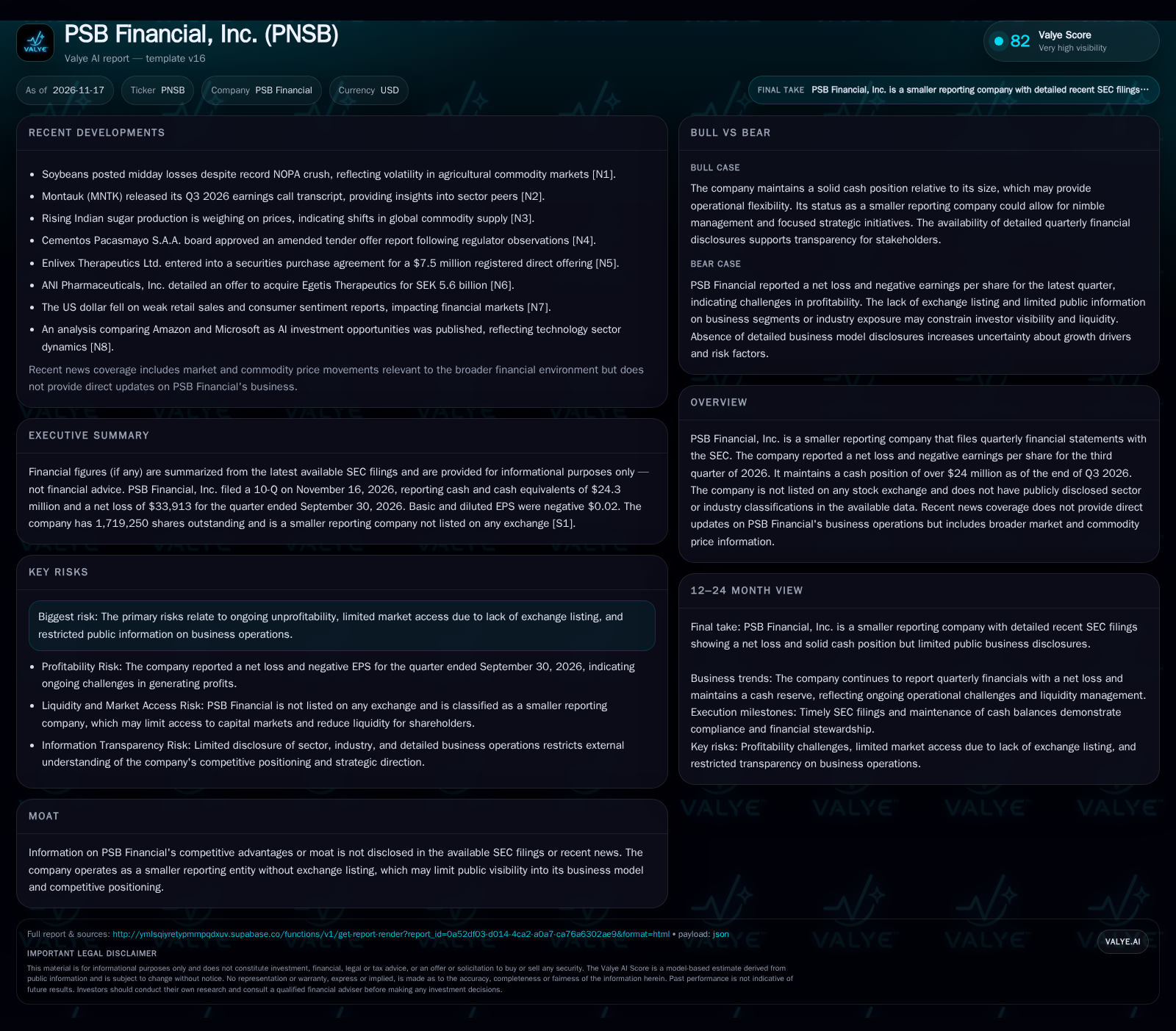
PSB Financial, Inc. reported a net loss of $33,913 for Q3 2026 and holds $24.3 million in cash. With no exchange listing and minimal disclosure about its business activities or industry focus, the company faces uncertainty regarding its ability to achieve sustainable profitability and attract capital or investor interest [S1].
PSB Financial, Inc. stands out for what it does not disclose as much as for what it reports. The company’s latest quarterly filing reveals a persistent net loss and a sizeable cash position, but offers little insight into its core business activities, sector exposure, or commercial strategy. Without an exchange listing or detailed public information, PSB Financial occupies a liminal position—financially solvent for now, but operationally and strategically opaque. This raises fundamental questions about its capacity to generate returns, withstand market shocks, and evolve beyond its current reporting status.
Recent Results Highlight Capital Preservation Amid Persistent Losses
PSB Financial, Inc. reported a net loss of $33,913 for the quarter ended September 30, 2026, with both basic and diluted earnings per share at negative $0.02. Despite these losses, the company retained $24,322,000 in cash and cash equivalents at quarter’s end [S1]. The company is not listed on any stock exchange and identifies as a smaller reporting company, with 1,719,250 shares outstanding as of November 16, 2026 [S1]. These facts are material because they frame PSB Financial’s near-term solvency and operational runway, but also underscore its ongoing struggle to achieve profitability and the lack of public market access that could otherwise facilitate capital raising or liquidity for shareholders.
Unclear Revenue Model and the Economics of Survival
With no disclosed sector or business model, PSB Financial’s economic mechanics are opaque. The reported net loss and negative EPS indicate that current revenues, if any, are insufficient to cover operating costs [S1]. The company’s sizable cash balance suggests prior capital accumulation or asset sales, but the absence of detail regarding revenue streams, cost structure, or asset base precludes analysis of operating leverage or margin potential. If PSB Financial operates in financial services, banking, or investment management—as the name may imply—typical revenue streams could include interest income, fees, or investment gains. However, without confirmation, it is equally plausible that the company holds legacy assets or is in a holding phase pending strategic redirection. The lack of exchange listing further complicates capital access and may constrain funding options to private placements or internal resources. Fixed costs could dominate if the company maintains a corporate infrastructure without active operations, while variable costs would be more relevant if it is engaged in transactional or fee-based business.
An additional layer of analysis involves considering the company’s capital efficiency and burn rate relative to its cash reserves. The company reported cash and liquidity metrics for the period; these figures do not by themselves establish operating runway, investment capacity, financial flexibility, or financing capacity. Conversely, if fixed costs are low and cash is held primarily for strategic investments or acquisitions, the company might sustain losses longer while positioning for future growth. Understanding the balance between cash preservation and investment deployment is critical in evaluating the sustainability of its current financial posture.
Furthermore, the absence of disclosed revenue streams complicates the assessment of scalability and operating leverage. If PSB Financial’s business model relies heavily on fixed costs, incremental revenue growth could lead to significant margin expansion. However, if revenues are volatile or dependent on one-time events such as asset sales, the path to profitability becomes more uncertain. A useful metric would be the ratio of recurring revenues to total revenues, which would help determine the stability and predictability of its income, as well as the company’s ability to plan and invest accordingly.
Strategic Invisibility: How Lack of Disclosure Impacts Competitive Standing
PSB Financial’s competitive position is difficult to assess due to the absence of sector, peer, or product-line disclosure [S1]. In typical financial sectors, advantages might derive from cost structure, customer relationships, or technology, but the company’s public filings do not reveal such differentiators. Its status as a smaller reporting company and lack of exchange listing could allow for operational nimbleness, but also means limited visibility to potential partners, customers, or investors. This opacity may be a disadvantage relative to peers with transparent, exchange-listed models, as it could hinder access to partnerships, customer trust, and efficient capital formation. Substitutes and competitive threats remain undefined; if PSB Financial operates in a commoditized segment, it may be vulnerable to larger, better-capitalized competitors. Conversely, if it is in a niche or wind-down phase, its risk profile would be different but equally opaque.
The strategic invisibility also has implications for talent acquisition and retention, which are often crucial for companies in financial services or asset management sectors. Without a clear market identity or growth narrative, attracting skilled professionals may be challenging, potentially limiting operational effectiveness and innovation. Moreover, partners and counterparties may hesitate to engage without transparency, reducing opportunities for collaboration or co-investment that could enhance competitive positioning. Thus, the lack of disclosure not only affects external perceptions but may also constrain internal capabilities necessary for long-term success.
Another dimension to consider is regulatory and compliance risk, which can be significant in financial sectors. The company’s minimal disclosure and lack of exchange listing could reflect a strategic choice to avoid certain regulatory burdens, but this may come at the cost of reduced credibility and investor confidence. Conversely, if the company operates in a lightly regulated niche or is transitioning between business phases, this opacity might be temporary. Monitoring regulatory filings and compliance-related disclosures would provide insight into whether the company’s strategic invisibility is sustainable or a potential source of future risk.
Unlocking Value Through Strategic Clarity and Business Model Activation
A favorable outcome for PSB Financial would likely require the articulation and execution of a clear commercial strategy that leverages its cash reserves. If the company were to disclose a defensible business model—such as a specialized lending platform, asset management, or even a plan to acquire operating businesses—it could use its cash to fund growth, attract partners, or re-rate its shares. Evidence confirming this scenario would include detailed public filings on business activities, sector focus, and forward-looking strategic plans, as well as the emergence of meaningful revenue growth or positive operating leverage. A falsification would be continued operational opacity, lack of new business disclosures, or persistent net losses despite cash deployment.
Ongoing Solvency Coupled with Strategic Drift
The most plausible near-term scenario is that PSB Financial continues to report quarterly net losses while maintaining its cash position, without significant change in business direction or market engagement. This path would be confirmed by continued filings that show modest cash burn, little or no revenue growth, and minimal change in corporate disclosures. The company may remain compliant and solvent for several quarters, but without strategic clarity or operational momentum, investor interest and valuation are likely to remain muted. Falsifying this scenario would require a clear shift—either a major business initiative, acquisition, sector disclosure, or a marked change in financial trajectory.
Erosion of reported cash balance Without Revenue Inflection
In a more adverse scenario, PSB Financial’s persistent net losses could accelerate, leading to a rapid depletion of its cash reserves. Without access to public equity markets or alternative capital sources, the company could face liquidity constraints, operational cutbacks, or even forced asset sales. This scenario would be confirmed by a sharp increase in quarterly losses, declining cash balances, or the emergence of negative working capital. Additional warning signs would include delayed or incomplete SEC filings, or disclosures indicating going-concern risks. The scenario could be falsified if the company stabilizes its cost base, finds new revenue streams, or secures external funding.
Testing PSB Financial’s Trajectory: What Could Shift the Thesis
Disclosure of core business activities, sector focus, or operating subsidiaries—would clarify revenue mechanics and risk profile.
Any material change in cash and cash equivalents across quarters—would signal either operational cash burn or capital deployment.
Emergence of meaningful revenue or fee income, if disclosed—would support a transition toward operational sustainability.
Quarterly net income or signs of operating leverage—would indicate improving business fundamentals.
Public announcement of strategic initiatives, acquisitions, or partnerships—would suggest a move toward business activation.
SEC filings indicating going-concern warnings, delayed reports, or auditor notes—would raise red flags about solvency.
Changes in share count or capital structure—could signal new fundraising or dilution risk.
Any intent to seek an exchange listing or broaden investor base—would be a positive signal for market access and valuation.
Disclaimer: This is research-only, informational analysis and not investment advice. It may include AI-generated interpretation and general industry context. Always verify important details using primary sources.

Comments