
Generation Income Properties: Net Lease Ambition Meets Liquidity and Compliance Pressures
The company’s focus on single-tenant triple-net assets and leadership expertise provide a potential edge, yet persistent capital constraints and legal distractions raise fundamental questions about its ability to scale and sustain operations.
Leadership changes and a pending legal proceeding involving the CEO add complexity. Sustainable improvement likely depends on successful asset sales, capital raises, or regaining stable compliance footing. [S2] [N1]
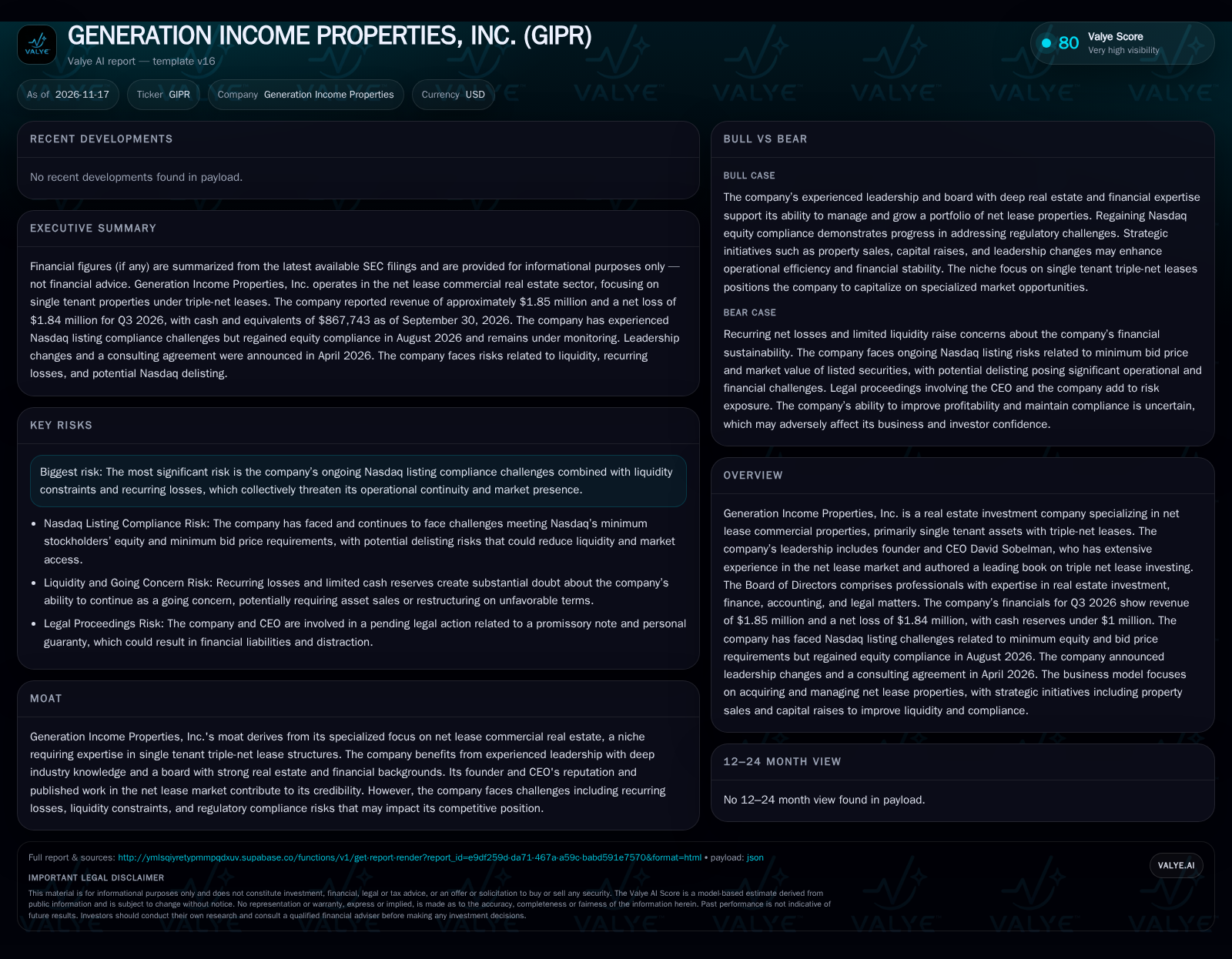
Generation Income Properties stands at a crossroads defined by its net lease commercial real estate focus and mounting operational headwinds. While the company leverages a leadership team with deep sector knowledge and a board versed in real estate and finance, persistent net losses and a cash position below $1 million raise material doubts about its capacity to weather near-term turbulence. Ongoing Nasdaq listing compliance issues and a pending legal dispute further complicate the outlook, making strategic execution—whether through asset sales, capital raises, or operational turnaround—critical to the company’s future viability. [S2] [N1]
Liquidity Constraints and Compliance Risks Shape the Current Operating Reality
Generation Income Properties reported $1,848,992 in revenue and a net loss of $1,841,501 for the quarter ended September 30, 2026, with cash and cash equivalents totaling $867,743 at quarter-end. These figures point to a business operating on a razor-thin liquidity margin, with recurring losses nearly matching top-line revenue. The company recently regained Nasdaq minimum equity compliance as of August 2026, but remains under a one-year panel monitor and faces unresolved risks related to minimum bid price and market value requirements. A legal proceeding over a $332,000 promissory note involving the CEO also remains pending, adding further uncertainty. Collectively, these factors frame a situation where near-term operational continuity may depend on successful execution of capital-raising or asset sale strategies. [S2] [N1]
How the Net Lease Model Could Deliver Earnings—And Where the Gaps Appear
Generation Income Properties’ business model centers on acquiring and holding single-tenant commercial properties under triple-net leases, where tenants bear the costs of maintenance, insurance, and taxes. In theory, this structure should create predictable rental income and limit operating expense volatility. However, given the company’s reported net loss nearly equal to its revenue, fixed costs—such as debt service, G&A, and potential property-level overhead—appear to be absorbing nearly all gross income. The absence of scale likely prevents meaningful operating leverage, as a small portfolio cannot spread corporate costs effectively.
Capital needs are inherent in this model: property acquisitions, periodic refinancing, and tenant turnover all require access to equity or debt markets. The company’s reported cash balance and recurring losses restrict its ability to invest in new properties without external funding. Asset sales could raise cash but may also reduce future income streams, especially if executed under duress. The triple-net format could theoretically produce stable cash flows if portfolio scale and financing terms are favorable, but current evidence suggests Generation Income Properties has not yet reached the necessary scale or cost efficiency for sustainable profitability. [S2]
Specialization in Single-Tenant Net Lease: Differentiation or Structural Disadvantage?
Generation Income Properties operates in a competitive landscape dominated by larger REITs and private investors with substantial portfolios, lower cost of capital, and greater access to property deal flow. The company’s focus on single-tenant, triple-net assets could enable it to target overlooked segments or less competitive geographies, leveraging management’s expertise to source and underwrite niche opportunities. The founder’s reputation in the net lease sector and the board’s industry background may help build credibility with brokers and potential sellers.
However, the company’s small size is a double-edged sword. Limited scale raises per-property transaction costs, constrains negotiating power, and can make portfolio diversification difficult, exposing the company to tenant-specific risks. With recurring losses and tight liquidity, Generation Income Properties may also be forced to compete on less favorable deal terms or accept higher cap rates, eroding returns. In the absence of a demonstrated sourcing advantage, the company risks being outbid by larger, more liquid players or relegated to higher-risk assets. [S2]
What a Successful Turnaround Could Look Like—And What Would Confirm It
If the company can demonstrate that it can recycle capital efficiently—selling lower-yield or non-core assets to fund higher-yield acquisitions—then operating leverage could improve, and recurring losses could narrow or reverse. Regaining and maintaining Nasdaq compliance would stabilize market access and potentially lower the cost of capital.
Confirmation of this scenario would require evidence of completed asset sales at favorable prices, a successful equity or debt raise that materially increases cash reserves, and sustained compliance with Nasdaq listing requirements. Improving net income margins and a growing, diversified property portfolio would further support the turnaround thesis. [S2] [N1]
Most Plausible Outcome: Ongoing Survival Mode, Incremental Progress, and Unresolved Risks
The most likely near-term scenario is that Generation Income Properties continues to operate with tight liquidity, seeking opportunistic asset sales and modest capital raises to address immediate cash needs and Nasdaq compliance threats. The company may be able to maintain operations and listing status through incremental progress—selling properties as needed, negotiating with lenders or investors, and making periodic compliance adjustments such as a reverse stock split. However, recurring losses and limited potential financial flexibility are likely to persist, preventing meaningful expansion or margin improvement.
This scenario would be confirmed by continued reporting of net losses, low cash balances, and periodic regulatory updates regarding Nasdaq compliance. Evidence against this scenario would include a dramatic improvement in profitability or a transformative capital raise that materially alters the company’s financial trajectory. [S2]
Liquidity Exhaustion, Delisting, and Forced Asset Sales: The Adverse Chain
If Generation Income Properties is unable to execute timely asset sales or capital raises, cash reserves could be depleted, triggering a liquidity crisis. In this scenario, the company could lose its Nasdaq listing due to persistent bid price or market value deficiencies, further restricting access to public markets and investor capital. Forced sales of properties at below-book values could ensue, eroding book equity and potentially breaching loan covenants. The pending legal matter involving the CEO could compound risk by diverting management attention or leading to additional liabilities.
Confirmation of this adverse scenario would include disclosures of asset sales at distressed prices, loss of Nasdaq listing, auditor going concern warnings escalating to material events, or rapid declines in cash balances without offsetting inflows. [S2]
Milestones That Will Determine Whether Generation Income Properties Can Reset Its Trajectory
Progress on asset sales, including disclosed sale prices versus book values and timing, would help gauge whether liquidity can be replenished without destroying long-term value.
Details and terms of any capital raise or refinancing—if disclosed—will indicate investor willingness to fund the company’s business model and on what terms.
Sustained Nasdaq compliance, particularly regarding minimum bid price and market value, will be essential for continued market access and investor confidence.
Quarterly net income or loss trends: persistent losses or narrowing deficits would reveal whether operational efficiency is improving or deteriorating.
Updates on the pending legal proceedings involving the CEO, including any settlements or judgments, will inform both financial exposure and management bandwidth.
Portfolio occupancy rates and tenant concentration—if disclosed—would help assess underlying property risk and cash flow stability.
Board and management turnover or further consulting agreements could signal either strategic renewal or instability, depending on context.
Disclaimer: This is research-only, informational analysis and not investment advice. It may include AI-generated interpretation and general industry context. Always verify important details using primary sources.

Comments