
Elauwit Connection’s Rental Community Focus: Rapid Revenue Growth, Financial Constraints, and the Challenge of Defensible Differentiation
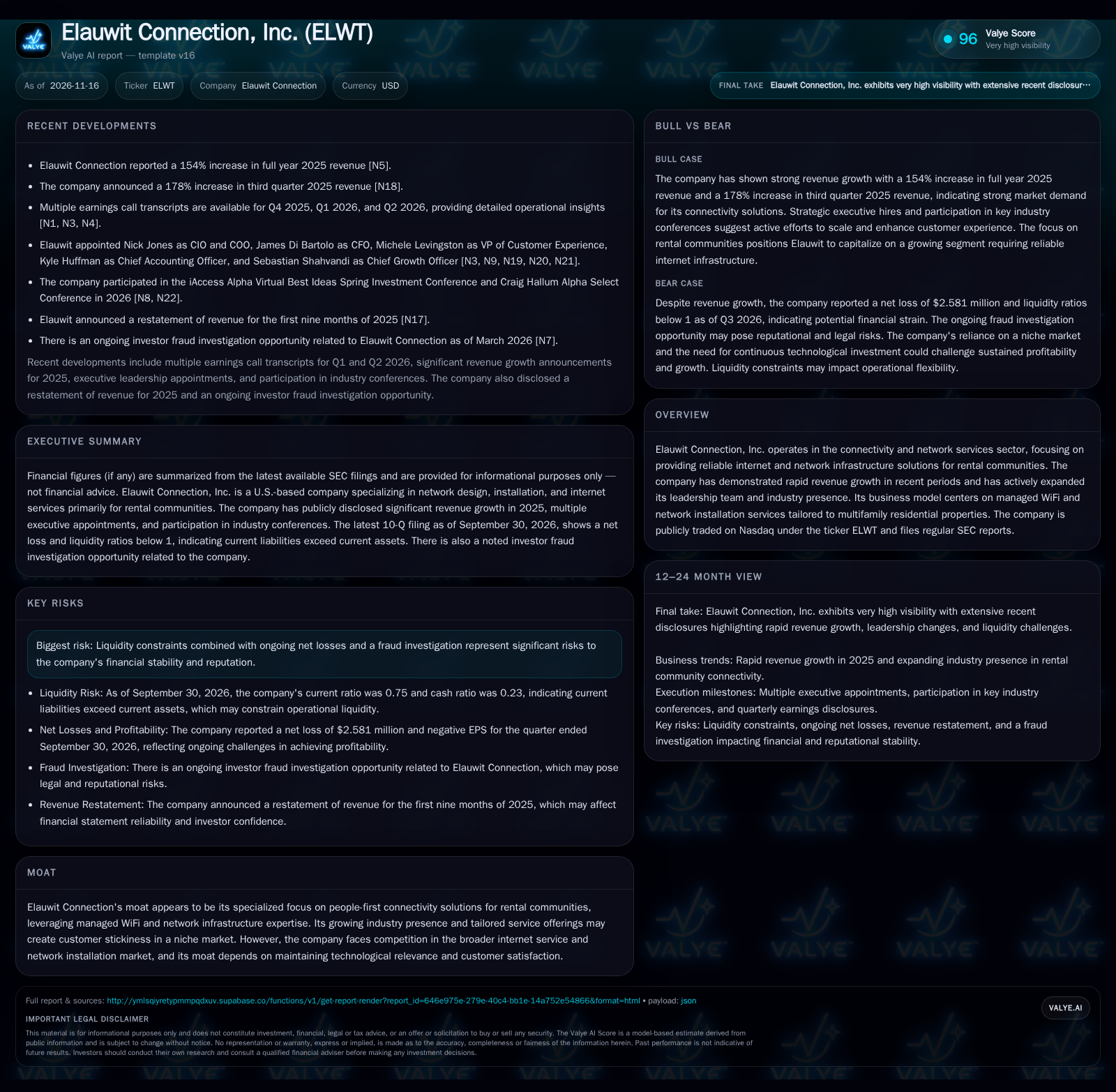
Elauwit Connection reported a 154% revenue surge in 2025, driven by its specialized managed WiFi and network solutions for rental communities, yet faces mounting net losses, a current ratio below 1, and a high-profile fraud investigation as of late 2026.
Elauwit Connection reported a 154% revenue surge in 2025, driven by its specialized managed WiFi and network solutions for rental communities, yet faces mounting net losses, a current ratio below 1, and a high-profile fraud investigation as of late 2026. The company’s ability to turn rapid top-line expansion into sustainable profitability is uncertain, with capital structure and market trust now critical to its forward trajectory. [S2] [N5] [N7]
Elauwit Connection, Inc. has carved out a niche in the U.S. connectivity landscape by specializing in managed WiFi and network infrastructure for rental communities—a market segment experiencing robust digital amenity demand. This focused strategy powered a dramatic 154% revenue increase in 2025, but the company’s Q3 2026 financials reveal persistent net losses and a current ratio below 1, raising questions about the sustainability of its growth. Meanwhile, an active investor fraud investigation clouds the company’s standing with both customers and capital providers, making the next phase of execution particularly high stakes. [S2] [N5] [N7]
Financial Momentum Meets Capital Pressure and Legal Scrutiny
Elauwit Connection’s standout fact is its 154% year-over-year revenue growth reported for full-year 2025, reflecting successful expansion in its chosen niche of network services for rental communities. However, as of September 30, 2026, the company’s balance sheet paints a less robust picture: cash and cash equivalents of $2.689 million, current assets of $8.784 million, and current liabilities of $11.679 million yield a current ratio of just 0.75 and a cash ratio of 0.23. This signals that short-term obligations outstrip available resources, introducing operational risk if new working capital is not secured. Compounding these challenges, Elauwit posted a net loss of $2.581 million and negative EPS for Q3 2026, and faces an ongoing investor fraud investigation as of March 2026—a potential overhang on both reputation and access to capital. [S2] [N5] [N7]
Revenue Drivers, Cost Structure, and the Profitability Hurdle
Elauwit’s business model revolves around designing, installing, and managing internet and network solutions for multifamily rental communities—typically under service contracts with property owners or managers. The company’s revenue mix likely combines one-time installation fees and recurring managed WiFi service charges, a structure that can generate attractive lifetime values if customer retention is strong. However, the sector is capital-intensive: upfront hardware costs, labor for installation, and ongoing support create a high fixed-cost base relative to the recurring service revenue, especially during rapid expansion phases.
Operating leverage can play both ways. If Elauwit achieves sufficient scale and customer density within targeted geographies, incremental gross margin from new contracts should improve, allowing overhead to be spread across a larger base. Conversely, if customer acquisition slows or churn rises, the company’s negative operating leverage—exacerbated by current net losses—could worsen. The company reported cash and liquidity metrics for the period; these figures do not by themselves establish operating runway, investment capacity, financial flexibility, or financing capacity.
Profitability hinges on the company’s ability to transition from rapid top-line growth to efficient scaling, with disciplined cost management and reliable cash conversion from contracts. Without reduction in unit delivery costs, increases in service pricing, or material improvement in customer lifetime value, persistent losses could lead to a liquidity crunch.
Defending a Niche: Specialization vs. Scale in PropTech Connectivity
Elauwit’s competitive angle lies in its focus on rental communities, where property owners prioritize differentiated digital amenities to attract and retain tenants. This specialization may offer some switching friction, as network installations can be embedded in building infrastructure, making it costly for property managers to switch providers mid-contract.
However, the broader connectivity and managed WiFi market is intensely competitive. Larger ISPs, regional telecoms, and other managed service providers can leverage greater scale, deeper balance sheets, and broader product portfolios to win contracts—especially for larger or multi-state property owners. Technology substitution risk also looms: advances in wireless broadband, 5G fixed wireless access, or property-level mesh networks could erode the value of bespoke installations.
Elauwit’s defensibility, therefore, depends on maintaining a technological edge, ensuring high service reliability, and fostering strong customer relationships. Without a clear, superior value proposition—such as faster installation, better uptime SLAs, or integrated smart-building features—the company’s niche focus may not be enough to ward off encroachment from larger players or new entrants.
From Top-Line Acceleration to Sustainable Scale: What Would Validate a Turnaround
A favorable scenario for Elauwit would see its rapid revenue growth translating into positive operating leverage and accelerating path to profitability. This could be achieved if customer acquisition costs decline through referrals or brand recognition, while churn remains low due to embedded infrastructure and high tenant satisfaction. Successful management of installation and support costs—potentially through process automation or vendor negotiations—would improve gross margins.
Confirmation would come from future quarters showing a narrowing net loss, a move towards or above a 1.0 current ratio (signaling improved liquidity), and evidence of recurring revenue growth outpacing increases in operating expenses. Announcements of multi-year contract renewals, expanded property portfolios, or successful cross-sell of value-added services (e.g., smart home integrations) would further support the bullish case.
Falsification would come if, despite top-line growth, losses persist or widen, liquidity deteriorates further, or customer retention rates fall—suggesting that scale is not delivering the expected economic benefits.
Managing Growth Under Financial Constraints: The Most Likely Trajectory
The most plausible near-term scenario is that Elauwit continues to grow its revenue base but remains under financial strain, with negative cash flow and ongoing net losses. The company may need to pursue bridge financing, renegotiate payment terms with suppliers, or seek equity infusions to support operations. Operationally, management could prioritize higher-margin contracts or focus on geographies with the densest customer clusters to improve per-unit economics.
The company’s reputation and customer acquisition could be hampered by news flow around the fraud investigation, even as it continues to participate in industry conferences and pursue new contracts. Incremental improvements in current and cash ratios, narrowing quarterly net losses, and evidence of successful contract renewals would confirm that management is executing a disciplined turnaround. Conversely, further deterioration in liquidity metrics, missed payments, or loss of major customers would challenge this base case.
Liquidity Squeeze and Erosion of Trust: How Adverse Dynamics Could Unfold
A negative scenario could see Elauwit’s liquidity position worsening, forcing the company to delay payments, cut back on growth initiatives, or even face creditor action. If new funding is not secured, operational disruptions could ensue—jeopardizing service delivery and reputation with property owners.
The ongoing fraud investigation could escalate, resulting in legal costs, management distraction, or regulatory penalties, further damaging credibility with both customers and investors. In this scenario, competitive pressure intensifies as larger or better-funded rivals win away key contracts, and Elauwit’s niche focus becomes a liability rather than a moat. Confirmation would come from further declines in liquidity ratios, a sharp rise in net losses, customer attrition, or adverse legal outcomes.
Milestones That Will Shape Elauwit Connection’s Business Model Viability
Quarterly trends in net loss and operating cash flow: A move towards breakeven or positive cash flow would signal improved business model sustainability.
Changes in current and cash ratios: Any improvement above 1.0 would suggest reduced liquidity risk; further declines would heighten distress signals.
Customer retention and contract renewal rates (if disclosed): High renewal rates would validate the stickiness of Elauwit’s service model.
Resolution or escalation of the fraud investigation: Legal or regulatory outcomes could materially alter capital access and brand trust.
Gross margin progression: Higher margins, especially in the recurring services component, would indicate better cost control and pricing power.
New funding events or debt restructuring: Securing additional capital on favorable terms would extend the company’s financial runway.
Announcement of major contract wins or losses: Large new deployments or the loss of anchor customers would directly impact revenue visibility and competitive standing.
Expansion into new service lines or geographies: Evidence of successful cross-sell or entry into adjacent markets would signal the potential for broader growth.
Disclaimer: This is research-only, informational analysis and not investment advice. It may include AI-generated interpretation and general industry context. Always verify important details using primary sources.

Comments