
Tenon Medical: Portfolio Expansion, Market Penetration Hurdles, and the SI Joint Fusion Opportunity
Tenon Medical is advancing a differentiated suite of minimally invasive SI joint fusion systems in a largely untapped market, but faces persistent net losses, capital needs, and execution risks as it seeks to scale physician adoption and regain Nasdaq compliance.
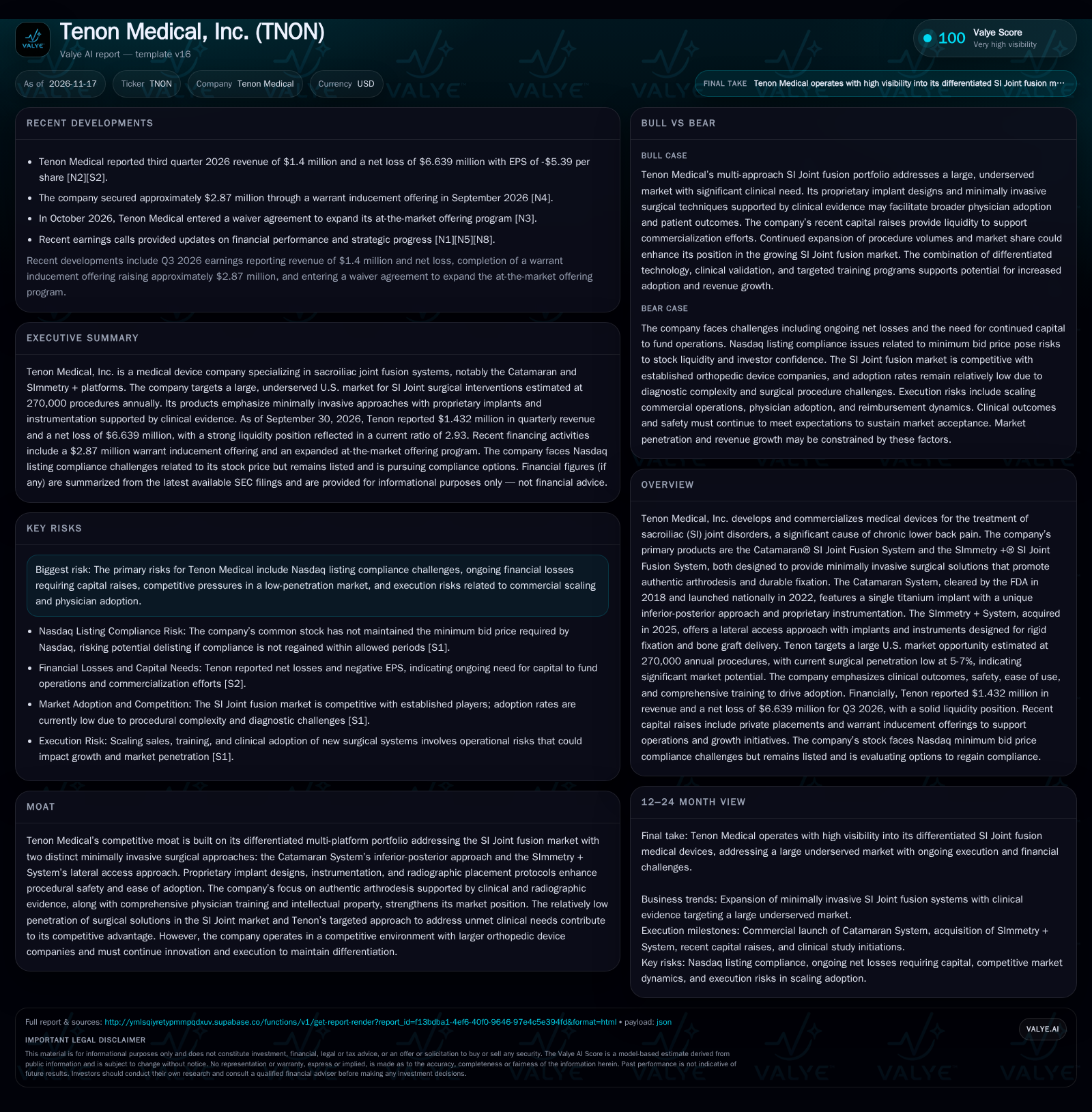
Tenon Medical’s Q3 2026 snapshot shows a broadened SI joint fusion portfolio and new capital raised, targeting a $2.1 billion U.S. market with low surgical penetration. Despite clinical validation and proprietary technology, ongoing losses and listing compliance issues highlight the hurdles to scalable, profitable growth. Execution on adoption, reimbursement, and commercial scaling will be critical.
Tenon Medical is navigating a pivotal phase as it scales a multi-platform SI joint fusion offering in a market with significant unmet clinical need. With the U.S. market for surgical SI joint interventions vastly underserved and Tenon’s technology portfolio recently broadened by acquisition, the company is positioned to address both primary and revision procedures. Yet, persistent net losses, ongoing capital requirements, and stock listing pressures underscore the challenge of converting clinical and technological differentiation into durable commercial traction. The next year will test whether Tenon’s strategy can drive meaningful market penetration, physician adoption, and financial sustainability.
Recent Portfolio Expansion and Financial Realities Define Tenon’s Near-Term Position
Tenon Medical’s Q3 2026 results highlight both its broadened product suite and the ongoing financial pressures of commercializing in a low-penetration market. The company reported $1.432 million in quarterly revenue and a net loss of $6.639 million, underscoring the gap between early sales and the scale needed for profitability [S2]. The company reported cash and liquidity metrics for the period; these figures do not by themselves establish operating runway, investment capacity, financial flexibility, or financing capacity. [S2] [N3] [N4] The acquisition of the SImmetry +® SI Joint Fusion System in August 2025 has expanded Tenon’s addressable procedures and improved its clinical offering [S1]. However, the company’s common stock continues to face Nasdaq minimum bid price compliance challenges, introducing an external risk to investor sentiment and potential capital access [S1].
Commercial Model: Procedure-Driven Revenue in a Capital-Intensive Market
Tenon Medical’s economics are tied directly to the volume of SI joint fusion procedures performed using its proprietary systems. The company’s revenue is primarily generated from sales of implants and associated surgical instrumentation, with procedure growth dependent on physician adoption, clinical evidence, and reimbursement access. Pricing in the U.S. SI joint fusion market tends to reflect both the complexity of the implants and the value attributed to minimally invasive techniques, but is often constrained by payer reimbursement rates and hospital purchasing dynamics.
Operating leverage is challenged by the need for a dedicated sales force, physician training programs, ongoing clinical studies, and post-acquisition integration costs. The capital intensity of building market presence—especially against entrenched orthopedic device competitors—means Tenon must sustain significant operating expenses relative to its current revenue base. While gross margins in medical devices can be high once scale is achieved, Tenon’s persistent net losses point to insufficient revenue to absorb fixed costs, a dynamic common for early-stage medtech commercializers.
Future economic improvement will depend on procedure volume growth, efficiency in sales and marketing, and a shift from one-time capital raises toward internally funded operations. The company’s balance sheet as of Q3 2026, while providing short-term liquidity, does not yet support self-sustained scaling without further capital infusion [S2].
Differentiation in a Crowded SI Joint Fusion Landscape
Tenon Medical’s competitive posture is shaped by a multi-platform portfolio with distinct surgical access options—the inferior-posterior Catamaran® and the lateral SImmetry +® systems—supported by proprietary instrumentation and radiographic protocols [S1]. This product breadth aims to meet diverse surgeon preferences and patient anatomies, which could help the company win share in a market where adoption barriers remain high.
The company faces competition from established orthopedic device manufacturers, many of whom offer their own minimally invasive SI joint fusion solutions. Key differentiators in this space include clinical outcomes (pain reduction, fusion rates), ease of adoption for surgeons, procedural safety, and the strength of supporting clinical evidence. Tenon’s emphasis on authentic bone fusion, comprehensive physician training, and proprietary approaches could enable it to carve out a niche, but larger competitors benefit from broader sales infrastructure, established hospital relationships, and more robust reimbursement support.
Switching costs for surgeons can be moderate to high, given the time investment in learning new techniques and the risks of clinical variability. However, meaningful competitive advantage will require Tenon to demonstrate superior or at least equivalent outcomes, simplified workflow, and consistent reimbursement access.
If Clinical Validation and Commercial Execution Converge
The most favorable scenario for Tenon Medical is one in which its differentiated SI joint fusion systems gain traction through a combination of compelling clinical outcomes, successful physician training, and expanded payer acceptance. If post-acquisition integration of SImmetry +® proceeds smoothly and Tenon’s clinical evidence continues to show superior pain relief, patient satisfaction, and fusion rates, the company could accelerate surgeon adoption and drive a higher share of the estimated 270,000 annual U.S. SI joint procedures [S1].
This upside would likely be confirmed by a rapid increase in procedure volumes, improving gross margins, and a narrowing of operating losses. Additional signals would include new or expanded reimbursement coverage, positive updates from ongoing or new clinical trials, and partnerships or endorsements from key opinion leaders in orthopedics. A successful resolution of Nasdaq listing compliance would further support investor confidence and facilitate future capital raising if needed.
Falsification of this scenario would come from stagnating procedure growth, negative clinical data, or inability to convert training into sustained surgeon utilization.
Incremental Adoption Amid Persistent Operating Losses
The most plausible trajectory for Tenon Medical over the next 12-24 months is gradual progress in expanding its installed base and surgeon network, but with continued net losses and reliance on periodic capital raises. Procedure volumes may grow as the market for SI joint fusion slowly expands and as the benefits of Tenon’s two-pronged portfolio become more widely recognized. However, the pace of adoption is likely to be constrained by the complexity of diagnosing SI joint dysfunction, the time required to train and convert new surgeons, and the inertia of established hospital purchasing patterns.
In this scenario, Tenon’s revenue base expands modestly, but R&D, sales, and support costs remain high relative to scale.
Commercial Traction Falters and Capital Constraints Intensify
A negative outcome for Tenon Medical could result from weak commercial uptake of its SI joint fusion systems, either due to lackluster clinical results, insufficient differentiation, or entrenched competition. If procedure growth stalls and the company fails to achieve meaningful market penetration, fixed operating costs would become harder to cover, accelerating cash burn and increasing the likelihood of dilutive financings or cost-cutting measures.
Exacerbating this scenario would be a loss of Nasdaq listing status, which could restrict access to capital markets and further erode investor confidence. Other confirming signs would include negative updates from clinical studies, delays in reimbursement approvals, or loss of key sales personnel. If new capital cannot be raised on acceptable terms, Tenon may be forced to scale back operations, seek strategic alternatives, or face insolvency risk.
Milestones That Will Validate or Challenge Tenon’s SI Joint Fusion Strategy
Quarterly procedure volume growth for Catamaran® and SImmetry +® systems—if disclosed—would directly measure commercial adoption momentum.
Gross margin trends, which would indicate whether increased scale or product mix is driving improved economics.
Updates on Nasdaq minimum bid price compliance and any actions taken to maintain listing status.
Progress in expanding reimbursement coverage or payer acceptance for SI joint fusion procedures.
Clinical trial results or peer-reviewed publications confirming real-world outcomes for Tenon’s systems.
Sales force expansion metrics and the number of surgeons trained and actively utilizing Tenon’s platforms.
Cash burn rate and timing or terms of future capital raises, as indicators of financial sustainability.
Integration milestones for SImmetry +®, including cross-selling success and operational synergies, if disclosed.
Disclaimer: This is research-only, informational analysis and not investment advice. It may include AI-generated interpretation and general industry context. Always verify important details using primary sources.

Comments