
Venu Holding Corp: Capital-Intensive Ambitions Collide with Acute Liquidity Strain in Live Entertainment
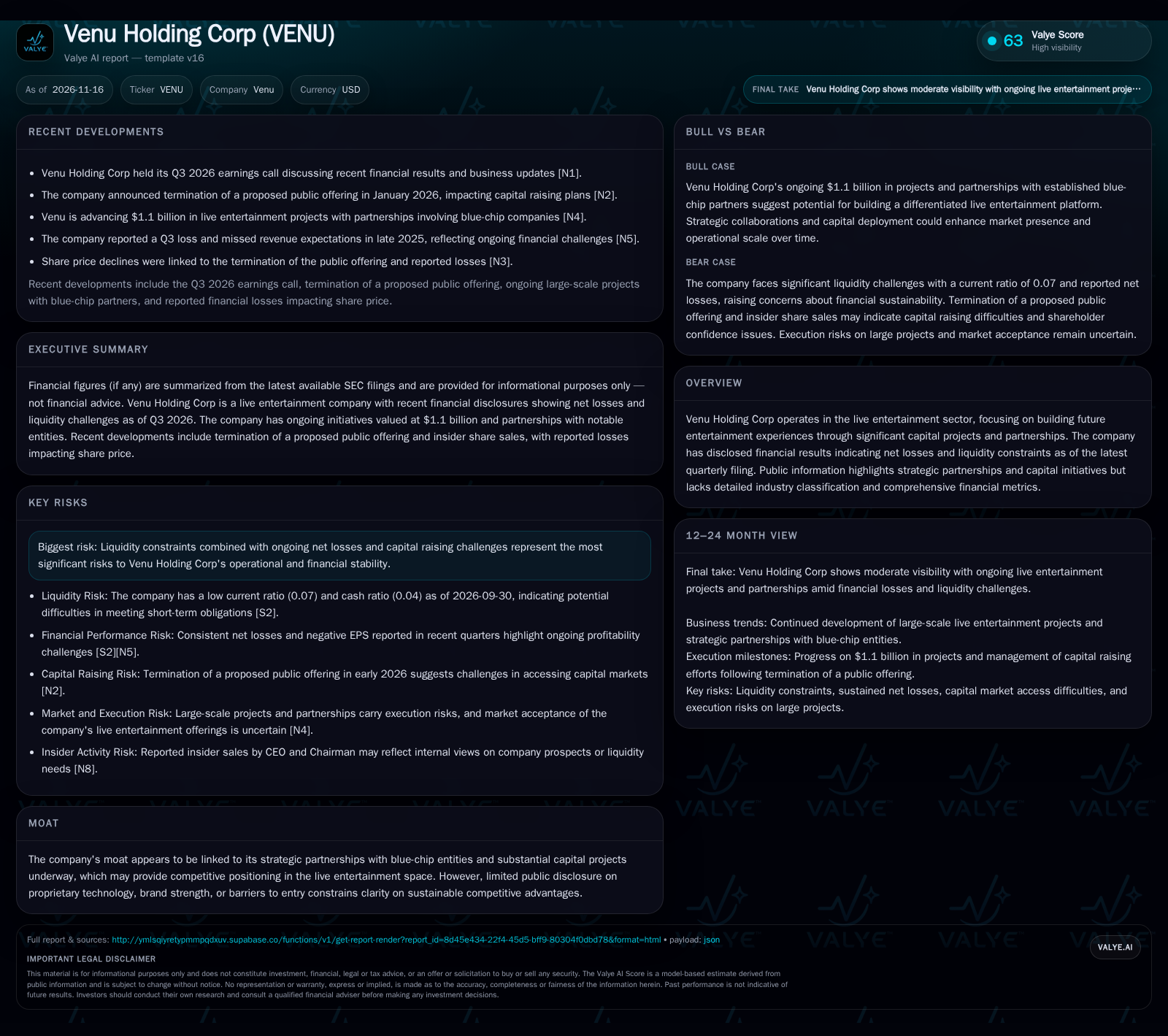
Venu Holding Corp is developing $1.1 billion in live entertainment projects with blue-chip partners, aiming to reshape the sector.
Venu Holding Corp is developing $1.1 billion in live entertainment projects with blue-chip partners, aiming to reshape the sector. The company’s ability to deliver on its ambitious vision will depend on near-term capital access, project execution, and market acceptance, all of which remain highly uncertain. [S2] [N4]
Venu Holding Corp is positioning itself as a next-generation live entertainment platform developer, leveraging high-profile partnerships and a $1.1 billion project pipeline to stake a claim in a crowded, evolving industry. Whether Venu can bridge this funding gap and deliver on its capital-intensive vision will define its trajectory over the next year. [S2] [N4]
Liquidity Crisis and Project Ambition Define the Present
Venu Holding Corp’s current situation is marked by two powerful, opposing forces. On one hand, the company is advancing $1.1 billion in live entertainment projects and has announced partnerships with blue-chip entities and celebrities such as Troy Aikman and Eight Light Lager, signaling ambitions to build a differentiated entertainment platform. [N4] On the other, Venu’s Q3 2026 financials reveal a net loss of $12.5 million, cash and equivalents of just $4.9 million, and current liabilities of $118.8 million—producing a cash ratio of 0.04 and a current ratio of 0.07. The company reported cash and liquidity metrics for the period; these figures do not by themselves establish operating runway, investment capacity, financial flexibility, or financing capacity. [S2] The early 2026 termination of a proposed public offering further underscores challenges in accessing new capital. [N2]
Capital Intensity and Unproven Revenue Model Shape Economic Outcomes
Venu’s business model revolves around developing and operating large-scale live entertainment experiences—an inherently capital-intensive proposition. The $1.1 billion in initiatives suggests a blend of venue development, event production, and possibly digital or hybrid experiences, but public disclosures do not clarify whether Venu earns revenue through ticket sales, event management fees, real estate leasing, brand partnerships, or recurring platform services. If the company is building or operating physical venues, it faces substantial upfront capex, long lead times, and high fixed costs, which can drive operating leverage but create acute vulnerability if early utilization or demand falls short. Variable costs may include event-specific production, talent, and marketing, while fixed overhead will be significant given the scale of projects described.
Revenue for the quarter ending March 2025 was just $718,722, reflecting an early-stage or small operating base relative to the investment narrative. [S2] This gap between revenue and investment outlay means Venu is likely dependent on continued external financing until projects mature and begin generating cash flows. If the company can secure sufficient funding and achieve high venue utilization, margins could eventually expand due to fixed-cost leverage. Conversely, delays or weak demand would exacerbate losses and liquidity stress. The economics of any platform or technology layer—such as digital ticketing, proprietary content, or loyalty programs—remain speculative without further disclosure.
The capital-intensive nature of large-scale live entertainment projects inherently introduces a high degree of operational leverage, meaning that fixed costs remain substantial regardless of revenue fluctuations. This leverage can amplify profitability once scale and utilization thresholds are met but conversely can exacerbate losses during ramp-up phases or demand shortfalls. Given the nascent revenue base, the company’s burn rate is likely elevated, necessitating continual capital injections. Moreover, the absence of disclosed recurring revenue streams suggests limited ability to smooth cash flows over time, increasing exposure to cyclical demand patterns and event-specific risks. Should Venu develop proprietary technology or platform services, these could provide higher-margin, scalable income streams that mitigate capital intensity, but such diversification remains speculative without further detail.
Can Strategic Partnerships Offset Sectoral Barriers and Intense Rivalry?
Venu’s claim to competitive differentiation rests on its blue-chip partnerships and ability to marshal large-scale capital for new entertainment concepts. In live entertainment, brand partnerships, celebrity endorsements, and exclusive content can drive traffic and pricing power, but established players—venue operators, event promoters, sports franchises, and digital streaming entrants—command deep relationships, existing infrastructure, and significant marketing reach. Incumbents may also benefit from economies of scale and proven operating models.
Without evidence of proprietary technology, exclusive rights, or a unique format, Venu’s moat appears to hinge on its ability to execute faster, partner more credibly, or innovate in ways incumbents cannot easily match. The risk is that capital and partnership access alone may not overcome entrenched audience habits, regulatory hurdles, or the scale advantages of existing entertainment giants. Execution complexity and market fragmentation could dilute the impact of even well-funded new entrants.
Strategic partnerships may provide Venu with initial market credibility and access to audiences, but sustaining competitive advantage will require more than brand association. The live entertainment sector is characterized by high customer acquisition costs and rapidly shifting consumer preferences, which can erode first-mover advantages. Additionally, incumbents benefit from entrenched supplier networks, regulatory familiarity, and established sales channels, creating significant barriers to entry. Venu’s ability to innovate in event formats or integrate digital engagement tools could differentiate its offerings, but such innovation demands both capital and organizational agility. The company’s success will thus depend on its capacity to execute complex projects efficiently while continuously adapting to evolving market dynamics and competitive responses.
Delivering on the $1.1 Billion Vision: What Would Unlock a Step-Change?
The most favorable outcome for Venu would involve successful completion and launch of key projects, rapid audience adoption, and the emergence of high-margin recurring revenue streams—potentially through exclusive experiences, digital engagement, or value-added services. If Venu’s partnerships translate into marquee events or venues with strong brand pull, the company could achieve premium pricing, fill rates, and cross-platform monetization. Evidence that would support this scenario includes rapid revenue growth outpacing cost increases, third-party validation of project milestones, successful access to non-dilutive funding (such as project financing or JV capital), and signed long-term deals with major partners or anchor tenants.
Falsification of this scenario would come from continued revenue stagnation, project delays, or inability to secure additional funding, as well as lack of evidence for recurring or high-margin revenue streams.
Navigating Capital Scarcity and Execution Risk Amid Industry Flux
The most plausible near-term trajectory is one where Venu struggles to advance major projects at the intended pace due to liquidity constraints, and is forced to prioritize, delay, or scale back initiatives while seeking additional capital through asset sales, joint ventures, or dilutive equity. Revenues may remain modest relative to project size, while fixed costs and interest expenses persist. Partnerships could help keep some projects alive, but the company may face ongoing trade-offs between growth, cash preservation, and control.
Confirmation of this scenario would be continued low revenue growth, further financing attempts (including asset sales or JV deals), and updates indicating project reprioritization or delayed timelines. Falsification would require a step-change in external funding, clear acceleration of project execution, or evidence of rapid revenue and margin expansion.
Acute Liquidity Shortfall Triggers Restructuring or Asset Liquidation
Given the current ratio of 0.07 and cash ratio of 0.04, even minor disruptions could trigger creditor actions or distressed asset sales. This scenario could also see key partners withdraw or renegotiate terms, with reputational damage compounding operational setbacks.
Indicators for this scenario would include missed payments, legal filings, accelerated asset sales, or public disclosures of going-concern doubts. Conversely, successful near-term capital raises or forbearance agreements would weaken this downside risk.
Milestones That Will Define Venu’s Ability to Realize Its Entertainment Ambition
Progress reports and third-party validation on the $1.1 billion project pipeline: Timely, credible updates would signal execution capability and market traction.
Details and terms of new or expanded partnerships—especially those involving revenue guarantees, co-investment, or anchor tenants—would help test the depth of commercial traction.
Announcements of non-dilutive financing, asset sales, or joint ventures: These would indicate management’s ability to creatively bridge funding gaps.
Revenue growth relative to project milestones: A useful metric would be revenue per project or per venue as new initiatives come online.
Disclosure of recurring revenue streams, if any: Evidence of subscription, membership, or platform-based income would support margin and resilience assumptions.
Any material legal, regulatory, or creditor actions: These would signal acute financial distress or operational disruption.
Attrition or renegotiation of partnerships: Early withdrawals or revised terms by blue-chip partners would be a warning sign for future project viability.
Disclaimer: This is research-only, informational analysis and not investment advice. It may include AI-generated interpretation and general industry context. Always verify important details using primary sources.

Comments