
Xtant Medical: Strategic Review, Revenue Volatility, and the Search for Sustainable Orthobiologics Growth
Xtant Medical faces a pivotal period defined by a Board-led strategic review, revenue headwinds from reimbursement shifts, and restrictive debt covenants. The company’s future hinges on its ability to deepen core orthobiologics penetration and stabilize cash flows amid competitive and financial pressures.
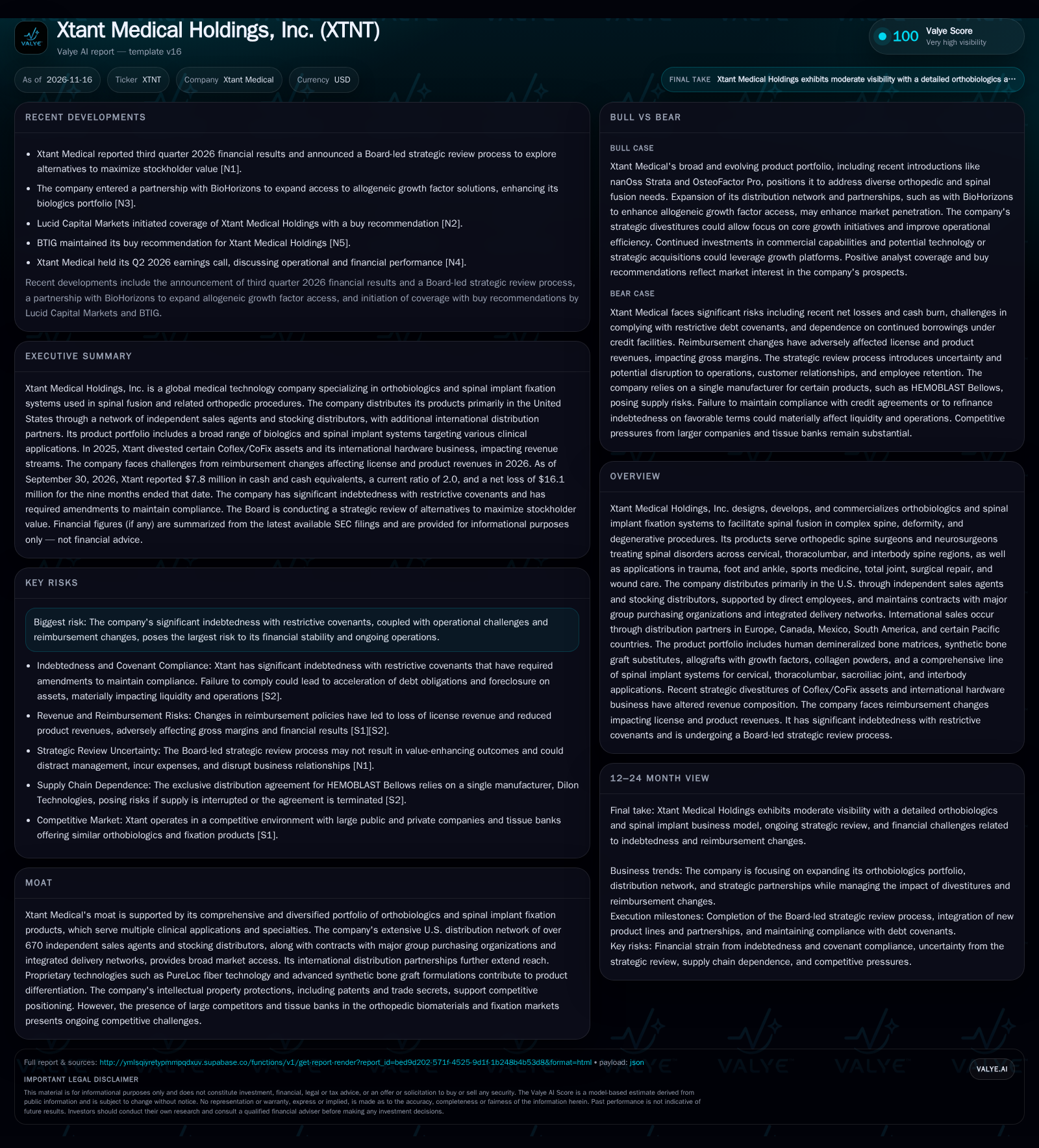
Xtant Medical is navigating a challenging inflection point: the company has divested non-core assets, faces reimbursement-driven revenue declines, and remains constrained by debt covenants that have required recent amendments. A Board-led strategic review is underway, introducing both the prospect of corporate change and operational uncertainty. The company’s prospects rest on its ability to strengthen its orthobiologics and spine hardware business, capitalize on recent partnerships, and restore revenue and margin stability despite intensifying competition and capital structure limits. [S1] [S2] [N1] [N3]
Xtant Medical Holdings stands at a crossroads. Once diversified across hardware and biologics, the company has now doubled down on its core orthobiologics and spine fixation systems after recent asset sales and faces a new revenue reality following reimbursement changes that erased a significant license stream. Debt covenants have forced operational discipline but also limited flexibility, and recurring amendments hint at persistent strain. As the Board pursues strategic alternatives—including possible sale, merger, or restructuring—Xtant’s ability to drive sustainable growth in its remaining portfolio, while managing execution risks from new partnerships and an evolving sales model, will determine whether it can reestablish stability or faces further disruption.
Recent Divestitures, Revenue Disruptions, and Strategic Review Define the Landscape
Xtant Medical’s business fundamentals have shifted markedly over the past year. In 2025, the company divested its Coflex/CoFix assets and international hardware business, generating $21.4 million in proceeds but also narrowing its revenue base. Compounding this, $18.7 million in license revenue recognized in 2025 is not expected to recur in 2026 due to reimbursement changes, removing a high-margin stream and contributing to pressure on gross margins and cash flows. [S1]
As of September 30, 2026, Xtant reported $7.793 million in cash and a net loss of $16.1 million for the first nine months of the year, with negative operating cash flow of $10.3 million. The company’s credit agreements require minimum liquidity and revenue levels, but Xtant has experienced difficulty complying, necessitating amendments in March and August 2026. [S2]
A Board-led strategic review is underway, with the stated goal of maximizing stockholder value. While such reviews can open the door to transformative transactions, they also introduce uncertainty and may distract management or disrupt business relationships. [N1]
Orthobiologics as the Core Profit Engine—Volume, Mix, and Margin Levers
Xtant’s business model is now centered on the commercialization of orthobiologics and spinal implant fixation systems. These products are typically sold to orthopedic spine surgeons and neurosurgeons treating a range of spinal disorders and related orthopedic indications. Revenue is generated through a combination of direct sales (via a large network of independent agents and stocking distributors) and GPO/IDN contracts that provide access to hospital and surgical center customers. [S1]
Economically, orthobiologics and spinal hardware often present a mix of high gross margin (for differentiated or proprietary biologics) and competitive pricing pressure (especially for commodity or undifferentiated implants). The loss of recurring license revenue due to reimbursement changes has reduced both revenue predictability and margin mix, as these streams often carried higher margins than product sales. [S1] [S2]
Operating leverage is limited by the need for a substantial salesforce and clinical support infrastructure, as well as increasing sales and marketing spend following the Dilon Technologies agreement (which involved hiring approximately 20 new sales personnel and a $5 million exclusivity fee write-off). The business remains capital-intensive, with working capital requirements and restricted access to additional debt under existing covenants. [S2]
Cash burn and net losses highlight the challenge of achieving scale and efficiency—particularly as new partnerships and product launches require upfront investment before revenue contributions are proven.
Distribution Depth, Product Breadth, and the Challenge of Scale in a Crowded Market
Xtant’s competitive position is rooted in its broad orthobiologics and spine hardware portfolio, which spans demineralized bone matrices, synthetic grafts, allografts, and a full suite of fixation systems. The company’s U.S. distribution network—over 670 independent sales agents and stocking agents—provides reach, but not necessarily exclusivity or high switching costs. [S1]
Contracts with major GPOs (Vizient, Premier, HealthTrust) and access to IDNs are significant for market entry, but these channels are also accessible to large competitors and tissue banks, limiting pricing power. Proprietary technologies (such as PureLoc fiber and nanOss synthetic bone grafts) offer some differentiation, but the market is crowded with larger, better-capitalized orthopedic device companies and non-profit tissue banks.
Recent partnerships, such as the BioHorizons alliance to expand allogeneic growth factor access, may help broaden the clinical and commercial footprint. However, execution risk remains high: integration, channel conflict, and the ability to drive surgeon adoption are persistent challenges. Competitive pressure is likely to keep margins in check unless Xtant can demonstrate clear clinical or economic superiority.
Unlocking Value Through Strategic Transactions and Biologics Growth
A favorable outcome for Xtant would involve one or more of the following: a value-enhancing strategic transaction (sale, merger, or partnership) emerging from the Board-led review; successful integration and ramp of new biologics and hardware partnerships (such as with BioHorizons and Dilon Technologies); and stabilization or growth in core product revenues as new products offset lost license streams.
This upside scenario would likely be confirmed if: (1) the company announces a definitive strategic transaction at a premium to current equity values; (2) sequential revenue stabilization or growth becomes visible in quarterly results despite the loss of license revenue; (3) margin improvement is evident, suggesting higher mix of proprietary or higher-value biologics; and (4) the company maintains compliance with all debt covenants without further amendments or waivers.
Critical signals would include new GPO or IDN contract wins, expanded hospital or ASC penetration, and evidence of surgeon adoption of newly launched or partnered products.
Restructuring and Revenue Rebuild Amid Ongoing Margin Pressure
The most plausible near-term trajectory is a period of operational restructuring and commercial rebuilding, with Xtant focused on stabilizing its orthobiologics and hardware revenue base while navigating the constraints of its credit agreements. The company may continue to face negative operating cash flow and margin pressure as it absorbs the impact of lost license revenue and higher sales and marketing expenses from recent partnership launches.
Confirmation of this scenario would come from continued covenant amendments, modest sequential revenue stabilization (but not robust growth), and persistent net losses or cash burn. The strategic review may not result in a transformative transaction but could yield incremental changes, such as cost reductions, further asset sales, or new distribution agreements.
If disclosed, metrics such as salesforce productivity, hospital account wins, and product mix shift toward higher-margin biologics would help test whether the rebuild is gaining traction.
Liquidity Erosion, Covenant Breach, and Disruption from Failed Strategic Alternatives
The adverse scenario centers on continued revenue and margin decline, leading to breach of minimum liquidity or revenue covenants under Xtant’s debt agreements. This could force the company into distressed restructuring, asset sales at unfavorable terms, or even default proceedings. [S2]
Operationally, a failed or prolonged strategic review could distract management, disrupt key customer and supplier relationships, and impair employee retention. Integration or supply chain issues—particularly with sole-sourced products like HEMOBLAST Bellows—could exacerbate the situation.
Evidence for this scenario would include further amendments or waivers for covenant compliance, sharp drops in cash levels, missed product launches, or public disclosure of strategic review abandonment. A spike in customer attrition or distributor defections would also be a clear warning sign.
Milestones and Metrics That Will Determine Xtant’s Orthobiologics Trajectory
Quarterly revenue progression, particularly the ability to replace lost license revenue with biologics and hardware sales, will be a primary indicator of stabilization or further decline. [S1] [S2]
Gross margin trends—especially improvement from product mix or operational efficiency—would help validate whether new partnerships and portfolio focus are translating into sustainable economics.
Disclosure of new or expanded GPO/IDN contracts, or major hospital/ASC customer wins, would signal commercial traction.
Updates on the Board-led strategic review process, including any definitive transaction announcements or indications of process outcome, will be critical to the company’s future direction. [N1]
Covenant compliance status and any further need for amendments or waivers under the Term and Revolving Credit Facilities should be monitored closely for signs of financial strain. [S2]
Salesforce productivity metrics—such as revenue per independent agent or per territory (if disclosed)—would help assess the effectiveness of recent salesforce expansion and integration.
Product launch and adoption milestones for new offerings, notably HEMOBLAST Bellows and BioHorizons-enabled products, would shed light on the company’s ability to drive adoption and diversify revenue.
Disclaimer: This is research-only, informational analysis and not investment advice. It may include AI-generated interpretation and general industry context. Always verify important details using primary sources.

Comments