
Barrel Energy’s Operating Reality: Net Losses, Liquidity Strain, and the Unclear Path to Commercial Viability
The company’s limited disclosures and uncertain business model leave open fundamental questions about its ability to achieve operational stability or growth.
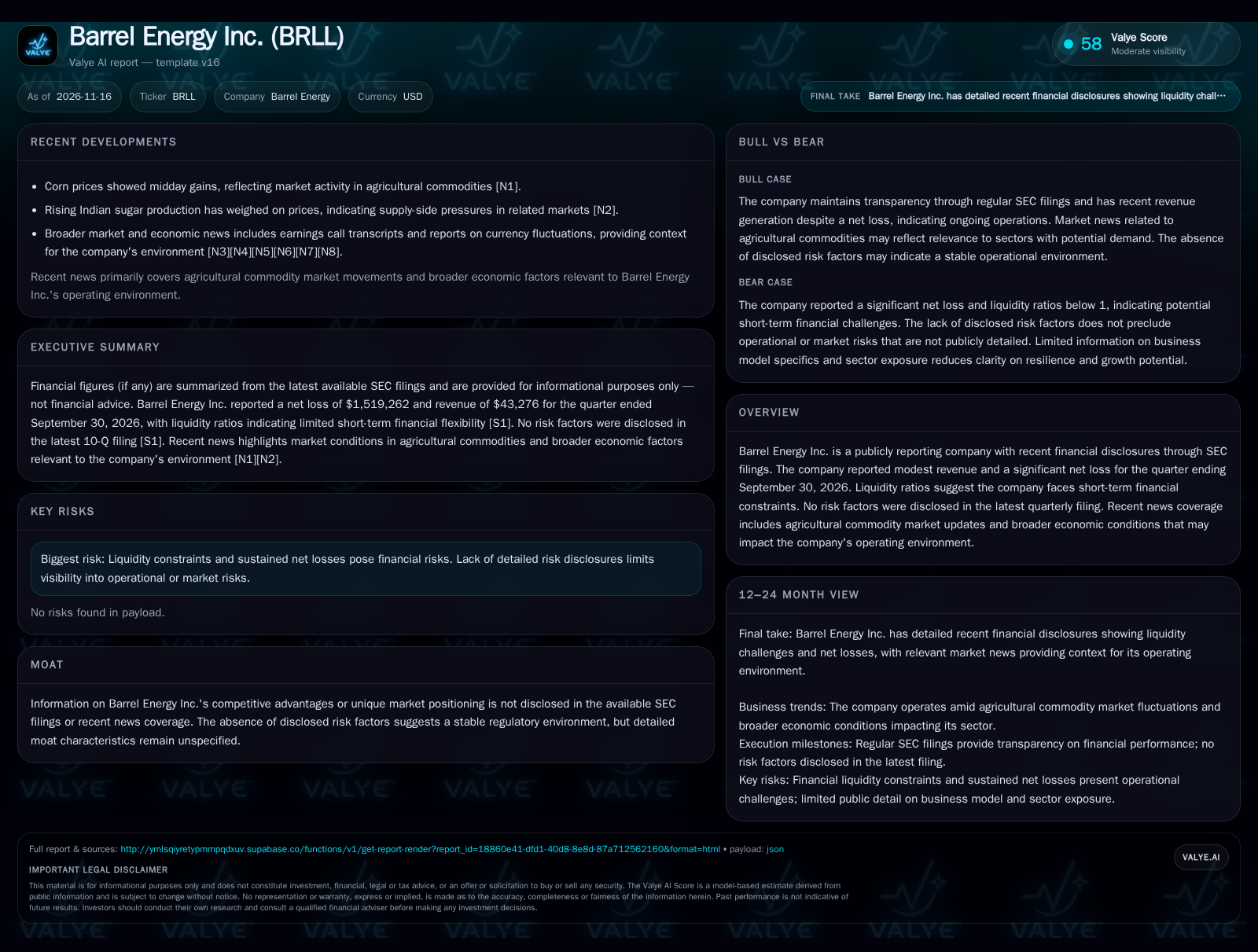
The absence of disclosed risk factors and scant business model detail complicate any assessment of the company’s prospects, leaving its path to sustainable operations highly uncertain. [S1]
The lack of disclosed risk factors and scant public detail on its business model or sector focus further clouds its outlook. Investors are left to interpret the company’s trajectory amidst significant uncertainty, with only regular SEC filings and commodity market news providing limited external context. [S1]
Latest Financials Paint a Bleak Short-Term Outlook
As of September 30, 2026, Barrel Energy Inc. reported $43,276 in revenue and a net loss of $1,519,262 for the quarter. The company’s current assets stood at $255,052, while current liabilities totaled $1,484,724, yielding a current ratio of just 0.17 and a cash ratio of zero. Notably, the company’s latest 10-Q disclosed no risk factors, offering no additional insight into management’s view of operational or market hazards. [S1]
Revenue Model and Cost Structure: The Missing Puzzle Pieces
With only $43,276 in revenue against over $1.5 million in net losses for the most recent quarter, Barrel Energy’s business economics are opaque and likely unfavorable. The available data suggests that the company’s cost base—whether fixed or variable—far exceeds its revenue-generating capacity. While the company’s name and related news coverage referencing agricultural commodities might imply involvement in sectors like biofuels, commodity trading, or energy-related agribusiness, there is no direct disclosure of its business model, pricing mechanisms, or customer types.
If the company is engaged in commodity-linked businesses, revenue volatility and thin margins are common, especially for small players lacking scale or proprietary advantages. High fixed costs, such as administrative expenses or legacy obligations, could drive persistent operating losses if not matched by substantial and recurring revenue streams.
A deeper understanding of Barrel Energy’s cost structure would be critical to evaluating its path to profitability. If a significant portion of costs are fixed, the company faces high operating leverage, meaning that incremental revenue growth could disproportionately improve margins once breakeven scale is reached. Conversely, if variable costs dominate, revenue growth might be more linear but could also be more sensitive to market price fluctuations or volume variability. Additionally, the presence of sunk costs or long-term contractual obligations could constrain management’s flexibility to adjust spending in response to revenue shortfalls, exacerbating liquidity pressures.
Competitive Standing: Undefined Amid Sector Uncertainty
Barrel Energy’s competitive positioning is indeterminate due to a lack of public detail on its core business activities, market focus, or customer relationships. If the company operates in energy or agricultural commodity markets, it would face entrenched competitors, price volatility, and exposure to regulatory shifts. Such sectors typically favor firms with scale, access to low-cost capital, proprietary technology, or established distribution networks—advantages for which there is no evidence in the current disclosures.
Without information on unique offerings, recurring contracts, or integrated value chains, it is difficult to argue for any sustainable moat. The absence of disclosed risk factors could reflect either a stable regulatory environment or a lack of detailed risk analysis, but does not itself confer competitive strength.
The company’s undefined competitive position also raises questions about barriers to entry and differentiation. In commodity-linked sectors, firms often compete primarily on cost efficiency, supply chain integration, or proprietary technology that reduces input costs or enhances product quality. Without evidence of such competitive advantages, Barrel Energy may be vulnerable to price competition and margin compression. Furthermore, the regulatory landscape in energy and agricultural commodities can impose compliance costs or create opportunities through subsidies or mandates; understanding how the company navigates these dynamics would be essential to assessing its resilience and strategic positioning.
What Would It Take for a Turnaround? Pathways to Revenue Scale or Strategic Capital
A favorable scenario for Barrel Energy would require a rapid and substantial improvement in revenue, either through the launch of a scalable product, the securing of long-term contracts, or a strategic pivot aligned with market demand—potentially in the agricultural or energy commodity space. This could be catalyzed by partnerships, technology licensing, or the acquisition of valuable assets. Securing external capital—whether through equity, debt, or strategic investment—would be essential to cover short-term obligations and fund growth initiatives.
Confirmation of this scenario would require clear disclosures of new commercial agreements, evidence of recurring or growing revenue, and announcements of successful capital raises. Conversely, an absence of such developments or continued minimal revenue would falsify the turnaround thesis.
Strategic partnerships could be a pivotal mechanism for Barrel Energy to accelerate its commercial development. Collaborations with established players might provide access to distribution channels, technical expertise, or market intelligence that the company currently lacks. Additionally, leveraging technology licensing agreements could enable Barrel Energy to monetize intellectual property without bearing the full cost of commercialization. However, such arrangements typically require demonstrable proof of concept or operational capability, which the company has yet to disclose. The timing and structure of external capital raises would also influence the company’s ability to execute growth initiatives and manage dilution risks.
Continued Cash Burn and Uncertain Viability Define the Probable Trajectory
Given the current financials and lack of operational transparency, the most plausible near-term scenario is that Barrel Energy continues to operate at a loss, with periodic attempts to raise capital or restructure obligations. Without a clear revenue engine or cost discipline, ongoing cash burn is likely to result in further dilution for existing shareholders or the necessity of asset sales and cost reductions. The company’s survival may depend on its ability to secure bridge financing or to identify a strategic partner willing to underwrite its next phase.
Evidence confirming this scenario would be continued reporting of low revenue, persistent net losses, and additional financing transactions. Falsification would require a step-change in revenue or a credible strategic transaction that materially alters the company’s cost and revenue profile.
Escalating Liquidity Pressure Could Force Restructuring or Asset Liquidation
The principal risk is that Barrel Energy’s acute liquidity shortage and sustained operating losses will culminate in insolvency, creditor action, or forced restructuring. Without access to new capital or a sudden swing in operating performance, the company may be compelled to sell assets, enter bankruptcy proceedings, or wind down operations. The lack of cash and the inability to cover current liabilities suggest that this scenario could develop rapidly if external financing is unavailable.
Indicators of this downside unfolding would include missed payments, going concern warnings in SEC filings, or announcements of restructuring advisors or bankruptcy proceedings. A sudden drop in disclosed assets or rapid turnover in executive leadership could also signal impending distress.
What Would Signal a Shift in Barrel Energy’s Trajectory?
Disclosure of new commercial agreements or long-term contracts that would provide recurring revenue and improve visibility into the company’s operating model.
Announcements of successful capital raises—equity, debt, or strategic investments—that materially increase liquidity and extend the company’s financial runway.
Quarterly trends in revenue growth, if disclosed, to assess whether the company is building commercial traction or continuing to stagnate.
Notices of debt restructuring, asset sales, or strategic transactions that alter the company’s balance sheet or cost structure.
Disclosure of going concern warnings or auditor notes regarding financial sustainability.
Changes in executive leadership or board composition, which could signal a strategic pivot or response to operational stress.
Detailed segment reporting or business model clarifications that would enable analysis of unit economics and competitive positioning.
Disclaimer: This is research-only, informational analysis and not investment advice. It may include AI-generated interpretation and general industry context. Always verify important details using primary sources.

Comments