
Xeriant’s Advanced Materials Ambition: Commercialization, Capital, and the Challenge of Market Entry
With its proprietary Durazite™ fire-retardant technology and eco-friendly NexBoard™ panels, Xeriant, Inc. aims to disrupt construction materials markets.
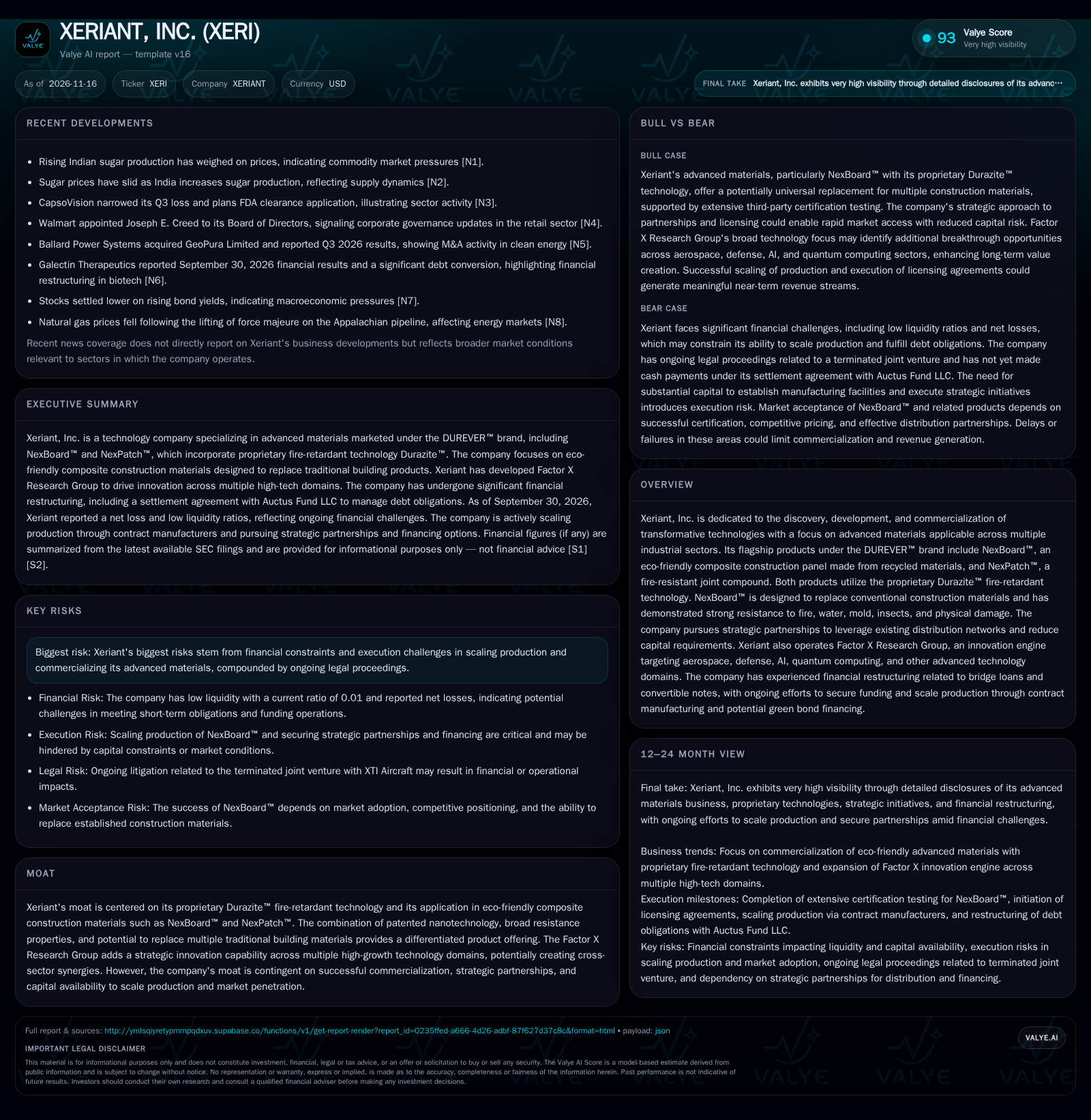
Xeriant, Inc. is developing advanced, eco-friendly construction materials with proprietary fire-retardant technology and has completed extensive certification testing for its NexBoard™ product. The company faces acute liquidity pressure, ongoing debt restructuring, and must secure strategic partnerships and external financing to commercialize its products and execute on its innovation pipeline. Execution risk is high, hinging on both capital access and market adoption [S1] [S2].
Xeriant, Inc. is positioning its advanced materials—most notably the fire- and moisture-resistant NexBoard™ panel—as eco-friendly replacements for legacy construction materials. Armed with Durazite™ technology and a completed certification gauntlet, the company stands on the verge of commercialization. Whether Xeriant can transition from R&D and certification to meaningful revenue and market share rests on its ability to overcome these intertwined operational and financial hurdles.
Recent Developments: Certification Success and Financial Strain Define the Outlook
Xeriant has completed 16 categories of third-party certification testing for NexBoard™, including fire, thermal, impact, mechanical, surface, indoor air quality, moisture, mold, and chemical resistance. This milestone positions NexBoard™ for both interior and exterior wallboard applications in standard sizes, supporting its ambition to replace drywall, plywood, and other conventional materials [S1].
Despite technical progress, Xeriant’s most recent financials show a current ratio of 0.01 and a net quarterly loss of $499,542 as of September 30, 2026. The company faces $4.99 million in current liabilities against just $39,255 in current assets, underscoring severe liquidity pressure [S2].
The company has not yet fulfilled cash payments under its debt settlement with Auctus Fund LLC, and is actively seeking additional funding, including green bond financing for manufacturing scale-up [S1].
Licensing agreements and revenue from NexBoard™ are anticipated to begin in Q4 2026, but as of the latest filings, no substantial commercial revenue has been recognized [S1].
How Xeriant’s Model Could Create Value—And Where Economic Friction May Arise
Xeriant’s core business model is predicated on monetizing proprietary materials technology—primarily the Durazite™-based NexBoard™ and NexPatch™—through a combination of direct product sales, licensing, and strategic partnerships. The use of contract manufacturers suggests a capital-light approach to scaling production, minimizing fixed overhead but potentially ceding some margin to manufacturing partners [S1].
If licensing becomes the primary revenue driver, Xeriant could benefit from high-margin, recurring income streams with limited incremental costs per unit sold. However, upfront capital is still needed to fund certification, business development, and working capital, especially before licensing revenue materializes.
Volume economics will depend on the speed and scale of market adoption. Construction materials are typically low-margin and price-sensitive, but NexBoard™’s durability and eco-friendly profile may justify premium pricing if performance claims are validated and regulatory acceptance is achieved.
Fixed costs remain a concern, given ongoing R&D, legal expenses from prior ventures, and the need for continued certification and product development. Without sufficient revenue inflow or external capital, operating leverage could amplify losses rather than profits.
Evaluating Xeriant’s Moat: Proprietary Technology Amid Entrenched Rivals and Substitution Threats
Xeriant’s competitive proposition is anchored in its proprietary Durazite™ fire-retardant technology, which imparts fire, water, mold, and mechanical resistance to NexBoard™ and NexPatch™. This positions the company as a challenger to legacy materials like drywall, plywood, OSB, MDF, MgO board, and cement board [S1].
Potential advantages include sustainability—NexBoard™ is composed of recycled plastic and fiber waste—and performance, as supported by completed third-party certifications. If these claims translate into field-proven reliability and code compliance, Xeriant could address growing regulatory and customer demand for safer, greener building products.
However, the incumbent materials industry is characterized by established distribution networks, commoditized pricing, and conservative adoption cycles. Large players with scale advantages, entrenched relationships, and broad product lines dominate the market. For Xeriant, success hinges on forming strategic partnerships that can bridge these channel gaps.
Technology substitution risk also looms: alternative eco-friendly panels, fire-resistant coatings, and other advanced composites are being developed by both startups and major manufacturers. Without rapid commercialization and demonstrable differentiation, Xeriant’s window for capturing share could narrow.
If Partnerships and Funding Align: The Road to Rapid Licensing and Market Penetration
The most favorable scenario for Xeriant involves securing the necessary funding to fulfill debt obligations and finance production scale-up, while simultaneously locking in strategic distribution or licensing deals with major building materials players. Successful completion of third-party certifications and positive early adopter feedback could accelerate regulatory acceptance and market pull.
If Xeriant can leverage contract manufacturing to quickly scale output without heavy fixed capital investment, and if licensing agreements begin generating meaningful revenue in Q4 2026 as anticipated, operating leverage could swing positive. In this scenario, partner networks provide rapid access to established sales channels, reducing customer acquisition costs and enhancing credibility.
Evidence that would confirm this scenario includes: announcements of major licensing or distribution partnerships, green bond or institutional investment inflows, and recognition of significant initial NexBoard™ revenue in SEC filings. Early customer adoption and positive performance data from pilot projects would further validate the thesis.
Commercialization Proceeds, But Capital Constraints Slow Scaling and Adoption
The most plausible path is that Xeriant achieves some initial licensing or sales activity following certification, but progress is hampered by ongoing liquidity challenges and the need for further capital. While NexBoard™ may gain traction in niche or pilot applications, broader adoption is likely slowed by the pace of partner onboarding, manufacturing ramp-up, and the need to build trust in a conservative market.
Debt servicing, legal overhang from the XTI Aircraft dispute, and the need to maintain R&D and business development capabilities will continue to strain limited resources. Incremental progress in securing manufacturing or distribution partners may generate some revenue, but not enough to fully offset cash burn or rapidly deleverage the balance sheet.
Confirmation would come from small-scale revenue recognition tied to licensing or pilot projects, continued amendments or extensions to debt arrangements, and incremental—but not transformative—partnership announcements. Falsification would involve either a complete stall in commercialization or inability to secure any outside capital, leading to further financial distress.
Liquidity Crunch and Delays in Commercial Traction Threaten Viability
In a more adverse scenario, Xeriant fails to secure the necessary funding to both fulfill its debt restructuring obligations and support production scale-up. Without new capital, the company may default on settlements, triggering legal or creditor actions that further drain resources and distract management.
Commercially, delays in finalizing licensing or distribution partnerships could mean that even with certified products, revenue remains negligible. Meanwhile, fixed costs and ongoing R&D and legal expenses continue to erode the company’s reported cash balance.
Downside confirmation would include missed or extended payment deadlines on debt, lack of any revenue recognition in subsequent quarters, and no announced progress on green bond or institutional financing. Loss of key personnel, halted R&D, or public disclosures of going-concern risk would further support the bear case.
Milestones That Will Define Whether Xeriant Can Move From Certification to Commercial Success
Execution and timing of licensing agreements, including the identity and scale of strategic partners committed to distributing or manufacturing NexBoard™.
Actual revenue recognition from NexBoard™ and NexPatch™ licensing or direct sales in SEC filings, starting with the anticipated Q4 2026 period.
Announcements regarding successful green bond issuances or other non-dilutive institutional financing to support manufacturing scale-up and debt repayment.
Progress updates on fulfillment of the Auctus Fund LLC settlement agreement, particularly timely cash payments and reduction of current liabilities.
Expansion of contract manufacturing capacity and evidence of scalable, cost-effective production processes for NexBoard™—if disclosed.
Early adopter feedback and case studies from pilot projects or initial customers, especially regarding product performance and regulatory acceptance.
Resolution or material reduction of legal exposure from the terminated XTI Aircraft joint venture and associated litigation.
Ongoing R&D output or technology pipeline advancements from Factor X Research Group, including any new patent filings or commercial applications.
Disclaimer: This is research-only, informational analysis and not investment advice. It may include AI-generated interpretation and general industry context. Always verify important details using primary sources.

Comments