
Elvictor Group’s Crew Management Model: Expansion Ambitions and Strategic Outlook
Elvictor Group, Inc. operates at the intersection of global crew management and ship management services, leveraging proprietary platforms and regional subsidiaries to target operational flexibility. Yet, persistent net losses and a stretched liquidity profile weigh against its ambitions to expand service offerings and geographic reach.
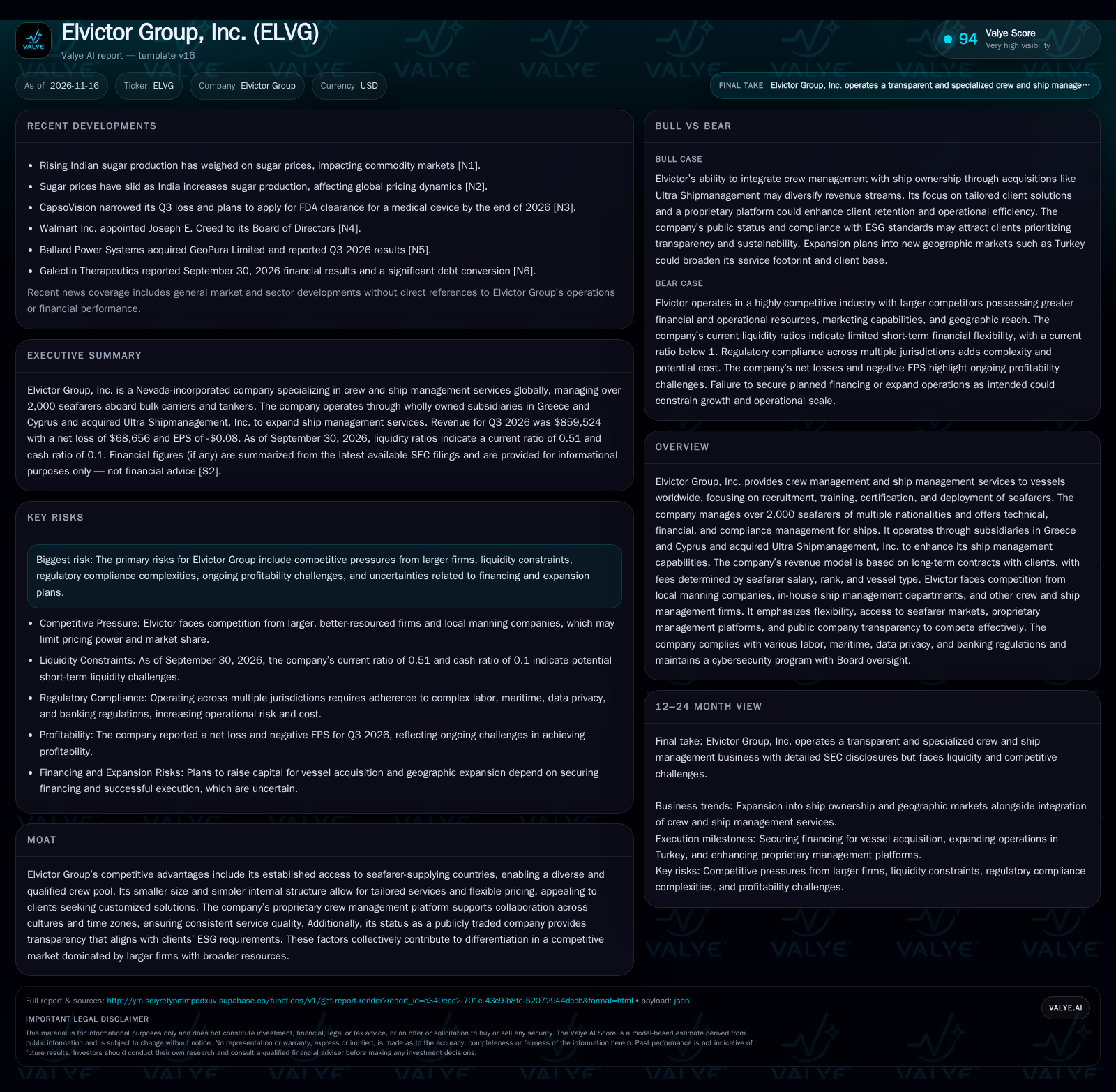
Elvictor Group manages over 2,000 seafarers globally and integrates crew and ship management through subsidiaries and acquisitions, but faces ongoing net losses and a current ratio below 1.
Elvictor Group, Inc. is positioning itself as a flexible, technology-driven provider of crew and ship management services, managing a diverse pool of over 2,000 seafarers across multiple jurisdictions. While its focus on tailored solutions and proprietary platforms offers potential differentiation in a fragmented market, the company’s latest financials reveal a persistent net loss and a liquidity profile that could constrain growth initiatives. The challenge for Elvictor is to bridge the gap between operational ambition and balance-sheet reality, particularly as it seeks to expand into ship ownership and new markets.
Financial Results and Balance Sheet Define Elvictor’s Strategic Options
Elvictor Group’s Q3 2026 revenue totaled $859,524, but the company posted a net loss of $68,656 and basic and diluted EPS of -$0.08 [S2]. As of September 30, 2026, cash and cash equivalents stood at $272,075, with a current ratio of 0.51 and a cash ratio of 0.1 [S2]. The company reported cash and liquidity metrics for the period; these figures do not by themselves establish operating runway, investment capacity, financial flexibility, or financing capacity. Against this backdrop, Elvictor’s ambitions—such as expanding into ship ownership and new geographies—will almost certainly require external financing or operational improvement to be realized.
Revenue Streams, Cost Dynamics, and Capital Requirements in Crew and Ship Management
Elvictor’s core business economics revolve around providing crew and ship management services under long-term contracts, with fees driven by the number, rank, and nationality of seafarers, as well as vessel characteristics [S1]. Revenue is typically recognized as performance obligations are satisfied, either on a fixed-price or cost-plus-fee basis. This structure provides some visibility, but margins are vulnerable to wage inflation, regulatory changes, and variable crewing costs. On the ship management side, technical and compliance services can introduce higher-margin opportunities, but also require investment in systems, insurance, and staff expertise.
The business is operationally labor-intensive, with a cost base dominated by salaries, training, and compliance expenditures. Operating leverage is limited unless the company can scale up the number of vessels or seafarers managed without proportionally increasing overhead. Capital requirements are moderate for crew management but could rise sharply if Elvictor moves into direct vessel ownership—a step that would tie up significant capital and introduce asset risk.
In addition to the direct costs associated with crew salaries and training, Elvictor must navigate the complexities of labor market fluctuations and geopolitical factors that influence seafarer availability and wage demands. For instance, shifts in immigration policies or bilateral labor agreements can alter the cost structure and sourcing strategies, potentially impacting contract profitability. Moreover, regulatory compliance costs are not static; evolving international maritime standards and flag state requirements may necessitate ongoing investment in certification, audits, and technology upgrades. This dynamic cost environment requires a flexible pricing model and proactive risk management to sustain margins over time.
Capital allocation decisions also play a critical role in Elvictor’s financial sustainability and growth trajectory. While crew management demands relatively modest capital expenditures, the transition toward vessel ownership introduces significant asset risk and exposure to market cycles in shipping. The company would need to balance the benefits of vertical integration—such as enhanced control over operational quality and revenue diversification—against increased financial leverage and potential impairments during downturns. Strategic partnerships or joint ventures could mitigate some capital intensity, but would also dilute control and require alignment of interests. Thus, capital strategy must be carefully calibrated to market conditions and internal capabilities.
How Elvictor Stands Out in a Competitive Maritime Services Landscape
Elvictor operates in a highly fragmented and competitive market, with rivals ranging from local manning agencies and in-house shipowner departments to large multinational ship management firms [S1]. The company’s scale is modest, which can be a double-edged sword: smaller size enables more flexible and tailored service, but limits bargaining power and resource depth relative to larger competitors.
Potential sources of differentiation for Elvictor include access to a multi-national seafarer pool, a proprietary crew management platform that could streamline recruitment and compliance, and public company transparency that aligns with the growing ESG demands of shipping clients. Nonetheless, these advantages are not insurmountable for larger or better-capitalized competitors to replicate or surpass. The company’s ability to maintain relationships with seafarer-supplying countries and adapt to evolving labor and data privacy regulations will be important for sustaining its competitive position.
Potential for Margin Gains and Scale Through Integration and Growth
An upside scenario for Elvictor would require successful integration of ship management and crew services, leveraging its proprietary platform to drive operational efficiency and client retention. If the company secures external financing and executes on its plan to acquire vessels, it could unlock new revenue streams and gain more control over the value chain, potentially improving margins and reducing client churn.
Confirmation of this scenario would include evidence of new long-term client wins, higher vessel counts under management, and successful entry into new geographies such as Turkey. Improvement in EBITDA margins and a move to cash flow breakeven would further support the case for sustainable growth. Conversely, if expansion fails to deliver operating leverage or if financing is unavailable on attractive terms, the thesis would be weakened.
Growth Prospects Amid Financial and Operational Constraints
The most plausible outcome, given current facts, is that Elvictor continues to operate as a niche provider focused on crew and ship management, growing modestly within existing markets and client relationships. The company may pursue incremental improvements to its proprietary platform and selectively target new clients or vessel types, but will be constrained by limited cash and working capital.
Evidence supporting this scenario would include stable or slightly increasing revenue, maintenance of the seafarer pool, and modest improvements in operating margin. Signs of successful cost control and regulatory compliance would also be consistent with this path. A lack of progress in raising capital or expanding service offerings would confirm that Elvictor remains in maintenance mode rather than breakout growth.
Risks from Liquidity Challenges and Market Competition
The downside scenario centers on persistent net losses and liquidity strain forcing Elvictor to scale back operations or seek dilutive financing. If competitive pressures intensify—such as price undercutting by larger firms or loss of key client relationships—Elvictor’s revenue base could erode while fixed costs remain sticky.
Confirmation of this scenario would include further deterioration in liquidity ratios, workforce reductions, loss of vessels under management, and evidence of high client churn. An inability to comply with regulatory requirements, especially if cash constraints impede investment in compliance systems, could also trigger negative outcomes such as fines or reputational damage.
Operational, Financial, and Market Factors Influencing Elvictor’s Trajectory
Growth or retention in the number of seafarers and vessels under management, which would indicate operational momentum (if disclosed).
Successful closing of new long-term contracts, particularly in new geographies such as Turkey, as evidence of expansion beyond the core base (if disclosed).
Progress in raising external financing or non-dilutive capital for vessel acquisition or platform investment (if disclosed).
Gross and operating margin trends, which would signal whether integration and platform investments are driving efficiency (if disclosed).
Client churn rates or renewal rates, which would help gauge competitive positioning and service stickiness (if disclosed).
Incidence and cost of regulatory or compliance events, including fines or remedial expenditures, reflecting the complexity of operating across multiple jurisdictions (if disclosed).
Disclaimer: This is research-only, informational analysis and not investment advice. It may include AI-generated interpretation and general industry context. Always verify important details using primary sources.

Comments