
Summit Networks Inc.: Acquisition Platform Ambition Confronts Liquidity and Execution Realities
Summit Networks Inc. is attempting to reposition itself as a disciplined acquirer of Asian logistics businesses, but faces acute liquidity shortfalls, no completed deals, and a need to prove both capital access and operational execution in a fragmented, competitive sector.
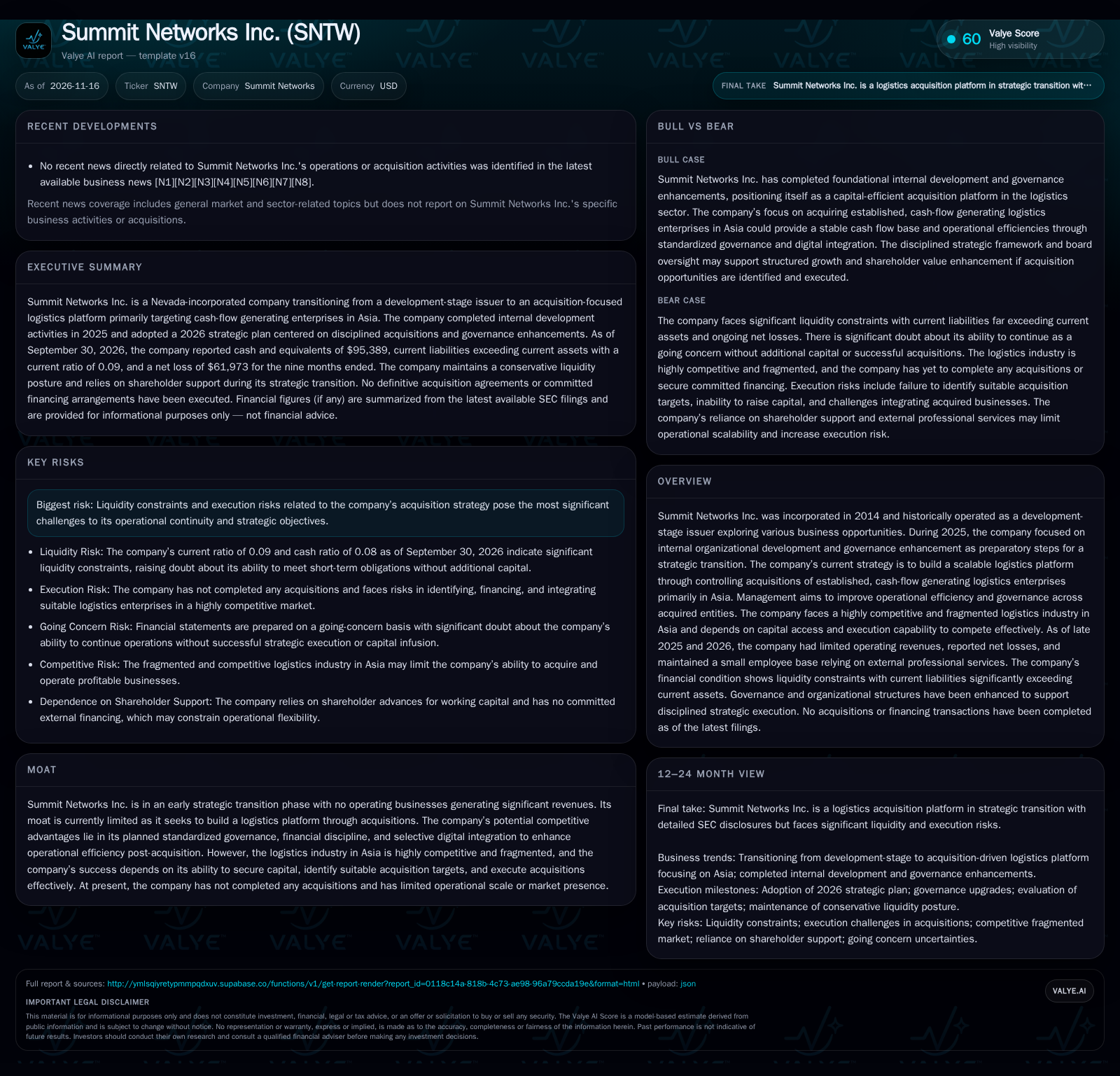
Summit Networks Inc. has transitioned from a development-stage entity to an aspiring acquisition platform targeting Asian logistics companies. As of late 2026, it has no completed acquisitions, limited revenues, and a current ratio of just 0.09. Success hinges on overcoming capital constraints and demonstrating the ability to identify, acquire, and integrate profitable targets. [S2]
Summit Networks Inc. stands at a pivotal crossroads: after years as a development-stage company, it has redefined itself as a logistics acquisition platform focused on Asia. Yet as of late 2026, it remains pre-operational—without completed acquisitions, with minimal cash, and facing a severe shortfall in liquidity. The company’s ambition to build a scalable, efficient logistics platform is clear, but realizing this vision will require not only disciplined deal-making and integration, but also immediate access to significant capital and operational expertise. The coming quarters will test whether Summit can transition from aspiration to execution—or whether structural constraints will force another strategic reset. [S2]
Liquidity Crisis and the Absence of Acquisitions Define the Current State
As of September 30, 2026, Summit Networks Inc. reported cash and equivalents of $95,389, a current ratio of just 0.09, and net losses totaling $61,973 for the first nine months of the year. The company’s current liabilities significantly exceed its current assets, underscoring acute liquidity strain. Critically, Summit has not completed any acquisitions or secured committed external financing, despite its stated strategy to build an acquisition-driven logistics platform targeting Asia. With no operating businesses generating significant revenue and an ongoing reliance on shareholder support for working capital, the company’s ability to execute its strategic plan remains in question. [S2]
Platform Economics: Potential Value Creation and Structural Constraints
Summit Networks’ intended business model is to acquire established, cash-flow generating logistics enterprises, consolidate their operations, and improve their efficiency through governance and selective digital integration. In theory, this roll-up approach could yield operating leverage by centralizing overhead, standardizing processes, and leveraging scale for better procurement and technology adoption. However, the company’s ability to extract value depends on several unproven factors: the quality and price of acquisition targets, the degree of fragmentation in the logistics sector, and the costs of integration.
The logistics industry, especially in Asia, is characterized by low margins, high competition, and capital intensity, with working capital needs for fleet, warehousing, and technology upgrades. Summit’s lack of committed capital and its current liquidity crisis mean it cannot pursue deals without immediate financing. Even if acquisitions are completed, the economics will hinge on the ability to generate synergies, control integration costs, and maintain cash flow at the acquired entities. The absence of recurring platform revenues and the reliance on external professional services add further structural challenges to achieving scalable profitability.
Fragmented Market, Intense Rivalry, and the Challenge of Differentiation
Summit Networks is entering a logistics sector in Asia that is highly fragmented, with thousands of local operators, regional players, and large multinational logistics firms. This fragmentation creates opportunities for consolidation, but also means competition for attractive acquisition targets is fierce—often from better-capitalized private equity, strategic buyers, and regional incumbents. Switching costs for customers are typically low, and logistics contracts are frequently won on price and service reliability rather than brand loyalty.
Summit’s potential competitive advantages rest on its vision of disciplined governance and digital integration post-acquisition. If executed well, these could improve operational efficiency and customer service at acquired firms. However, with no operational track record, no completed deals, and limited current resources, the company does not yet possess a meaningful moat or demonstrable market presence. Its success will depend on its ability to source, finance, and integrate acquisitions faster and more effectively than regional competitors—and to avoid overpaying for assets in a seller’s market.
What Success Would Look Like: From Capital Infusion to Platform Scale
A favorable outcome for Summit Networks would begin with securing a substantial capital infusion—either through equity, debt, or a strategic partnership—enabling the company to move quickly on identified acquisition targets. The initial acquisition of a profitable, cash-flow positive logistics business would provide operating revenues and a platform for further roll-ups. Effective integration would yield cost savings through shared services, IT upgrades, and standardized governance, improving margins and cash flow.
Growth would be reinforced by demonstrating rapid post-acquisition improvements and successfully onboarding additional targets under the same disciplined framework. Over time, the company could achieve scale advantages, strengthen its negotiating position with suppliers and customers, and potentially command a valuation premium as a consolidator in a fragmented market. Confirmation of this scenario would require public announcements of completed acquisitions, new capital commitments, and evidence of positive operating cash flows from acquired entities.
Incremental Progress Dependent on Capital Access and Deal Execution
The most plausible near-term outcome is one of incremental, if uncertain, progress. Summit Networks may secure a modest round of bridge financing or shareholder advances, which would provide limited runway to continue evaluating acquisition targets and support basic corporate operations. One or more small-scale acquisitions could be completed if suitable targets are found at reasonable prices and if financing is arranged, but integration risks and initial scale would remain substantial hurdles.
Operating losses are likely to persist until at least one acquisition is completed and generates positive cash flow. The company’s credibility and access to further capital would depend on demonstrating early success with its first deal, including integration and retention of key personnel at the acquired entity. Confirmation of this scenario would come from announcements of new financings, signed letters of intent or definitive agreements, and early post-acquisition financial disclosures showing improvement in liquidity and revenues.
Liquidity Exhaustion and Strategic Stagnation Threaten Continuity
In an adverse scenario, Summit Networks is unable to secure additional capital—either from external investors or further shareholder support—leaving it unable to meet short-term obligations. The company’s acute liquidity shortfall would force it to curtail operations, delay or abandon acquisition efforts, and potentially seek restructuring or dissolution. Without completed acquisitions, there would be no operating revenues to offset ongoing expenses, and reliance on external professional services could exacerbate cash burn.
Execution failures could also arise if the company overpays for a poorly performing target, faces integration setbacks, or is unable to realize promised synergies. In this scenario, continued net losses and a lack of visible progress would reinforce going concern doubts, and the company could enter a cycle of failed financings and strategic resets. Confirmation would come from further deterioration in liquidity metrics, missed payment obligations, or disclosures of halted operations and abandoned acquisition plans.
Milestones That Will Determine Whether Summit Networks Can Execute Its Platform Ambition
Completion and public disclosure of a definitive acquisition agreement with a profitable logistics company.
Announcement of a committed capital raise, whether through equity, debt, or strategic partnership, sufficient to fund both acquisitions and near-term operating needs.
Evidence of positive operating cash flow or EBITDA from acquired entities, if disclosed, post-integration.
Visible progress on integration steps, such as standardized governance adoption and digital platform implementation at acquired businesses.
Retention of key personnel and operational continuity at acquired firms, as measured by disclosed employee counts or management commentary.
Disclosures regarding the pipeline of acquisition targets and any signed letters of intent or exclusivity agreements.
Disclaimer: This is research-only, informational analysis and not investment advice. It may include AI-generated interpretation and general industry context. Always verify important details using primary sources.

Comments