
PGIM Private Credit Fund: Expense Controls, Affiliate Access, and the Realities of Private Credit Governance
The fund’s near-term economics hinge on careful governance, disciplined cost containment, and navigating credit market volatility.
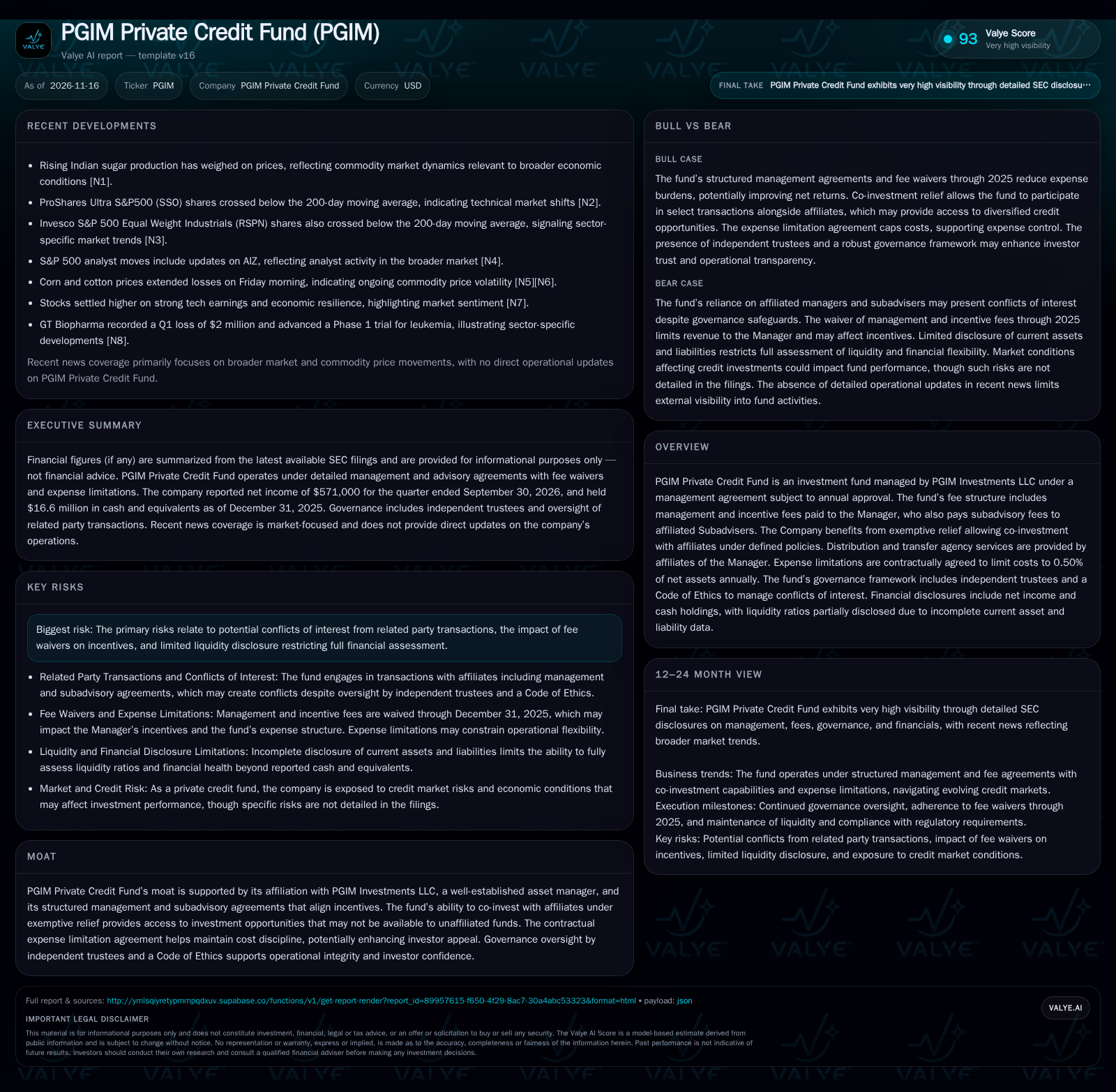
PGIM Private Credit Fund operates under a detailed management structure with fee waivers and expense limitations through 2025, supporting lower fund-level costs and potential for attractive net returns. Exemptive relief allows the fund to co-invest alongside affiliates, broadening deal access. Governance is robust, but true potential financial flexibility remains partly opaque. [S2]
PGIM Private Credit Fund sits at the intersection of institutional asset management discipline and the nuanced risks of private credit investing. With its management and incentive fees waived through 2025, and an annual expense cap in place, the fund offers investors a cost-controlled entry into private credit markets. Its ability to co-invest with PGIM affiliates could unlock access to select deals that smaller or unaffiliated funds cannot reach. Yet, this structure also embeds complex related-party dynamics and leaves gaps in real-time liquidity visibility. As the fee waiver period nears its end and credit markets evolve, the fund’s ability to sustain performance and transparency will be put to the test. [S2]
Recent Financials and Governance: What Shapes the Near-Term Outlook
The fund reported net income of $571,000 for the quarter ended September 30, 2026, and cash and equivalents of $16.6 million as of December 31, 2025. Management and incentive fees are currently waived through December 31, 2025, and the fund benefits from a contractual expense limitation agreement capping certain costs at 0.50% of net assets annually. Exemptive relief permits co-investment alongside affiliates, potentially widening the fund’s exposure to private credit deals. Governance is structured around independent trustees, quarterly reviews of related-party transactions, and a Code of Ethics to manage conflicts of interest. The company reported cash and liquidity metrics for the period; these figures do not by themselves establish operating runway, investment capacity, financial flexibility, or financing capacity. [S2]
Mechanics of Cost Control and Private Credit Returns
PGIM Private Credit Fund’s economics are shaped by a multi-layered fee structure and contractual expense management. The waiver of management and incentive fees through 2025, alongside the 0.50% expense cap, lowers the fund’s cost base and may improve net returns to investors, at least temporarily. These waivers and caps are not permanent, and their expiration could increase costs and pressure net returns unless offset by asset growth or higher portfolio yields.
The fund pays management and incentive fees to PGIM Investments LLC, which in turn pays subadvisory fees to affiliated Subadvisers. Distribution and shareholder servicing fees are based on NAV and paid to an affiliate acting as principal underwriter. While these arrangements may support scale and operational efficiency, they also introduce layered costs and potential conflicts if not tightly governed.
Private credit funds typically generate returns through interest income, fees, and capital appreciation from direct lending or structured credit investments. Portfolio returns depend on credit selection, default management, and the ability to originate or participate in attractive deals—capabilities that may be enhanced by the fund’s ability to co-invest with PGIM affiliates. However, the capital intensity of private credit, potential illiquidity, and the need for ongoing due diligence make cost discipline and risk management critical to sustainable performance.
Affiliate Leverage and the Landscape of Private Credit Access
The fund’s competitive position draws on its affiliation with PGIM Investments LLC, which provides institutional infrastructure, deal origination capabilities, and access to proprietary transactions via exemptive relief for co-investment. This structure may deliver advantages over standalone or smaller funds that lack access to large-scale, diversified deal flow.
However, the reliance on affiliated managers and subadvisers introduces persistent conflict-of-interest risks, requiring robust governance and transparency to preserve investor trust. In the broader private credit market, competition comes from other institutional funds, direct lenders, and increasingly from alternative asset managers with global reach. The ability to participate in co-investments could help PGIM Private Credit Fund access larger or more complex deals, but success will depend on execution, credit discipline, and the fund’s ability to differentiate on cost and performance after the fee waiver period ends.
Substitution risk is present, as investors can allocate to other private credit vehicles, liquid credit funds, or even public fixed-income markets if risk-adjusted returns or transparency prove subpar. The fund’s future standing will likely hinge on demonstrating consistent performance net of fees, strong governance, and clear communication regarding risk and liquidity.
Unlocking Value Through Fee Discipline and Co-Investment Scale
A favorable scenario unfolds if the fund leverages its current fee waivers and expense caps to deliver consistently attractive net returns, capitalizing on co-investment opportunities with PGIM affiliates to access high-quality, diversified credit deals. The fund could benefit from disciplined credit selection, low loss rates, and a stable yield environment, supporting both income generation and NAV preservation.
This scenario would be confirmed by persistent positive net income, growing distributions to shareholders, and evidence of successful participation in marquee co-investment deals. Additional indicators would include transparent disclosures of portfolio turnover, realized returns on credit investments, and the ability to sustain low expense ratios even after the waiver period ends. If the fund manages to maintain or expand its asset base while demonstrating strong governance and conflict management, its value proposition could become increasingly compelling relative to peers.
Navigating Fee Expiry and Credit Market Cycles
The most plausible outcome is that PGIM Private Credit Fund continues to benefit from its current expense controls and affiliate access through the end of 2025, delivering stable—if unexceptional—returns. As fee waivers and expense caps roll off, the fund may experience increased cost drag unless asset growth or portfolio yield improvement compensates for higher expenses. Credit market volatility and potential defaults could create intermittent performance pressure, but the fund’s governance and affiliation with PGIM may support sound risk management.
Confirmation of this scenario would come from steady, moderate net income, maintenance of reported liquidity position (if disclosed), and continued adherence to governance protocols. If the fund discloses stable NAV, regular distributions, and limited impairment losses, it would suggest solid—if not market-leading—performance. A key falsifier would be a sudden increase in expenses or a notable decline in net income as fee waivers expire, without a corresponding uptick in gross returns.
When Fee Waivers End: Risks of Rising Costs and Credit Stress
An adverse scenario could play out if the expiration of fee waivers and expense caps sharply increases the fund’s expense ratio, eroding net returns and investor appeal.
This scenario would be confirmed by declining net income, reduced or suspended distributions, and evidence of increased expenses outpacing revenue growth. Additional red flags would be emerging governance issues, such as related-party transactions drawing regulatory scrutiny or investor pushback. If the fund’s NAV drops materially, or if liquidity constraints emerge due to undisclosed or unfavorable asset/liability mismatches, investor confidence could erode, leading to capital outflows or impaired fundraising.
What Could Affirm or Challenge the Fund’s Expense-Driven Thesis
Actual expense ratio trends post-2025, especially in the quarters following the expiration of fee waivers and expense limitations, would provide a direct test of cost discipline and net return sustainability.
The volume, quality, and realized returns of co-investment deals with PGIM affiliates—if disclosed—would reveal whether the fund’s affiliate access translates into superior deal flow or risk-adjusted returns.
Net income and NAV trends over successive quarters, particularly as market conditions evolve, will signal whether the fund can maintain performance as cost structures normalize.
Any changes to management, subadvisory, or distribution agreements—especially shifts in fee terms or service providers—could alter the fund’s economics or governance profile.
Evidence of related-party conflicts impacting investment decisions or leading to regulatory or trustee intervention would challenge the current governance narrative.
If the fund faces redemption pressure or capital outflows, monitoring the impact on portfolio stability and liquidity management would be crucial.
Disclaimer: This is research-only, informational analysis and not investment advice. It may include AI-generated interpretation and general industry context. Always verify important details using primary sources.

Comments