
GP-Act III Acquisition Corp.: Dronamics Deal Defines the Next Phase—But Liquidity and Execution Risks Loom Large
GP-Act III Acquisition Corp. has entered into a definitive agreement to combine with Dronamics, transitioning from a cash shell to a potential logistics innovator. However, a stark liquidity gap and the inherent uncertainties of SPAC transactions put both the deal’s closing and future operating viability under scrutiny.
GP-Act III Acquisition Corp. (GPAT) has announced a business combination with Dronamics, a transformative step that, if completed, will shift the company from its SPAC structure to an operating entity focused on logistics technology. The future of the combined entity hinges on closing the transaction, successfully integrating Dronamics’ operations, and accessing new capital or revenue streams.
GP-Act III Acquisition Corp. stands at a pivotal crossroads: its pending business combination with Dronamics, a logistics technology company, marks a transition from pure SPAC status to a potential operating entity. Yet, the company’s financial statements as of September 2026 reveal a stark liquidity deficit, with current liabilities far outstripping available cash and assets. The outcome of the Dronamics deal—subject to shareholder approval and a multi-step cross-border restructuring—will determine whether GPAT emerges as a viable logistics innovator or remains a cautionary tale of SPAC execution risk.
Dronamics Deal Announced Amid Severe Liquidity Tension
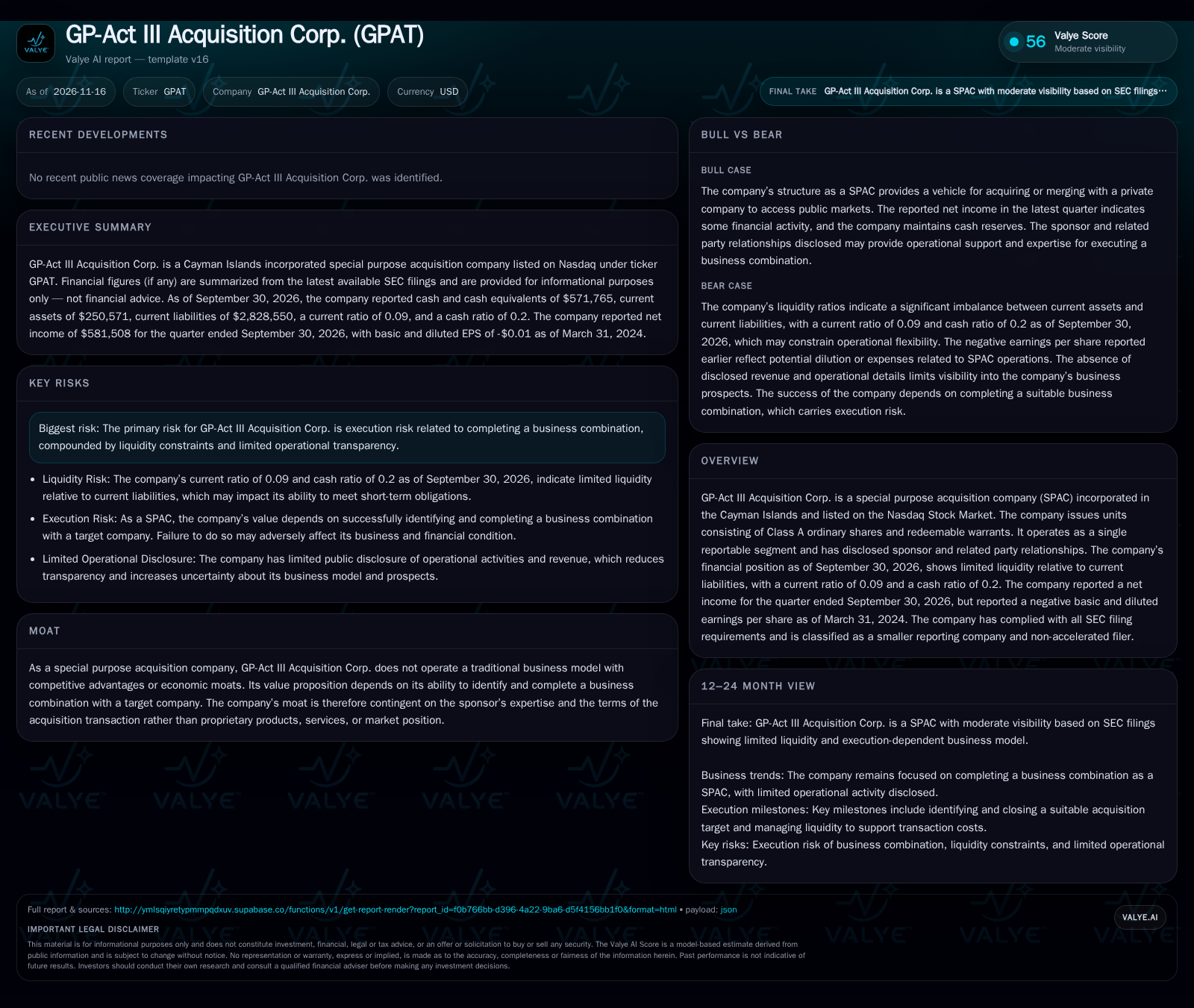
As of November 3, 2026, GP-Act III Acquisition Corp. has entered into a definitive agreement to combine with Dronamics, a logistics company, via a complex multi-step transaction involving domestication and mergers. This marks a material shift from blank-check status to an operating company model, contingent on shareholder approval and the successful completion of the transaction [S2].
The company reported a cash ratio of 0.2 for the period. [S2]
Despite reporting a quarterly net income of $581,508, the company’s negative EPS earlier in 2024 and lack of disclosed revenue highlight the absence of ongoing commercial operations in the SPAC phase [S2].
These facts frame the business combination not only as a growth opportunity but as a necessity for ongoing viability.
From Blank Check to Operator: The Economics of a Post-Combination Entity
Prior to the Dronamics deal, GPAT’s economics were typical of a SPAC: minimal operating expenses, no revenue, and reliance on IPO proceeds and sponsor funding to cover administrative costs. The core value proposition was the promise of a future transaction, not ongoing operations.
Post-combination, the economics will depend entirely on Dronamics’ business model. If Dronamics is typical of logistics technology startups, its revenue model could involve transaction fees, recurring logistics contracts, or technology licensing. Margins in logistics are often thin, but technology-driven models can offer higher gross margins if network effects or proprietary platforms are realized.
Operating leverage may be achievable if Dronamics can scale its logistics solutions without proportionate increases in fixed costs. However, capital needs are likely to increase as the combined entity invests in technology, fleet, or infrastructure. With GPAT’s current liquidity depleted, closing the transaction and securing additional capital—via PIPEs, debt, or secondary offerings—would be essential to fund growth and cover integration expenses.
The transition from a cash shell to an operating company increases financial complexity and risk: any delays or failures in the integration process could rapidly exhaust remaining resources.
Competitive Stakes: From SPAC Arbitrage to Logistics Disruption
As a SPAC, GPAT’s competitive differentiation was primarily access to capital markets and sponsor relationships. Post-merger, its fate is tied to Dronamics’ ability to carve out a niche in the logistics sector—a space crowded with established incumbents, technology-driven entrants, and conventional carriers.
Dronamics’ potential advantages could include proprietary logistics technology, differentiated air or drone-based delivery models, or unique regulatory approvals. However, barriers to entry in logistics are high, and scaling a new model requires both capital and proof of commercial traction.
The combined entity will face competition from traditional logistics giants, emerging drone delivery startups, and integrated supply chain platforms. Switching frictions may exist for customers if Dronamics can deliver superior reliability, speed, or cost savings, but these advantages must be demonstrated in real-world operations.
Ultimately, the competitive moat will depend less on the legacy SPAC structure and more on whether Dronamics can achieve scale, retention, and pricing power in a notoriously margin-sensitive industry.
If the Deal Closes and Dronamics Delivers: A Path to Growth and Differentiation
The most favorable scenario unfolds if the business combination closes smoothly, Dronamics demonstrates operational traction, and the combined entity secures fresh capital to fund growth. In this case, Dronamics could leverage public market access to accelerate technology deployment, expand its logistics network, and win commercial contracts.
Upside would be confirmed by evidence such as rapid post-merger revenue ramp, public customer wins, and successful follow-on capital raises (e.g., PIPEs or secondary offerings). Early indications of margin improvement, operational scale, or network effects would further validate the thesis.
This scenario presumes that integration risks are well managed, regulatory approvals are obtained, and the new entity can differentiate itself in a competitive market. The greatest validation would come from sustained revenue growth and evidence that Dronamics’ model can scale profitably.
In a scenario where Dronamics successfully leverages its technology to could create network effects, the business model could transition from transactional logistics services to platform-based solutions. This shift would enable the company to capture value not only from direct delivery operations but also from facilitating third-party logistics providers through its platform. Such a model could enhance margins and create defensible market positioning through data-driven optimization and customer lock-in. Achieving this would require robust technology infrastructure and strategic partnerships, underscoring the importance of execution beyond initial capital raises and operational milestones.
Execution Risk Dominates: Transaction Closes, But Integration and Funding Remain Uncertain
The most plausible path is that the business combination proceeds—perhaps with some delays or renegotiations—but the early post-merger period is characterized by operational and financial uncertainty. The new entity may struggle to secure immediate revenue traction or additional capital, and faces the challenge of integrating teams, technologies, and regulatory compliance frameworks.
Confirmation of this scenario would include the deal closing on revised terms, modest initial revenue or customer announcements, and ongoing disclosures around capital needs and cash burn. Falsification would come from either a failed closing (deal termination) or, on the contrary, a surprising surge in commercial activity and capital inflows.
In this scenario, the company’s valuation and momentum would hinge on the first few quarters of operating results and the ability to communicate a credible growth plan to public investors.
Deal Failure or Post-Merger Liquidity Crunch: SPAC Risks Materialize
The most adverse scenario is that the business combination with Dronamics fails to close—due to shareholder rejection, regulatory hurdles, or inability to meet closing conditions. In this case, GPAT would remain a cash-depleted SPAC, facing the risk of liquidation or further sponsor dilution.
Downside evidence would include deal termination announcements, failure to obtain shareholder or regulatory approvals, or post-merger disclosures highlighting severe cash burn, missed milestones, or inability to raise additional capital. In either case, investor value would be at significant risk.
Milestones That Will Test the Dronamics Combination Thesis
Shareholder approval and regulatory clearance for the Dronamics business combination—deal closure is the gating event for any future scenario.
Disclosure of PIPE or other committed capital to support post-merger operations and growth, if available.
Initial financial guidance or revenue disclosures from the combined entity—early evidence of commercial activity would help test the operating thesis.
Cash burn rate and updated liquidity metrics in the first quarters post-merger—critical for assessing sustainability.
Public announcements of customer contracts, pilots, or partnerships, which would indicate market traction.
Integration milestones: technology, personnel, and operational alignment updates.
Ongoing SEC filings for any material changes to deal terms, capital structure, or sponsor support.
Disclaimer: This is research-only, informational analysis and not investment advice. It may include AI-generated interpretation and general industry context. Always verify important details using primary sources.

Comments