
CIM Real Estate Finance Trust: Navigating Profitability, Affiliation Leverage, and Structural Constraints
CIM Real Estate Finance Trust delivered $188.1 million in revenue and $26.5 million in net income for Q3 2026, backed by $148.2 million in cash.
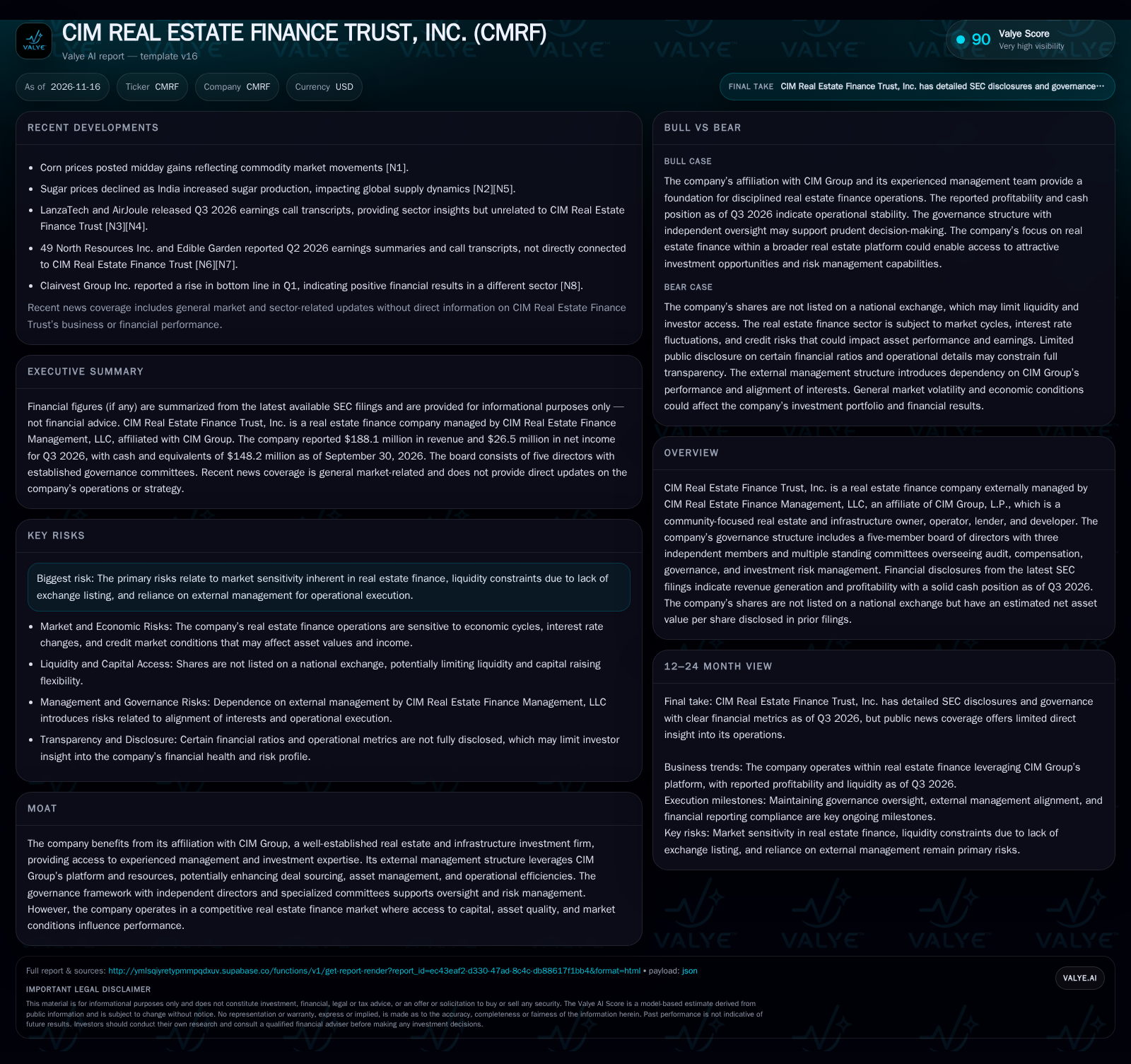
CIM Real Estate Finance Trust delivered $188.1 million in revenue and $26.5 million in net income for Q3 2026, backed by $148.2 million in cash. Externally managed by CIM Group affiliates, the company’s non-listed shares and limited disclosure create both structural advantages and transparency challenges. Its future hinges on capital deployment, risk discipline, and real estate market cycles, with governance and management alignment in focus. [S1] [S2]
CIM Real Estate Finance Trust, Inc. stands at the intersection of institutional real estate finance and externally managed investment vehicles. Reporting solid Q3 2026 profitability and a meaningful cash balance, it benefits from affiliation with CIM Group—a platform with deep real estate expertise and deal flow. However, the company’s shares remain unlisted, constraining liquidity and public market visibility. As it navigates the volatile real estate finance sector, the alignment between external management, governance, and shareholder value will be tested, especially given the selective nature of its public disclosures and the sector’s cyclical risks.
Q3 2026: Profitability, Liquidity, and the Implications of Non-Listing
CIM Real Estate Finance Trust reported $188.1 million in revenue and $26.5 million in net income for the third quarter of 2026, with cash and equivalents totaling $148.2 million as of September 30, 2026 [S2]. This signals not only ongoing operational activity but also the ability to generate profits in a challenging real estate environment. The company is externally managed by CIM Real Estate Finance Management, LLC, an affiliate of CIM Group—a firm with a broad footprint in real estate and infrastructure [S1]. Shares remain unlisted on any national exchange, which restricts secondary market liquidity and may impact the investor base and capital-raising flexibility. The disclosed estimated net asset value per share of $5.14 as of December 31, 2025, offers a reference point but not a real-time market price [S1]. These realities shape both the company’s opportunity set and its constraints.
How CMRF’s Model Monetizes Real Estate Finance: Capital Deployment, Fee Structures, and Cost Dynamics
CMRF’s core business is the origination, acquisition, and management of real estate-related loans and assets, seeking to earn a spread between the yield on investments and the cost of capital. As an externally managed vehicle, a significant portion of operating expenses may consist of management and incentive fees paid to CIM Group affiliates, rather than fixed in-house costs. This structure can offer operating leverage when asset growth outpaces fee increases, but may also cap scalability if fees are tied to assets under management or performance.
Revenue is primarily driven by interest income from loans and leases, with possible ancillary income from asset sales or fee-based services. The company’s ability to generate attractive risk-adjusted returns depends on disciplined underwriting, access to deal flow, and robust portfolio management—areas where CIM Group’s platform could confer advantages. However, the external manager’s incentives—especially if tied to AUM or short-term benchmarks—may not always fully align with long-term shareholder value. Capital needs are dictated by the pace of asset deployment, portfolio turnover, and the need to maintain liquidity buffers for market swings or redemptions. Non-listed status may constrain access to new equity capital and limit investor exits, raising the importance of internal capital recycling and prudent leverage.
Affiliation with CIM Group: Sourcing Advantages Versus Market Realities
CMRF’s competitive edge is anchored in its relationship with CIM Group, which provides access to established deal pipelines, real estate expertise, and risk management infrastructure [S1]. This could enable the company to source higher-quality assets, underwrite transactions more effectively, and respond to market dislocations with agility. The governance structure, featuring three independent directors out of five and specialized committees, supports oversight of both risk and manager alignment [S1].
However, the broader real estate finance landscape is crowded, with competitors ranging from REITs and private debt funds to banks and alternative lenders. Many of these entities have lower cost structures, greater scale, or public listings that enhance capital access and investor liquidity. Moreover, in a rising-rate or volatile property market, asset quality and risk discipline become paramount—potentially eroding any advantage from affiliation alone if underwriting or asset selection falters. External management also introduces the perennial challenge of incentive alignment, as fee structures may prioritize asset growth over total return.
If CIM Group’s Platform Unlocks Superior Deal Flow and Discipline
The most favorable trajectory for CMRF would see the company consistently leveraging CIM Group’s sourcing and underwriting strengths to assemble a portfolio of high-yield, well-collateralized real estate loans and investments. If management can maintain discipline—avoiding excessive risk-taking during frothy markets and capitalizing on dislocations—net interest margins could expand and portfolio credit quality could remain high.
Confirmation of this scenario would require evidence of continued profitability, stable or improving net asset value per share, and transparent portfolio disclosures demonstrating low non-performing asset rates and strong risk-adjusted yields. Additionally, if the company can recycle capital efficiently and perhaps even return capital to shareholders, it would signal operational maturity and strategic discipline.
Steady-State: Navigating Cyclicality with Moderate Returns and Controlled Risk
A more likely path is that CMRF delivers moderate, variable returns shaped by real estate market cycles, with profitability maintained through disciplined underwriting but constrained by the cost of external management and the limitations imposed by non-listed status. Revenue and earnings may fluctuate with credit conditions, property valuations, and interest rates, but affiliation with CIM Group provides a baseline of deal flow and risk management expertise.
In this scenario, investors should expect periodic swings in net asset value and income, with governance oversight serving as a moderating force on risk. Evidence supporting this outcome would include continued positive net income, stable cash balances, and the absence of major credit losses or portfolio impairments. Conversely, a decline in earnings quality, rising operating expenses relative to assets, or unexplained swings in NAV would challenge the base case.
When Market Stress, Asset Quality, or Alignment Breaks Down
A negative scenario would unfold if CMRF’s portfolio suffers from rising credit losses or asset impairments, perhaps due to adverse property market moves, interest rate spikes, or underwriting missteps. The risk is amplified by the external management model: if incentive structures prioritize asset growth or short-term income, discipline may erode during competitive or exuberant periods.
Downside confirmation would come from deteriorating net income or cash flows, a shrinking or impaired asset base, and a declining NAV per share. Additional red flags would include the need to liquidate assets at a loss, an inability to recycle capital into new opportunities, or governance breakdowns (such as conflicts of interest or abrupt management departures). Lack of transparency—if portfolio disclosures become more opaque—would further undermine the investment case.
Testing the Thesis: What Would Confirm or Challenge CMRF’s Value Proposition
Quarterly revenue and net income trends—persistence or volatility would clarify the stability of earnings and the effectiveness of underwriting.
Net asset value per share trajectory—whether NAV is stable, rising, or eroding, especially during periods of real estate market stress.
Portfolio composition and credit quality—if disclosed, detail on loan types, geographic concentration, and non-performing asset rates would help assess risk discipline.
Management fee and expense ratios relative to assets—rising costs or fees outpacing asset growth would signal potential misalignment.
Cash and liquidity changes—material draws or buildups in cash would indicate shifts in deployment or risk posture.
Governance events—board composition changes, committee actions, or disclosed conflicts of interest would impact oversight confidence.
Capital-raising or asset sale activity—frequency, terms, and necessity of such actions would reveal both opportunity and stress.
External market conditions—shifts in interest rates, property values, and credit spreads will directly influence portfolio performance and risk.
Disclaimer: This is research-only, informational analysis and not investment advice. It may include AI-generated interpretation and general industry context. Always verify important details using primary sources.

Comments