
New Peoples Bankshares: Regional Banking Dynamics and Competitive Pressures
New Peoples Bankshares' profitability and substantial liquidity reflect the enduring appeal of relationship-driven community banking, but the company’s ability to defend its niche against larger institutions and fintech disruptors will determine its long-term trajectory.
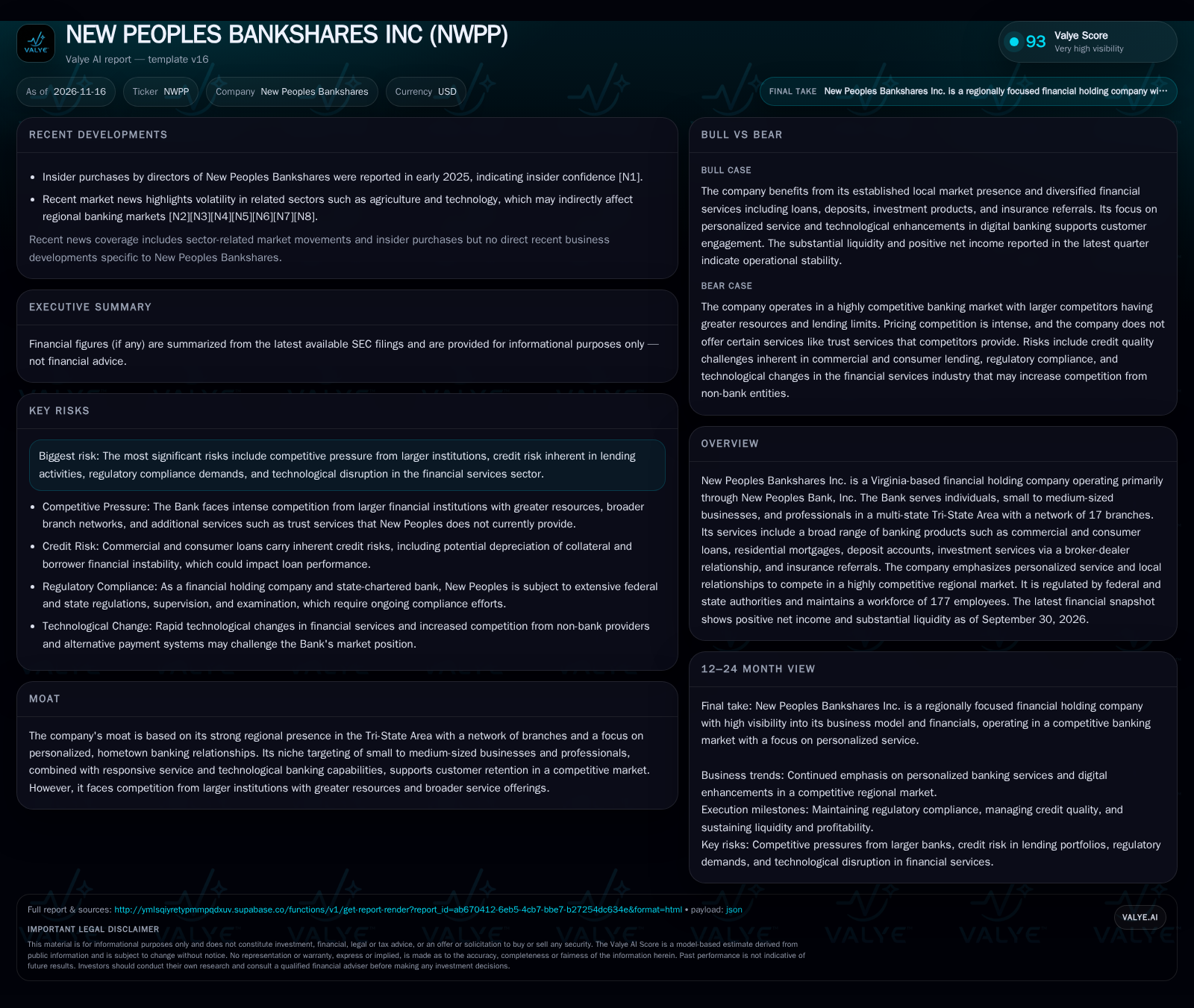
New Peoples Bankshares Inc. operates a 17-branch network across four states, focusing on personalized banking for individuals and small businesses in the Tri-State Area. As of September 2026, the company reported $3.51 million in quarterly net income and nearly $100 million in cash and equivalents, highlighting operational stability amidst intense regional competition. Its business relies on lending, deposit gathering, and fee-based services, but faces risks from larger banks, evolving technology, and credit quality pressures. The sustainability of its relationship-based model will depend on its ability to manage credit risk, adapt to digital shifts, and maintain customer loyalty in a rapidly evolving financial landscape. [S1] [S2]
New Peoples Bankshares Inc. exemplifies the strengths and vulnerabilities of regional community banking in the modern era. With a branch network spanning Virginia, West Virginia, North Carolina, and Tennessee, the company has built a reputation on personalized service and hometown relationships. The core question is whether New Peoples can leverage its local advantage while adapting to industry-wide shifts in technology, customer expectations, and regulatory demands. [S1] [S2]
Recent Financial Trends and Strategic Overview
As of September 30, 2026, New Peoples Bankshares reported $3.51 million in net income for the quarter and held $99.8 million in cash and equivalents. The company operates 17 full-service branches across four states, focusing on the Tri-State Area, and serves individuals, small and medium-sized businesses, and professionals. These facts highlight both operational profitability and a reported liquidity position, which are critical for confidence among depositors, borrowers, and regulators. In the context of ongoing sector consolidation and digital disruption, New Peoples' emphasis on personalized, relationship-driven service is its main differentiator, but also places it at risk from competitors with greater scale and digital reach. [S1] [S2]
Revenue and Cost Impacts of Relationship Banking
New Peoples Bankshares monetizes its business primarily through interest income on loans (commercial, consumer, and residential mortgages) and net interest margin generated by the spread between loan yields and deposit funding costs. Non-interest income is derived from investment services—offered via a broker-dealer relationship—and insurance referrals, supplementing core banking revenue. The company’s cost structure is dominated by branch operations, personnel expenses, and regulatory compliance, which are relatively fixed in the short term due to the physical network and staffing needs. Variable costs scale with transaction volumes and servicing activity. Capital needs are influenced by loan growth, regulatory capital requirements, and technology investment to meet evolving customer expectations. Operating leverage is moderate; incremental growth in loans or deposits can improve margins, but branch-heavy models risk suboptimal efficiency ratios if revenue growth stalls or digital adoption accelerates.
The interplay between fixed and variable costs in New Peoples Bankshares' branch-centric model also influences its strategic flexibility. For instance, fixed personnel and branch maintenance expenses create a baseline cost structure that can be challenging to reduce rapidly in response to revenue fluctuations, potentially compressing profitability during downturns. Conversely, the scalability of digital channels could offer a pathway to lower marginal costs per transaction over time, provided the bank invests effectively and achieves meaningful adoption. Additionally, the capital allocation decision between loan portfolio growth and technology upgrades requires balancing near-term earnings stability against long-term competitiveness. The bank’s ability to optimize this balance will be critical, especially as regulatory capital requirements evolve and pressure risk-weighted asset management.
Local Differentiators and Competitive Constraints
New Peoples Bankshares’ competitive position is anchored in its regional footprint and emphasis on personalized, community-oriented service. Its 17 branches foster deep customer relationships, which may support retention and cross-selling among individuals and small businesses. However, the bank faces intense competition from larger regional and national banks offering broader product suites (including trust and wealth management services), more advanced technology platforms, and larger lending limits. Additionally, non-bank fintechs and digital-first banks represent a growing substitute threat, particularly for younger and tech-savvy customers who value convenience over in-person service. While the company’s focus on relationship banking offers a moat against pure price competition, its lack of certain services and slower digital adoption could erode market share over time if not addressed.
Capitalizing on Community Loyalty to Foster Growth
In a favorable scenario, New Peoples Bankshares successfully deepens its customer relationships, increasing wallet share among existing clients while attracting new small businesses and professionals seeking personalized service. If the company expands its digital offerings—such as enhanced mobile banking and integrated financial planning tools—without sacrificing its relationship banking ethos, it could capture both traditional and younger demographics. Evidence supporting this scenario would include sustained or accelerating deposit and loan growth, improving net interest margins, rising non-interest income from investment services, and stable or declining credit losses. Confirmation would also come from customer satisfaction metrics, higher cross-sell rates, and positive trends in branch-level profitability.
Maintaining Stability with Gradual Digital Integration
The most plausible near-term trajectory is one of steady, moderate growth, with New Peoples maintaining its core customer base but facing gradual erosion of market share at the margins to larger and more digitally advanced competitors. Loan and deposit volumes may grow in line with regional economic activity, while fee income from investment and insurance services remains a modest but stable contributor. The bank invests selectively in technology to meet basic customer expectations, but does not fundamentally alter its branch-centric model. Confirming evidence would be flat to modestly rising efficiency ratios, stable credit quality metrics, and maintenance of current profitability levels. Signs of increased customer churn or persistent margin compression would challenge this outlook.
Risks to Relationship Banking from Market and Credit Challenges
In a negative scenario, intensified competition from larger banks and digital-first entrants leads to loss of key customer segments, forcing New Peoples to compete more aggressively on rates and fees. At the same time, a deterioration in regional economic conditions could trigger higher credit losses, especially in commercial and consumer loan portfolios. Rising regulatory compliance costs and technology investment demands may further pressure margins, while a failure to keep pace with digital innovation accelerates customer attrition. Evidence for this scenario would include declining deposit and loan balances, rising non-performing assets, widening efficiency ratios, and negative operating leverage. Increased customer complaints or branch closures would also support a bearish view.
Elements Influencing New Peoples Bankshares’ Competitive Strength
Quarterly trends in net interest margin, which would indicate the bank’s ability to manage funding costs and loan pricing in a competitive environment.
Loan growth and credit quality metrics (e.g., non-performing loan ratios, charge-offs), as rising credit losses or stagnant loan volumes would challenge the earnings outlook.
Deposit growth and composition—particularly changes in non-interest-bearing versus higher-cost time deposits—as a signal of customer loyalty and pricing sensitivity.
Non-interest income trends from investment and insurance services, which would show the effectiveness of cross-selling and diversification efforts.
Branch-level profitability and customer retention rates, if disclosed, to test the resilience of the relationship banking model.
Progress in digital banking adoption and customer migration to online/mobile platforms, as a measure of competitive relevance.
Any regulatory actions or material compliance costs disclosed in filings, which could impact capital allocation and profitability.
Regional economic indicators such as unemployment rates and business formation, as these directly affect loan demand and credit performance.
Disclaimer: This is research-only, informational analysis and not investment advice. It may include AI-generated interpretation and general industry context. Always verify important details using primary sources.

Comments