
First Guaranty Bancshares: Regulatory Pressure Forces Restructuring and Refocus on Core Banking Franchise
Recent asset sales, shrinking balance sheet, and a regulatory Consent Order have pushed First Guaranty Bancshares into a defensive posture. The bank’s ability to restore capital ratios, manage credit quality, and rebuild profitability will determine whether its regional relationship-banking model can regain momentum or remain constrained by persistent risks.
First Guaranty Bancshares has undergone a significant transformation, selling its Texas operations and shrinking assets and deposits by over 20% in less than a year. Under a new regulatory Consent Order, the bank is racing to strengthen its capital ratios and reduce non-performing assets, even as profitability remains pressured by a compressed net interest margin and lingering credit concerns. The next phase will test whether the institution’s relationship-driven model can overcome structural headwinds and regulatory constraints.
First Guaranty Bancshares, a traditionally relationship-focused regional bank, is in the midst of a wholesale restructuring. Facing a regulatory Consent Order and material asset-quality issues, the company has sold off its Texas franchise, slashed its loan book and deposits, and paid down wholesale funding to shore up its capital position. The next chapter will hinge on whether these defensive moves translate into sustainable profitability and restored regulatory compliance—particularly as net interest margins remain thin and credit costs elevated. Investors must weigh the durability of its regional relationship model against persistent regulatory and economic headwinds.
Asset Sales, Regulatory Mandates, and a Shrinking Franchise: The Current State
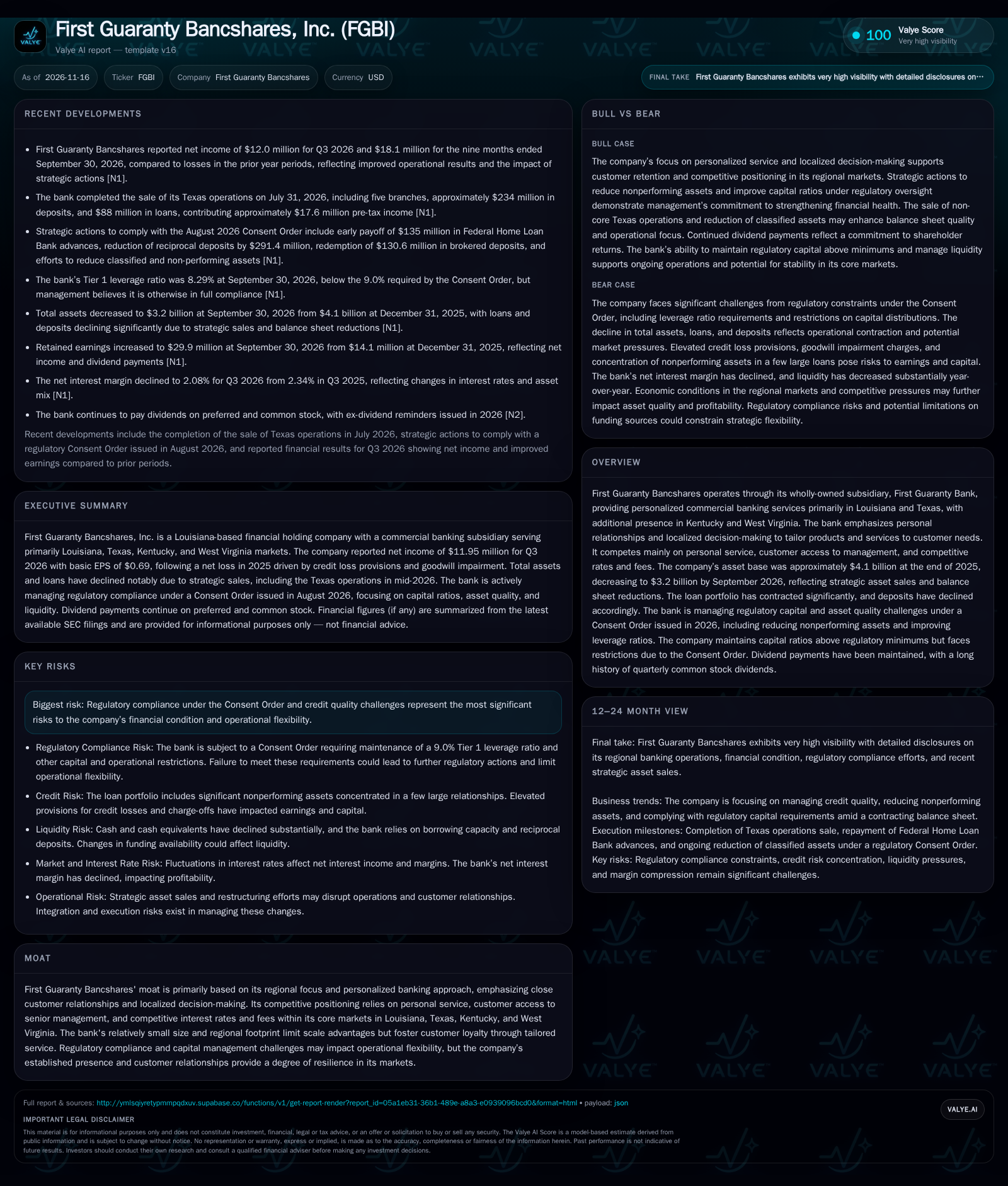
First Guaranty Bancshares has seen its total assets contract sharply from $4.1 billion at the end of 2025 to $3.2 billion as of September 30, 2026—a reduction driven largely by the sale of its Texas operations, which included five branches, $234 million in deposits, and $88 million in loans. This transaction contributed a one-time pre-tax gain of $17.6 million but also accelerated the downsizing of the bank’s balance sheet [S2] [N1].
The bank is operating under a regulatory Consent Order issued in August 2026, which compels it to maintain a minimum 9.0% Tier 1 leverage ratio. The actual ratio stood at 8.29% as of September 2026, below the mandated threshold. To address this, management has reduced leverage, paid down $135 million in Federal Home Loan Bank advances, and redeemed substantial brokered and reciprocal deposits [S2] [N1].
Profitability rebounded in Q3 2026 with reported net income of $11.95 million and EPS of $0.69, reversing a $56 million net loss in 2025 that was driven by goodwill impairment and high credit loss provisions. However, the underlying net interest margin declined to 2.08% in Q3 2026, down from 2.34% a year earlier, reflecting both higher funding costs and a less favorable asset mix [S2] [N1].
How Asset Mix, Funding Costs, and Credit Quality Shape Bank Earnings Power
At its core, First Guaranty’s earnings model hinges on deploying low-cost deposits into loans and securities that generate a spread—its net interest margin (NIM). The recent decline in NIM from 2.34% to 2.08% is meaningful: even small reductions in spread compress overall profitability, especially as the bank’s fixed-cost base (branches, personnel, compliance) is not easily downsized in tandem with the shrinking balance sheet [S2] [N1].
The bank’s move to sell its Texas assets and reduce brokered and reciprocal deposits sharply curtailed both earning assets and funding, suggesting a pivot away from growth toward regulatory compliance and risk containment. Such actions typically reduce short-term revenue but may stabilize capital and lower risk-weighted assets, improving regulatory ratios. However, smaller scale reduces operating leverage, which could pressure efficiency ratios and limit future earnings recovery unless offset by cost cuts or fee income growth.
Credit quality is another critical swing factor. The allowance for credit losses has increased to 2.30% of loans, and nonperforming assets remain concentrated in a few large relationships. While management is actively selling and writing down OREO and classified assets, further credit shocks could erode capital and force additional loss provisions, especially in a contracting loan book [S2] [N1].
Relationship Banking Versus Scale, Efficiency, and Regulatory Drag
First Guaranty’s competitive posture is grounded in personalized service, local decision-making, and senior management accessibility—traits that support customer loyalty in its core Louisiana and adjacent markets. This relationship-driven model can help retain core deposits and small business customers even as larger banks compete on technology and national reach.
However, the bank’s regional focus and moderate size limit economies of scale, making it vulnerable to fixed-cost absorption issues as the balance sheet contracts. Larger regional and super-regional banks often have more diversified funding, superior digital platforms, and greater ability to absorb compliance costs or invest in technology.
Recent regulatory constraints—specifically the Consent Order and its capital requirements—further restrict strategic flexibility. The inability to grow assets, originate new loans freely, or expand into new markets may cede ground to both traditional competitors and fintech-driven deposit gatherers. The question is whether the bank’s relationship model can maintain enough customer stickiness and pricing power to offset these structural disadvantages.
Regaining Regulatory Compliance and Restoring Core Profitability
The favorable scenario is predicated on the bank successfully executing its regulatory remediation plan: reducing problem assets, rebuilding capital ratios above the 9.0% Tier 1 leverage threshold, and returning to normalized earnings power. If nonperforming assets continue to decline and credit costs stabilize, the bank could reallocate capital to core lending, rebuild its deposit base, and begin to expand net interest income.
Confirmation would come from a sustained drop in nonperforming loans and OREO, visible improvement in the Tier 1 leverage and risk-based capital ratios, and a reversal in NIM compression—perhaps through a more favorable funding mix or targeted loan growth in higher-yielding segments.
This scenario would be falsified if credit quality deteriorates further, if capital actions fail to achieve regulatory thresholds, or if ongoing margin compression outweighs cost savings and asset sales.
Navigating a Prolonged Period of Constrained Growth and Regulatory Oversight
In a base case, First Guaranty Bancshares remains in a holding pattern, focused on compliance and gradual risk reduction rather than growth. The bank continues to operate under the Consent Order, with management prioritizing incremental improvements in capital ratios and asset quality. Net interest margin may remain compressed as funding costs stay elevated and loan demand is tepid, limiting the pace of earnings recovery.
Credit costs could stabilize but remain above historical averages, given the concentration of nonperforming assets and ongoing economic uncertainty in core markets. The bank may maintain profitability at modest levels, supported by cost controls and selective asset sales, but without a clear catalyst for renewed expansion.
Strategic flexibility is likely to remain limited until regulatory restrictions are lifted. This scenario would be characterized by slow progress on key metrics—such as Tier 1 leverage ratio, nonperforming asset reduction, and efficiency ratio improvement—without a decisive inflection in growth or profitability.
Credit Deterioration or Regulatory Escalation Forces Further Contraction
The adverse scenario is that ongoing credit challenges—especially in large, concentrated nonperforming loans—trigger further losses and erode capital below regulatory minimums, leading to heightened regulatory intervention or forced asset sales. If economic conditions in the bank’s markets weaken, or if higher interest rates accelerate problem loan formation, provisions could spike again.
If the Tier 1 leverage ratio fails to meet the Consent Order threshold despite asset reductions, the bank could face additional regulatory sanctions, restrictions on dividends or new business, or even a forced merger or sale. Persistent NIM compression—especially if funding costs rise or deposit competition intensifies—could further sap earnings and capital.
This scenario would be confirmed by rising nonperforming asset balances, further increases in loan loss provisions, missed regulatory capital targets, or new regulatory actions. It would be falsified by stabilization in credit quality, successful capital restoration, and a return to modest profitability.
Milestones That Will Reveal Whether First Guaranty’s Turnaround Is Gaining Traction
Quarterly Tier 1 leverage ratio progression relative to the 9.0% Consent Order threshold—improvement or further slippage will be a direct gauge of regulatory compliance.
Net movement in nonperforming assets and OREO balances—continued reductions would signal progress in risk management and asset quality.
Allowance for credit losses as a percentage of loans—stabilization or reduction would suggest credit normalization; further increases would imply ongoing risk.
Net interest margin trends—reversal of recent declines would indicate improving profitability and funding mix.
Deposit and loan growth (or contraction)—stabilization after the Texas sale would demonstrate franchise resilience; continued declines would raise strategic concerns.
Regulatory disclosures regarding the status or potential lifting of the Consent Order—removal would materially increase strategic flexibility.
Expense trends and efficiency ratio—cost discipline will be crucial in offsetting lost scale and margin compression.
Disclaimer: This is research-only, informational analysis and not investment advice. It may include AI-generated interpretation and general industry context. Always verify important details using primary sources.

Comments