
ODNB Financial Corp: Navigating Opaque Fundamentals and the Implications of Minimal Disclosure
With only basic quarterly profit data and no public details on its business model, ODNB Financial Corp presents a challenging case for fundamental analysis.
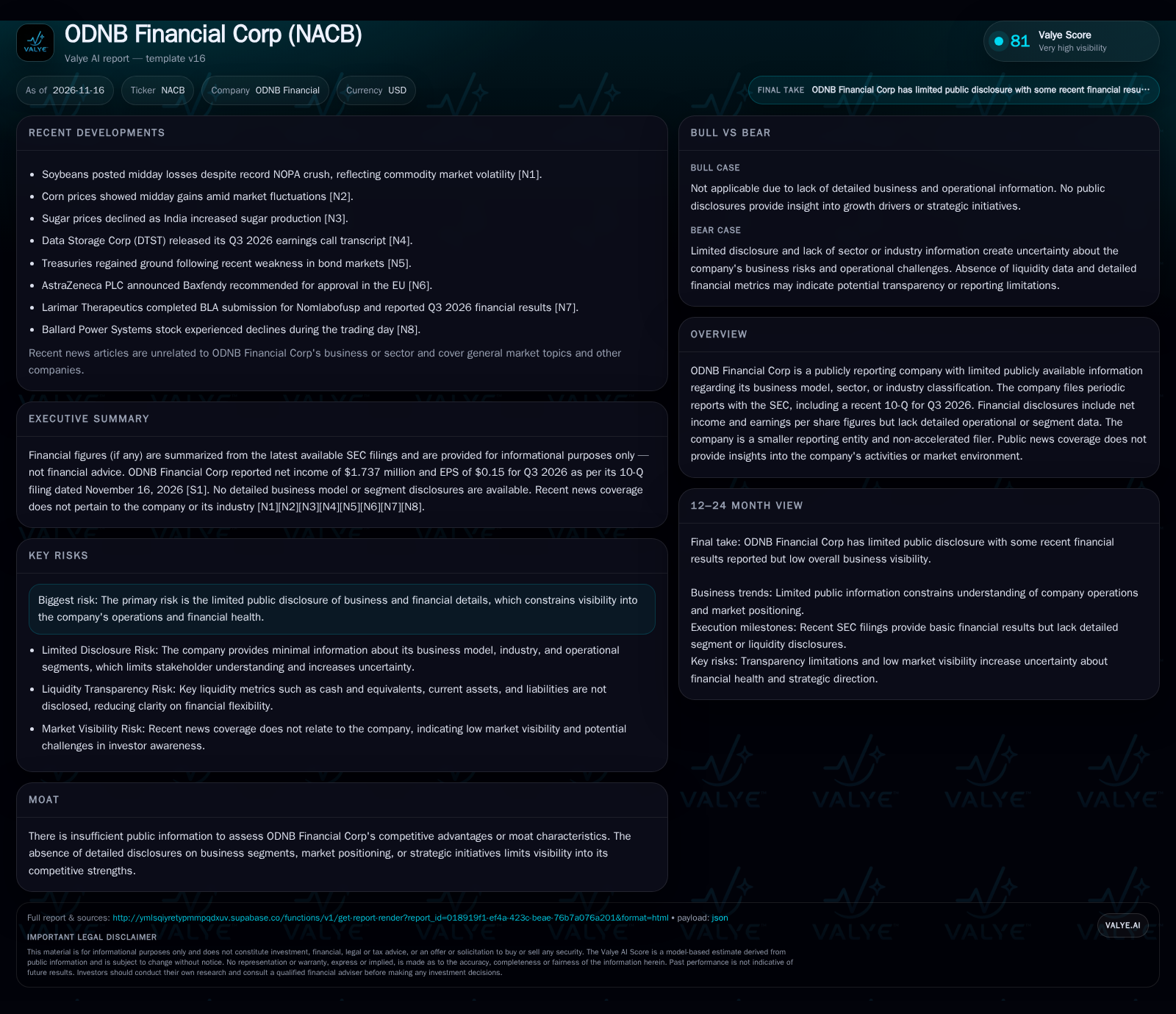
ODNB Financial Corp reported positive net income for Q3 2026 but offers no material disclosures on its business activities, liquidity, or industry context. This lack of transparency limits any thorough assessment of sustainable profitability, risk profile, or competitive positioning. Investors must weigh the significance of reported earnings against the heightened uncertainty that comes from such limited disclosure. [S1]
ODNB Financial Corp’s latest quarterly filing reveals a positive net income and basic earnings per share, but little else about the company’s operations, business model, or financial health. In the absence of revenue, liquidity, or segment disclosures, stakeholders are left with a single snapshot of profitability that is difficult to contextualize. This extreme opacity raises both practical and strategic questions: Is the reported profit sustainable? What are the underlying risks? And does the lack of transparency itself constitute a material risk for investors and partners? In this analysis, we examine the implications of such limited disclosure and explore the plausible economic, competitive, and risk scenarios for ODNB Financial Corp. [S1]
What We Know: Sparse Profitability Data and a Void of Operational Clarity
The most material current facts about ODNB Financial Corp are its reported net income of $1,737,000 for Q3 2026 and earnings per share of $0.15, based on 11,462,065 shares outstanding as of November 16, 2026 [S1]. The company is identified as a non-accelerated filer and a smaller reporting company, which typically correlates with less extensive SEC reporting requirements and, often, with companies at an earlier stage or operating in niche markets. Notably, there is no public disclosure of revenue, segment breakdowns, liquidity, or even a stated industry classification. Recent news coverage offers no relevant context for the company’s activities or environment. These omissions are material because they prevent any conventional analysis of business quality, financial resilience, or strategic direction.
Interpreting Earnings Without Context: What Could Drive the Economics
In the absence of revenue, cost structure, or business model disclosures, the reported net income and EPS are difficult to interpret as indicators of sustainable economics. If we assume ODNB Financial Corp operates in a typical financial or service sector, earnings could be generated from interest spreads, fee income, or advisory services, each with distinct margin and risk profiles. Alternatively, if the company is active in investment, asset management, or specialty finance, results could be volatile and dependent on market or transactional events.
Without information on recurring versus non-recurring income, fixed versus variable cost base, or capital requirements, we cannot assess the durability of margins or the presence of operating leverage. The lack of liquidity disclosures is particularly significant: a company reporting positive net income but with constrained cash or working capital could face operational risks or be reliant on external financing. Conversely, a business with a lean, asset-light model might exhibit strong operating leverage if revenue scales without matching cost increases. Ultimately, the absence of these details makes it impossible to infer the underlying economic engine or its sustainability.
Can Competitive Advantages Be Inferred When the Business Is Unnamed?
With no public information on ODNB Financial Corp’s industry, products, or customer base, it is not possible to identify direct competitors or to benchmark performance. If ODNB operates in financial services, it could face competition from banks, specialty lenders, fintech platforms, or asset managers, each with different barriers to entry and margin structures. The company’s classification as a smaller reporting entity may indicate a focus on niche markets or underserved customer segments, where scale and brand are less decisive but regulatory compliance and relationship networks could matter.
However, absent disclosures on technology, distribution, or customer retention mechanisms, there is no way to assess switching frictions, pricing power, or network effects. The extreme opacity itself may be a disadvantage, as it could limit access to capital, deter potential partners, or result in higher perceived risk among counterparties. Conversely, a lack of visibility might be deliberate if the business model depends on proprietary strategies or operates in a highly regulated or sensitive domain.
How Limited Disclosure Could Mask Underappreciated Value
One positive scenario is that ODNB Financial Corp’s minimal disclosures reflect an early-stage or niche business with a sustainable, high-margin model that has not yet attracted significant market attention. In this scenario, the reported net income would be representative of underlying earnings power, and the absence of news coverage would simply reflect a lack of promotional activity rather than operational weakness.
Confirmation of this thesis would require future filings to reveal consistent profitability, the emergence of recurring revenue streams, and eventual disclosure of business activities, customer relationships, or growth initiatives. Evidence that would falsify the upside case would include future restatements, unexplained volatility in earnings, or the emergence of one-off items driving reported profit. A future capital raise or liquidity event, if accompanied by expanded disclosures, could also reveal whether the company has been undervalued due to its opacity.
The Most Plausible Middle Ground: Ongoing Opacity and Persistent Uncertainty
The most likely scenario is that ODNB Financial Corp continues to provide minimal public information, reporting intermittent profitability without revealing its economic model or risk factors. This pathway suggests the company operates in a niche or lightly regulated corner of the financial sector, or that it is deliberately limiting disclosure for strategic or operational reasons.
In this scenario, investors and stakeholders will remain unable to assess the sustainability of earnings, the adequacy of liquidity, or the nature of business risks. The company may continue to meet basic SEC reporting requirements but not provide enough data to support robust valuation or risk analysis. Confirmation would come from further quarters of basic profit disclosures without expanded transparency, while falsification would occur if the company begins to provide segment, liquidity, or operational detail, or if it ceases to file periodic reports.
When Lack of Transparency Conceals Material Risks
The adverse scenario is that ODNB Financial Corp’s limited disclosure masks underlying problems, such as irregular or unsustainable sources of profit, liquidity constraints, or even regulatory or governance issues. In this case, the reported net income could be a function of non-recurring events, accounting maneuvers, or extraordinary items rather than ongoing business activity.
This risk would be confirmed by future filings that reveal negative surprises: sudden losses, restatements, going-concern warnings, or the need for emergency financing. A further red flag would be a cessation of SEC filings or a move to deregister as a public company. Investors would then have little recourse, as the lack of historical disclosure would make it difficult to reconstruct the true state of the business ex post.
Milestones That Could Illuminate ODNB Financial Corp’s True Business Quality
Disclosure of revenue, gross margin, or business segment data in future filings would provide essential context for profitability.
Any statement of cash, cash equivalents, or working capital would help assess liquidity and potential financial flexibility.
A useful metric would be the identification of recurring versus non-recurring income sources, clarifying earnings quality.
Disclosure of customer concentration, contract duration, or relationship depth would help gauge revenue visibility and risk.
If disclosed, details on capital expenditures or investment commitments would clarify capital needs and growth ambitions.
Publication of industry classification or peer comparisons would allow benchmarking of performance and risk.
Evidence of regular, timely SEC filings and the absence of going-concern warnings would support a case for basic operational stability.
The appearance of relevant news coverage, analyst attention, or investor communications would indicate rising market visibility.
Disclaimer: This is research-only, informational analysis and not investment advice. It may include AI-generated interpretation and general industry context. Always verify important details using primary sources.

Comments