
60 Degrees Pharmaceuticals: Clinical Ambition Confronts Capital and Compliance Headwinds
60 Degrees Pharmaceuticals is advancing niche infectious disease therapies such as tafenoquine for babesiosis, but persistent net losses, low equity, and Nasdaq compliance risks threaten business continuity. Recent fundraising and clinical progress provide some momentum, yet capital constraints and regulatory setbacks could disrupt long-term value creation.
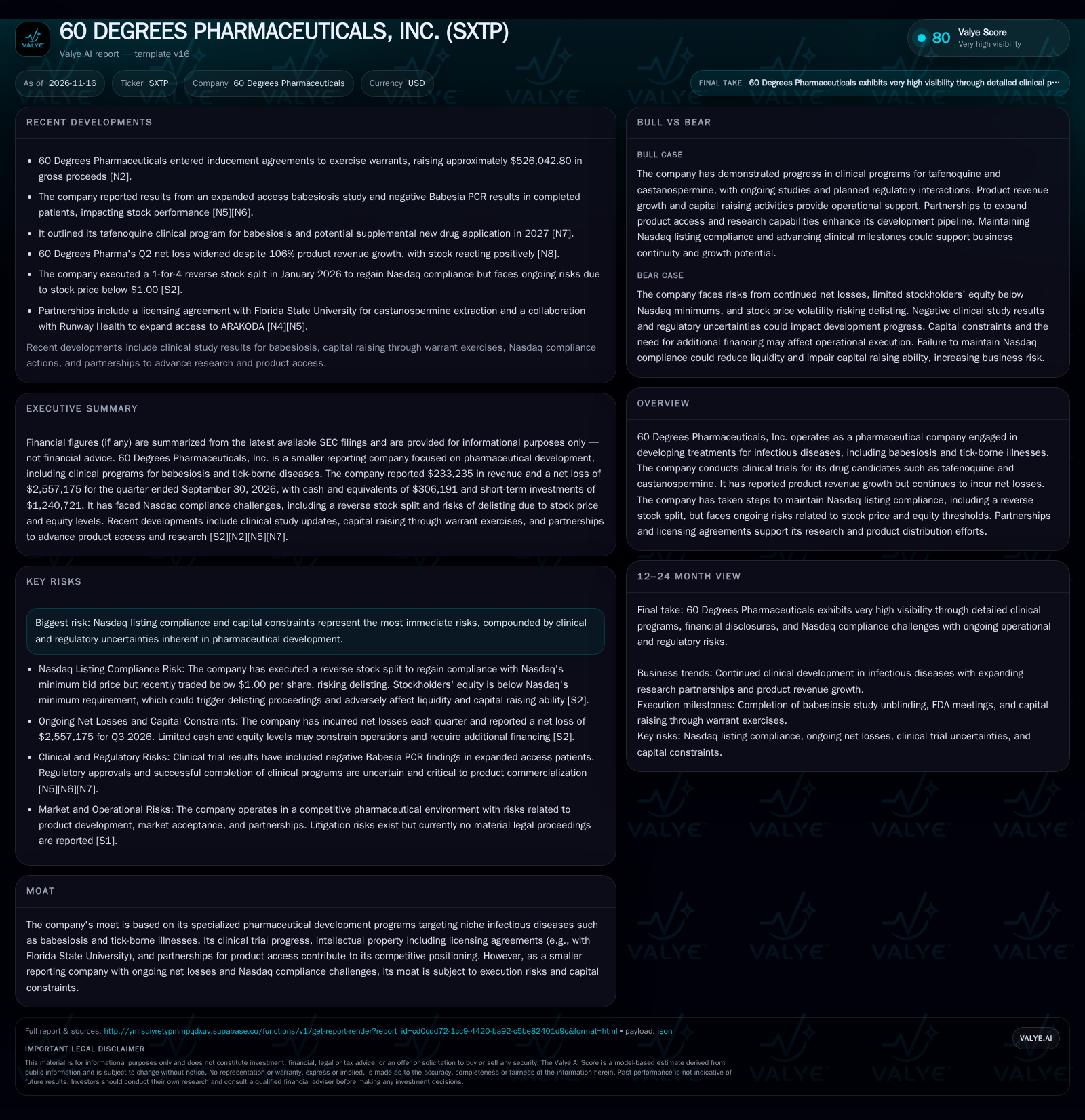
60 Degrees Pharmaceuticals continues to develop treatments for infectious diseases, reporting product revenue growth and recent fundraising through warrant exercises. However, ongoing net losses, stockholder equity below Nasdaq minimums, and a sub-$1.00 share price endanger its listing and operational flexibility. Clinical progress—especially with tafenoquine—remains a critical lever, but capital constraints and regulatory hurdles will define the company's near-term trajectory. [S2] [N2] [N8]
60 Degrees Pharmaceuticals sits at a critical juncture: while the company has demonstrated product revenue growth and advanced its clinical pipeline for infectious diseases, it remains deeply unprofitable and faces immediate existential threats from Nasdaq compliance breaches. This analysis explores how the company’s economics, competitive context, and strategic options could shape its future.
Latest Developments Heighten Urgency Around Compliance and Capital
60 Degrees Pharmaceuticals reported Q3 2026 revenue of $233,235 but posted a net loss of $2,557,175, continuing its pattern of unprofitable operations even as product revenue grows [S2] [N8]. As of September 30, 2026, the company held $306,191 in cash and equivalents and $1,240,721 in short-term investments, resulting in a current ratio of 1.17 and a cash ratio of 0.71 [S2]. Stockholders’ equity stood at $755,911—far below the Nasdaq’s $2.5 million minimum—while the company’s share price remains under $1.00 despite a 1-for-4 reverse stock split in January 2026, putting its listing at risk [S2]. To shore up liquidity, the company recently raised $526,042.80 through inducement agreements to exercise warrants [N2]. These facts underscore an acute need for capital and regulatory compliance, even as clinical and commercial progress continues.
How the Economics of Drug Development Shape Viability
The core of 60 Degrees Pharmaceuticals’ business model is the development and commercialization of drugs for infectious diseases—primarily babesiosis and other tick-borne illnesses. Revenue is currently derived from product sales, but the scale remains modest, and cost structures are dominated by R&D and regulatory expenses. This high fixed-cost, low-revenue dynamic is typical of early-stage pharma, where operating leverage is only realized if a product achieves significant market adoption or secures premium pricing following regulatory approval.
The company’s recent product revenue growth suggests some degree of market traction, but persistent net losses indicate that existing sales volumes are insufficient to cover fixed costs or meaningfully fund further development [N8] [S2]. Funding requirements are likely to remain elevated, with milestone-based clinical trials, regulatory submissions, and commercialization efforts all demanding capital. The recent warrant exercise provided a modest cash infusion, but unless additional non-dilutive funding or larger-scale equity raises can be secured, the company may face a choice between dilutive financings and further cost reductions—potentially slowing pipeline progress.
Pharmaceutical pricing power is often contingent on product differentiation, regulatory exclusivity, and payer acceptance. If tafenoquine or future candidates secure FDA approval and are included in key treatment guidelines, the company could see step-function revenue expansion and margin improvement. However, until such inflections occur, the economics remain structurally unfavorable, with high cash burn and dependency on external capital.
Positioning in a High-Risk, Niche Pharma Landscape
60 Degrees Pharmaceuticals operates in the competitive and capital-intensive pharmaceutical sector, but its focus on niche infectious diseases such as babesiosis provides both opportunity and risk. The addressable market for these indications is smaller and less crowded than for major chronic diseases, potentially allowing faster regulatory pathways and reduced direct competition. However, niche focus also means less revenue diversification and higher vulnerability to clinical or regulatory setbacks in its lead programs.
The company’s competitive position is bolstered by clinical progress in tafenoquine and ongoing research partnerships, including licensing agreements with academic institutions. Intellectual property protection and first-mover advantage in underserved indications could provide barriers to entry if regulatory milestones are achieved. That said, larger pharmaceutical companies or well-capitalized peers targeting infectious diseases could outspend 60 Degrees in clinical trials, commercialization, or in-licensing, especially if initial results generate broader interest.
Substitute therapies—whether existing off-label treatments or new entrants—pose ongoing risk, particularly if clinical data for tafenoquine or other candidates fail to show clear superiority. The company’s ability to establish payer acceptance and physician adoption will be critical to realizing any commercial moat.
Breakthroughs in Clinical Data and Regulatory Milestones Unlock Value
The most favorable trajectory for 60 Degrees Pharmaceuticals centers on successful clinical outcomes from its tafenoquine program and other pipeline candidates, leading to regulatory approval and market uptake in babesiosis and related diseases. If the company delivers positive efficacy and safety data, secures FDA approval (potentially via a supplemental new drug application in 2027 [N7]), and achieves inclusion in key treatment guidelines, product revenue could scale rapidly—potentially transforming the company’s economics.
Such a scenario would likely be confirmed by: (1) consistently positive clinical trial results, (2) successful regulatory filings and acceptances, (3) new or expanded commercial partnerships, and (4) evidence of meaningful uptake in target markets. Additional non-dilutive funding—such as grants, milestone payments from partners, or licensing deals—would further strengthen the case for sustainable growth and reduce reliance on dilutive equity raises.
Falsification would come from negative or inconclusive clinical trial results, regulatory setbacks, or an inability to secure commercial partnerships, which would delay or prevent revenue inflection and threaten the company’s viability.
Incremental Progress, Ongoing Losses, and Capital Uncertainty Define the Likely Course
The most plausible outcome is that 60 Degrees Pharmaceuticals continues to make incremental progress in its clinical and commercial programs, but remains constrained by ongoing net losses and capital scarcity. Modest product revenue growth may persist, supported by niche market adoption, but unlikely to cover the high fixed costs of pharmaceutical development in the near term.
Nasdaq compliance remains a chronic risk, with the company’s equity and share price both below required thresholds. Periodic capital raises—whether via warrant exercises, small equity financings, or partnership payments—may provide temporary relief, but each round brings dilution and uncertainty about long-term solvency.
Confirmation of this scenario would come from continued but slow revenue growth, persistent net losses, and repeated compliance warnings or extensions from Nasdaq. Falsification would require a decisive shift—either a major clinical/regulatory win or a material deterioration in financial or operational execution.
Delisting, Capital Exhaustion, and Clinical Setbacks Threaten Business Continuity
The most adverse outcome is a convergence of negative clinical results, failed regulatory milestones, and an inability to raise sufficient capital. In this scenario, 60 Degrees Pharmaceuticals could lose its Nasdaq listing—either due to persistent sub-$1.00 share price or inadequate stockholders’ equity—which would restrict access to public equity markets, reduce liquidity, and impair investor confidence.
If clinical programs fail to deliver positive results or regulatory agencies reject key applications, the company’s lead assets may be devalued, making additional capital even harder to secure. In such a situation, operations could be severely curtailed, assets might be sold at distressed valuations, or the company could enter restructuring or liquidation.
Confirmation would come from delisting notices, failed or abandoned clinical trials, inability to close new financings, or sharp reductions in operational activity. Falsification would require stabilization of the share price, equity infusions sufficient to regain compliance, or unexpectedly positive clinical developments.
Milestones That Will Determine 60 Degrees Pharmaceuticals’ Strategic Trajectory
Progress and results in ongoing tafenoquine clinical trials for babesiosis, including any interim safety or efficacy data releases.
Regulatory milestones, especially the timing and outcome of a potential supplemental new drug application (sNDA) for tafenoquine in 2027.
Updates on Nasdaq compliance status—specifically, any notices, extensions, or actions related to the minimum bid price and stockholders' equity requirements.
Quarterly trends in product revenue growth, including absolute figures and growth rates (if disclosed), to assess commercial traction.
Changes in cash, equivalents, and short-term investments, particularly in relation to planned R&D and operational outflows.
Announcements of new partnerships, licensing arrangements, or non-dilutive funding that could diversify capital sources.
Any further reverse stock splits or capital structure changes aimed at maintaining listing status.
Disclosure (if any) of pipeline expansion or new indications beyond current infectious disease programs.
Disclaimer: This is research-only, informational analysis and not investment advice. It may include AI-generated interpretation and general industry context. Always verify important details using primary sources.

Comments