
Tariffs, Technology, and Domestic Expansion: Retractable Technologies’ Strategic Crossroads in Safety Syringes
Retractable Technologies, Inc. stands at a pivotal moment as its patented safety syringes face acute cost headwinds from surging China tariffs. With government-backed domestic capacity coming online, the company’s future will hinge on its ability to balance cost competitiveness, regulatory navigation, and differentiation in a market dominated by larger rivals.
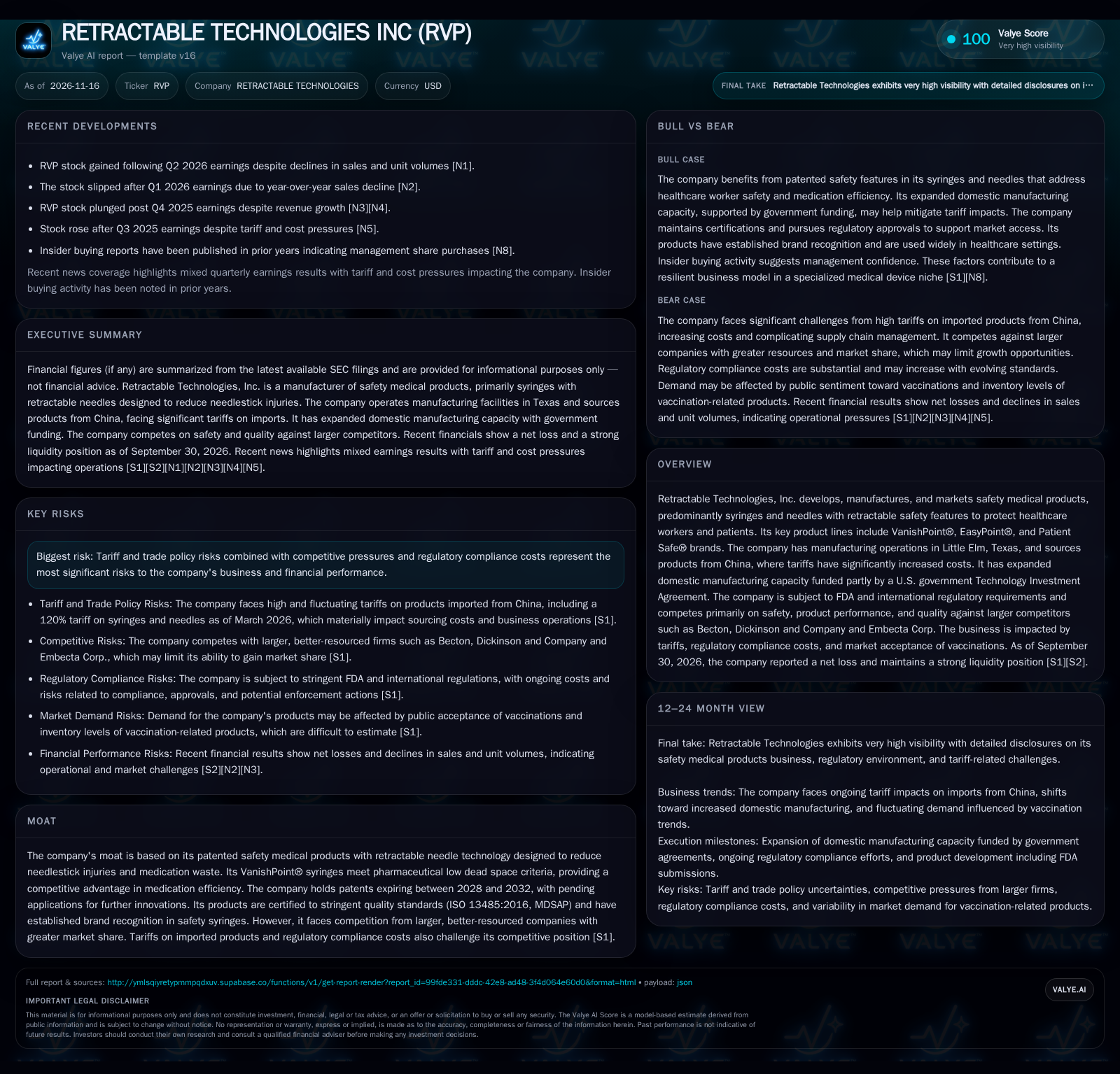
Retractable Technologies, Inc. is navigating a complex landscape shaped by a 120% tariff on China-sourced syringes, net losses, and competitive pressure from industry giants. The company has responded by expanding U.S. manufacturing with government funding and leveraging patented safety features. The next phase depends on whether domestic production can offset cost inflation and sustain product differentiation in a tightly regulated, price-sensitive market. [S1] [S2]
Retractable Technologies, Inc. (RVP) is at a strategic inflection point. Once buoyed by unique needle-safety technology and pandemic-driven demand, the company now faces acute cost inflation from a 120% tariff on China-sourced syringes and needles, while reporting ongoing net losses. To counteract this, RVP has invested heavily—backed by U.S. government funding—in expanding domestic manufacturing. The critical question: Can the combination of patented safety features and new U.S. capacity restore competitiveness and reverse recent declines, or will regulatory, pricing, and scale disadvantages continue to weigh on performance?
Surging Tariffs and Domestic Expansion Shape the Current Reality
As of November 2026, Retractable Technologies is contending with a 120% tariff on China-imported syringes and needles—an extraordinary escalation that directly impacts its cost of goods and product sourcing strategy. This development is especially material given the company's reliance on both domestic and outsourced manufacturing, with China previously a key supplier. The company has responded by accelerating domestic capacity expansion, funded in part by an $81 million Technology Investment Agreement with the U.S. Department of Defense and BARDA, bringing new production online in Texas. [S1]
Financially, the company reported a net loss of $2.36 million for the quarter ended September 30, 2026, and reported liquidity-ratio trends of 4.54, supported by $1.89 million in cash and $64.64 million in current assets. The company reported cash and liquidity metrics for the period; these figures do not by themselves establish operating runway, investment capacity, financial flexibility, or financing capacity. [S2]
Product mix remains concentrated: syringes accounted for 65.1% of sales in 2025, with EasyPoint® products at 31.2%, emphasizing the company’s dependence on a single product category exposed to both tariff and competitive pressures. [S1]
Cost Structure Transformation and the Quest for Margin Recovery
Retractable Technologies’ revenue model is built on the sale of proprietary safety syringes and related medical devices, marketed under the VanishPoint®, EasyPoint®, and Patient Safe® brands. Pricing in this segment is constrained by hospital procurement budgets and GPO-negotiated contracts, with incremental volume often won through competitive bidding. Historically, the company’s patented retractable needle technology offered a premium niche, but price sensitivity remains high across the healthcare system.
The imposition of a 120% tariff on China-sourced products has radically altered the company’s cost structure by sharply increasing input costs for imported syringes and needles. This erodes gross margins—unless offset by price increases (challenging in a commoditized market) or a rapid shift to lower-cost domestic production. The $81 million government-funded expansion in Texas is a direct strategic response, aiming to internalize manufacturing, reduce tariff exposure, and potentially regain lost margin. [S1]
Operating leverage is a double-edged sword: higher fixed costs from the new facility increase the need for consistent volume to achieve breakeven, but also offer the potential for margin expansion if capacity is filled and cost advantages materialize. The capital intensity of medical device manufacturing—especially with regulatory-mandated quality systems—means that underutilized capacity could amplify losses, while efficient ramp-up could restore profitability.
Regulatory compliance (FDA, ISO 13485:2016, MDSAP, EU MDR) adds to fixed expenses but is non-negotiable for market access. These requirements may create a modest barrier to entry but also limit flexibility in cost-cutting during demand downturns.
Differentiation Versus Scale: Navigating a Market of Giants
Retractable Technologies’ core competitive advantage lies in its patented retractable-needle technology, which addresses the critical issue of needlestick injuries and medication waste in clinical practice. The VanishPoint® product’s low dead space design is particularly valued for reducing medication waste—an increasingly important feature as hospitals look to maximize drug utilization. [S1]
However, the company operates in a market dominated by Becton, Dickinson and Company (BD), Embecta Corp., and other large multinationals that benefit from global distribution, broader product portfolios, and significant economies of scale. These competitors can absorb input cost shocks, invest heavily in incremental innovation, and negotiate more favorable terms with large healthcare systems.
Switching frictions for hospitals are moderate: while safety features and regulatory certifications are important, procurement cycles are influenced by price, contract terms, and supply reliability. Retractable’s ability to win share depends on both sustaining its safety and efficiency claims and proving reliable, cost-competitive delivery—especially as tariffs disrupt legacy supply chains. The risk is that larger players may further leverage their scale to squeeze smaller competitors as cost pressures mount.
The company’s patent portfolio (expiring 2028-2032) provides some temporal protection, but the durability of its moat is challenged by the potential for alternative safety technologies and the limited pricing power in a commoditized product category.
How Domestic Scale and Safety Features Could Reignite Profitability
The most favorable scenario for Retractable Technologies hinges on a successful, rapid ramp-up of U.S.-based manufacturing, allowing the company to significantly reduce or eliminate reliance on high-tariff China imports. If the Texas facility achieves targeted throughput and cost efficiencies, gross margins could recover—especially if the company leverages its government partnership to win new contracts or preferred supplier status in public health initiatives.
In this scenario, the company’s patented safety features and established regulatory certifications (FDA, ISO, MDR) would reinforce its value proposition, supporting not only retention of existing hospital accounts but also new customer wins, particularly where needlestick injury reduction is a procurement priority.
Confirmation of this scenario would come from sequential margin improvement, stabilization or growth in sales volumes, evidence of new multi-year supply agreements, and public sector contract wins. Additional signals could include successful EU MDR certification, patent extensions, or new product launches that expand the company’s addressable market.
Cost Headwinds Partially Offset by Domestic Production—But Growth Remains Elusive
The most plausible near-term trajectory is that Retractable Technologies manages to partially offset tariff-driven cost inflation by ramping up domestic output, but continues to face margin compression and subdued volume growth. The company’s product quality and regulatory compliance maintain its presence in safety-sensitive hospital segments, but sustained competitive pricing from larger players and a cautious procurement environment limit share gains.
Sales mix remains stable—dominated by syringes with only incremental growth from secondary product lines (such as EasyPoint®). Regulatory compliance costs and fixed expenses for the expanded Texas facility keep operating leverage high, so profitability remains sensitive to modest changes in demand or pricing.
This scenario would be confirmed by continued net losses or only marginal improvements in profitability, stable but unremarkable sales volumes, and ongoing commentary in filings about tariff, cost, and competitive pressures.Insider transaction activity was reported in the cited source; this activity does not by itself establish insider confidence.
Margin Squeeze and Demand Volatility Threaten Sustainability
A more adverse scenario would see tariff-driven cost inflation outpacing the company’s ability to shift production or raise prices, leading to further margin erosion and deepening net losses. If the new U.S. facility faces operational delays, underutilization, or quality issues, the fixed cost burden could exacerbate losses rather than relieve them.
Demand risk is amplified if vaccination-related purchasing remains weak or if hospitals turn to lower-priced alternatives from larger suppliers in response to cost pressures. Intensifying competition, especially if rivals introduce new safety features or price aggressively, could result in share losses.
Confirmation of this scenario would come from widening net losses, negative gross margins, reduced cash balances, or public disclosures of production or regulatory setbacks. A decline in customer retention, loss of major contracts, or inability to achieve targeted output from the new facility would further support the downside case.
What Will Determine Retractable Technologies’ Next Chapter?
Sequential gross margin trends—improvement would indicate successful mitigation of tariff impact; deterioration would signal further cost pressure.
Volume ramp and utilization rates at the new Texas manufacturing facility, if disclosed, would clarify whether domestic capacity is being efficiently absorbed.
Updates on major contract wins or losses, especially with government or large hospital systems, would reveal market acceptance and competitive traction.
Progress on regulatory milestones, including EU MDR certification and any new FDA submissions, would expand or sustain addressable markets.
Product mix evolution—shifts toward higher-margin or differentiated products (such as next-generation safety devices) would suggest strategic progress.
Any indications of further tariff changes, trade policy shifts, or new government support would materially affect the cost structure and strategic flexibility.
Insider transaction activity was reported in the cited source; this activity does not by itself establish insider confidence.
Disclaimer: This is research-only, informational analysis and not investment advice. It may include AI-generated interpretation and general industry context. Always verify important details using primary sources.

Comments