
FOXO Technologies: Diversification Ambitions Meet Acute Financial and Structural Constraints
FOXO Technologies is pursuing a diversified healthcare and life sciences platform spanning rural hospitals, behavioral health, biospecimen sourcing, and epigenetic diagnostics.
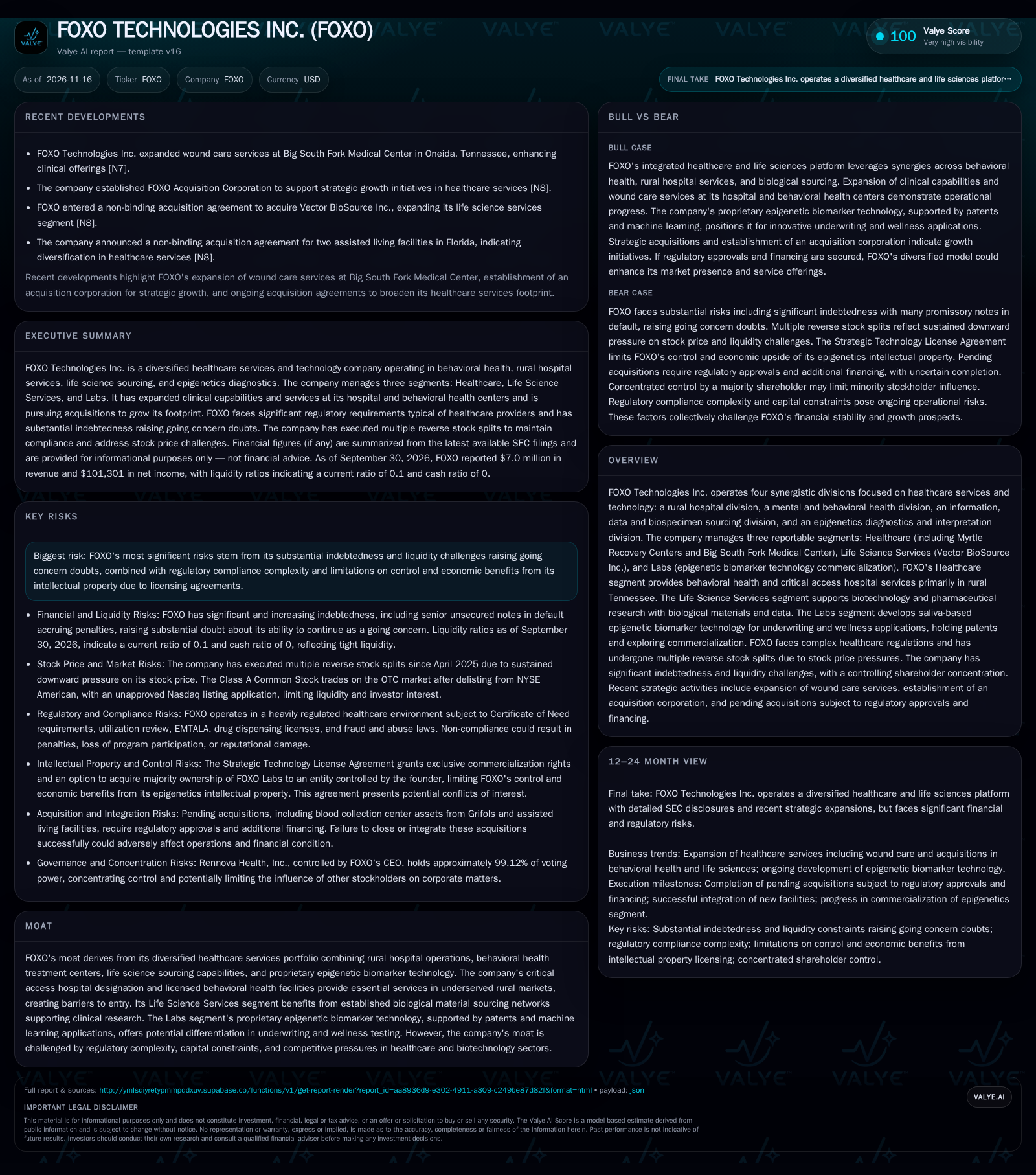
FOXO Technologies operates a multi-pronged healthcare and life sciences model, with recent expansions in hospital and behavioral health services and pending acquisitions in biospecimen sourcing and assisted living. However, the company’s acute liquidity crisis, substantial debt in default, and loss of control over its key epigenetics IP threaten both operational continuity and future upside. Execution on pending acquisitions and the ability to realize value from its technology portfolio will be decisive for its trajectory over the next 12-24 months. [S1] [S2] [N7] [N8]
FOXO Technologies Inc. stands at a precarious intersection of ambition and constraint. While the company touts a platform spanning rural healthcare delivery, behavioral health, biospecimen sourcing, and a proprietary epigenetics diagnostics technology, its financial foundation is deeply challenged. Recent expansions in clinical services and a flurry of acquisition agreements signal an aggressive diversification strategy. The next year will test whether FOXO can stabilize its balance sheet and realize value from its disparate assets—or whether its structural and financial headwinds will overwhelm its growth ambitions.
Liquidity Strain and Structural Shifts Define FOXO’s Present Reality
As of September 30, 2026, FOXO Technologies reported $7.0 million in revenue and net income of $101,301, but its liquidity position is acute: just $42,678 in cash and equivalents against current liabilities of $39.8 million, producing a current ratio of 0.1 and a cash ratio of zero. These ratios underscore a severe short-term funding gap. [S2]
The company’s debt burden is substantial, with senior unsecured notes in default and subject to restrictive covenants, raising explicit doubt about its ability to continue as a going concern. [S2]
Operationally, FOXO has recently expanded wound care services at its rural Tennessee hospital and established FOXO Acquisition Corporation to drive further growth in healthcare services. [N7] [N8]
Strategically, FOXO Labs’ core epigenetic biomarker technology is now under an exclusive commercialization license—with an option for majority acquisition—granted to an entity controlled by the founder, reducing FOXO’s control and future economic participation in this asset. [S2]
How FOXO’s Business Model Attempts to Bridge Healthcare and Life Sciences
FOXO’s economic model is built on three pillars: rural healthcare delivery (critical access hospital and behavioral health), life science services (biospecimen sourcing and data for pharma/biotech), and proprietary diagnostics (epigenetic biomarkers for insurance and wellness). Each segment faces distinct revenue mechanics and cost structures.
The rural hospital and behavioral health units rely on fee-for-service and payer reimbursements, with some exposure to government payers. These businesses typically generate thin margins, are capital intensive, and require ongoing investment in compliance, staffing, and clinical capabilities. Expansion into wound care and tele-specialty services may boost revenue per patient, but also increase fixed costs and regulatory complexity.
The Life Science Services segment, anchored by Vector BioSource, targets higher-margin B2B contracts by supplying biospecimens and data to research organizations. Gross margins here can be attractive if scale and reliable sourcing are achieved, but the economics are sensitive to contract volume, biospecimen quality, and the credibility of sourcing networks.
The Labs segment’s epigenetic biomarker platform could, in theory, command high-margin licensing or SaaS-like recurring revenue if adopted for insurance risk classification or wellness screening. However, FOXO’s recent licensing arrangement cedes commercialization control and future upside to a founder-affiliated entity, making the realization of these economics indirect and uncertain.
Competitive Realities: Niche Access, Regulatory Complexity, and Eroding Differentiation
FOXO’s competitive strengths are rooted in serving rural, underserved markets through its critical access hospital and licensed behavioral health centers. These segments face less direct competition than urban providers, and regulatory entry barriers (e.g., Certificate of Need) provide some protection. However, dependence on government reimbursement and the challenge of attracting clinical talent can erode these advantages.
In biospecimen sourcing, competition is intense, with established players and networks serving pharmaceutical and biotech clients. Success depends on reliability, compliance, and the ability to provide high-quality, well-characterized samples at scale. FOXO’s pending acquisition of blood collection assets could enhance its sourcing capability, but integration and reputation risk remain.
The epigenetics diagnostics segment represents the company’s most differentiated asset, but the exclusive licensing agreement and option granted to a founder-controlled entity diminish FOXO’s ability to build a defensible position or capture network effects. Competing diagnostic and biomarker firms, often with greater capital and commercialization expertise, could outpace FOXO in market adoption.
Across all segments, regulatory complexity—ranging from hospital licensing to biospecimen handling and diagnostics—raises fixed costs and exposes the company to compliance risk, which can be particularly acute for undercapitalized operators.
Unlocking Value: What Would Need to Go Right for FOXO
For FOXO to realize upside, several favorable developments would need to align: the company would need to secure bridge or long-term financing to stabilize liquidity and avoid further debt defaults; complete and successfully integrate its pending acquisitions (biospecimen assets and assisted living facilities), thereby expanding its service footprint and revenue base; and benefit from downstream royalty or fee streams as its epigenetic biomarker technology is commercialized—even if indirectly.
Confirmation of this upside scenario would include evidence of successful debt restructuring or new capital raised (without punitive dilution or loss of core assets), regulatory approval and closing of acquisitions, demonstrated revenue growth and improved operating margins from expanded services, and public disclosure of material income from the epigenetics licensing deal.
Falsification would occur if the company fails to secure essential financing, acquisitions fall through or prove loss-making, or the epigenetics asset fails to generate meaningful revenue for FOXO due to the licensing structure.
Stagnation Risk: Treading Water Amid Debt and Control Constraints
The most plausible middle path is that FOXO remains operational but constrained. The company may manage to maintain core hospital and behavioral health operations through incremental cost-cutting and piecemeal financing, but lacks the resources to fully realize synergies or scale new lines of business. Acquisitions may be delayed, renegotiated, or completed but remain marginally profitable due to underinvestment and integration challenges.
The epigenetics platform could generate some royalty or fee income, but the majority of strategic and economic benefit accrues to the licensee, not FOXO. The company’s ability to attract new capital or regain a major exchange listing remains limited, perpetuating a cycle of low liquidity and limited investor interest.
This scenario would be confirmed by stable but stagnant financials, recurring liquidity warnings, and minimal progress on acquisition integration or meaningful new revenue from the Labs segment.
Structural Failure: When Financial and Control Risks Converge
A negative scenario could unfold if FOXO is unable to service its defaulted debt or raise new capital, triggering creditor action, forced asset sales, or bankruptcy proceedings. In this scenario, operational disruptions could affect patient care and client relationships, eroding whatever goodwill exists in its rural hospital and behavioral health franchises.
If pending acquisitions collapse due to lack of financing or regulatory hurdles, FOXO’s diversification narrative would unravel, leaving the company with a shrinking core and no path to scale. The loss of control and economic interest in the epigenetics platform could leave FOXO with no differentiated growth engine, further undermining any recovery prospects.
Evidence confirming this scenario would include bankruptcy filings or asset liquidations, public notice of failed deals, loss of key contracts or licenses, and continued inability to raise capital even on highly dilutive terms.
Company-Specific Markers That Will Clarify FOXO’s Trajectory
Closing of the pending Grifols blood collection asset acquisition and the Florida assisted living facility deals; updates here will reveal whether FOXO can execute on its diversification strategy. [S2] [N8]
Any announced debt restructuring, new credit facilities, or equity raises—especially if terms are non-punitive and allow for operational stability. [S2]
Disclosures on royalty or fee income generated from the epigenetics licensing agreement; a useful metric would be the percentage of Labs segment revenue accruing from this arrangement if disclosed.
Progress in expanding and sustaining new wound care and tele-specialty services at Big South Fork Medical Center, including patient volume and payer mix data if available. [N7]
Trends in current liabilities, cash flows from operations, and working capital—any improvement here would suggest stabilization; continued deterioration would signal escalating risk. [S2]
Regulatory outcomes or compliance issues affecting any business segment, particularly relating to pending acquisitions or existing hospital and behavioral health operations.
Changes in voting control, board composition, or further dilution events—any shift could alter the company’s strategic flexibility or capital access.
Disclaimer: This is research-only, informational analysis and not investment advice. It may include AI-generated interpretation and general industry context. Always verify important details using primary sources.

Comments