
American Rebel Holdings: Brand Ambition in Beer Meets Structural Financial Strain
Strategic partnerships and event sponsorships offer potential for regional growth, yet the company’s capital structure and cash position present substantial obstacles to scaling in a fiercely competitive beverage market.
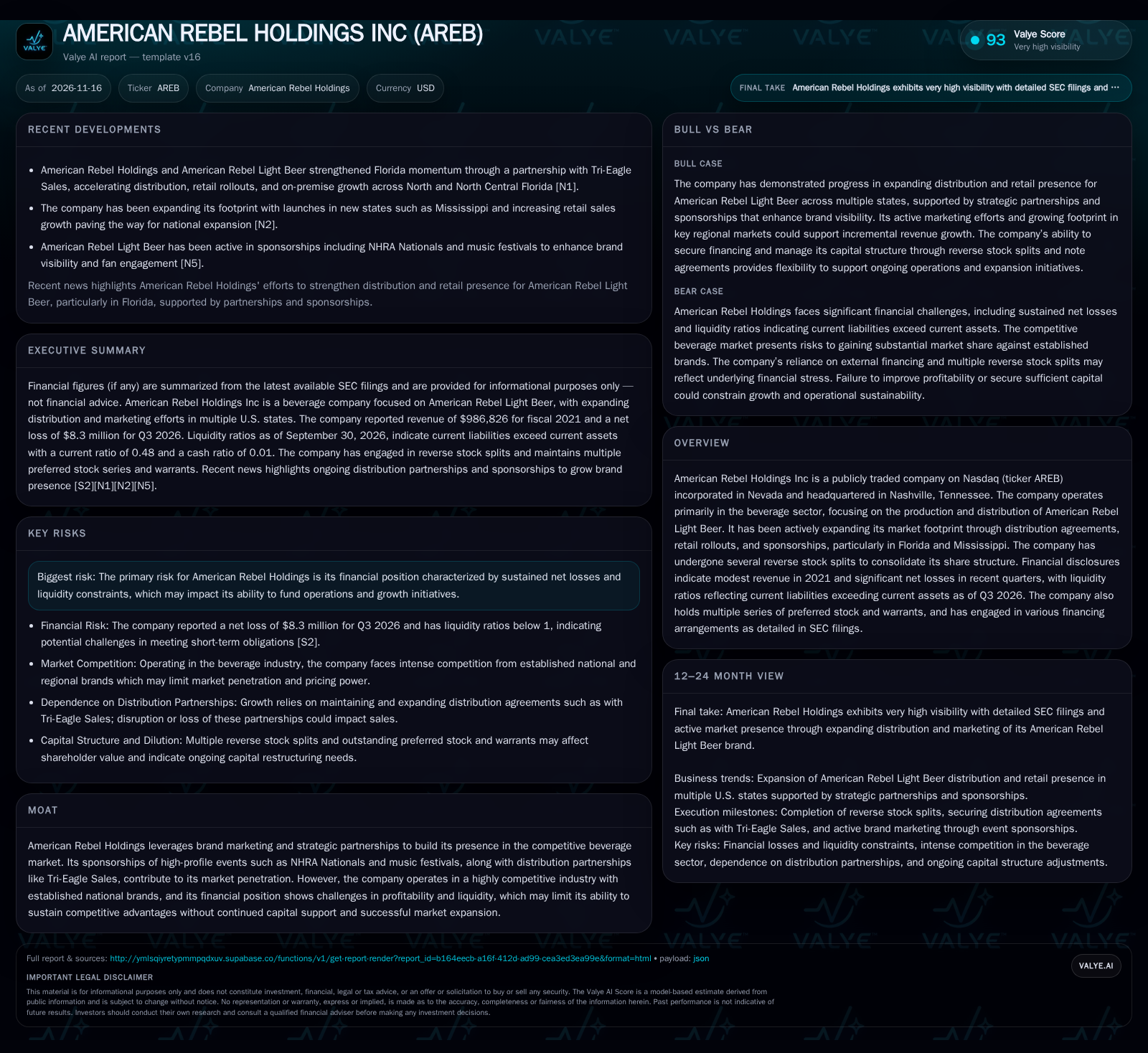
American Rebel Holdings is expanding its American Rebel Light Beer distribution through partnerships and event marketing, but the company faces sustained net losses, a current ratio of just 0.48, and a cash ratio of 0.01 as of Q3 2026. Multiple reverse splits and outstanding preferred stock signal ongoing capital-structure pressures. Future growth depends on both market traction and the ability to address acute liquidity and financing needs. [S2]
American Rebel Holdings is striving to carve out space in the crowded beverage sector by pushing American Rebel Light Beer into new markets via retail rollouts, distributor partnerships, and high-visibility sponsorships. The core question is whether American Rebel can build enough brand momentum and distribution scale to offset its persistent financial headwinds—or whether the structural disadvantages will prove too great in an industry dominated by giants.
Recent Financials and Strategic Moves Define the Immediate Reality
As of September 30, 2026, American Rebel Holdings reported a net loss of $8,332,518 for the quarter, with basic and diluted EPS at -$0.28. The company’s current liabilities stood at $30,408,926, dwarfing its current assets of $14,641,619 and leaving a current ratio of 0.48 and a cash ratio of just 0.01. This acute liquidity shortfall is compounded by a cash balance of only $213,850. The company has executed several reverse stock splits—including a 1-for-20 split in February 2026—and maintains multiple series of preferred stock and warrants, signaling ongoing capital structure pressures. Meanwhile, American Rebel Light Beer has expanded its distribution footprint through partnerships (notably with Tri-Eagle Sales in Florida) and event sponsorships, as the company attempts to build visibility and regional traction. [S1] [S2]
How American Rebel Could Monetize Beer—But Where Scale Meets Capital Constraints
The primary revenue engine for American Rebel Holdings is the production and sale of American Rebel Light Beer, a low-calorie entrant in a highly competitive segment. The company’s growth model depends on expanding distribution—both through wholesalers and direct retail placements—and amplifying brand awareness via event sponsorships and regional partnerships. In the beer industry, margins are typically thin at small scale, with economies of scale, route-to-market efficiency, and brand loyalty driving profitability for established players.
American Rebel’s capital needs are significant: entering new markets and sustaining marketing campaigns require upfront cash outlays and working capital to support inventory and receivables. The company reported cash and liquidity metrics for the period; these figures do not by themselves establish operating runway, investment capacity, financial flexibility, or financing capacity. The repeated reverse stock splits and presence of preferred stock and warrants suggest ongoing dilution risk for common shareholders as the company seeks external funding.
If American Rebel can achieve sufficient volume through new distribution agreements, it might be able to negotiate better production costs and logistics terms, improving gross margin. However, without clear evidence of accelerating revenue growth (most recent annual revenue disclosed was under $1 million for 2021 [S2]), achieving scale remains speculative. Fixed costs in production, distribution, and marketing could swamp early gross profit, resulting in continued operating losses unless volume ramps meaningfully.
Branding, Distribution, and Muscle: Where American Rebel Stands in the Beverage Fray
American Rebel competes against both national giants (e.g., AB InBev, Molson Coors) and a crowded field of regional craft and value beer brands. The beverage sector’s barriers to entry are formidable: entrenched distribution networks, massive marketing budgets, and consumer loyalty to legacy brands. American Rebel’s use of event sponsorships (NHRA Nationals, music festivals) and regional partnerships (Tri-Eagle Sales) is a standard tactic for new entrants seeking to build awareness and credibility.
However, these strategies only create lasting competitive advantage if they translate into repeat purchase and shelf-space retention. Without proprietary brewing processes, unique brand equity, or a differentiated route to market, American Rebel’s defensibility is limited. Its reliance on external distribution partners exposes it to the risk of being deprioritized in favor of higher-volume or more established brands. Moreover, the company’s financial constraints may limit its ability to match the sustained promotional outlays required to build a durable consumer franchise.
A Turnaround Hinges on Viral Brand Adoption and Partnership-Driven Scale
The most optimistic scenario for American Rebel Holdings is that recent distribution expansions and high-profile sponsorships drive a surge in consumer trial and repeat purchase of American Rebel Light Beer. If the brand gains traction—especially in states like Florida where Tri-Eagle Sales is active—retailers could allocate more shelf space, and distributors might prioritize the product, creating a virtuous cycle of volume growth and cost leverage.
Confirmation of this thesis would come from a marked acceleration in quarterly revenue, improving gross margins, and evidence of positive operating cash flow. Additional distribution agreements in new states, or the conversion of sponsorship-driven awareness into sustained retail velocity, would also support the upside case. Falsification would occur if revenue growth stalls despite marketing spend, or if there is evidence that new distribution partners are not renewing contracts or expanding placements.
Persistent Financial Strain Amid Incremental Distribution Gains
The likeliest outcome given current evidence is that American Rebel achieves incremental distribution gains in select markets but continues to struggle with cash burn and limited pricing power. Revenue may rise modestly as new retailers and distributors are added, but the scale needed to cover fixed costs and service liabilities remains out of reach in the near term.
This scenario would be confirmed by ongoing net losses, continued reliance on dilutive financing or debt, and a failure to materially improve liquidity ratios. If the company can at least stabilize its cash position and slow the rate of net loss, it may buy time to prove out the brand, but the window for self-sustaining growth appears narrow without a step-change in sales velocity or a strategic capital injection.
Liquidity Crisis and Distribution Setbacks Could Trigger Restructuring or Contraction
The adverse scenario is that American Rebel’s acute liquidity position and sustained net losses force the company into more aggressive restructuring—potentially including asset sales, bankruptcy protection, or a wind-down of operations. Distribution partners could become wary of supply disruptions or financial instability, leading to lost shelf space or terminated agreements.
Evidence of this scenario would include missed payments to suppliers, further reverse splits or recapitalizations, shrinking distribution footprints, or auditor going-concern warnings in SEC filings. If event sponsorships fail to convert into meaningful sales, the company could see both financial and brand momentum erode, making recovery unlikely without external rescue or acquisition.
Milestones That Will Clarify Whether American Rebel Can Overcome Its Financial Headwinds
Quarterly revenue growth by state or region—especially in markets served by new distribution agreements—would help test whether brand and distribution strategies are translating into real sales.
Gross margin trends, if disclosed, would indicate whether scale or pricing improvements are being achieved as the distribution footprint expands.
Cash flow from operations and changes in working capital will reveal if the company is progressing toward financial sustainability or deepening its cash burn.
The pace and terms of new financing or dilution events (e.g., additional reverse splits, preferred stock issuances, or warrants) will reflect the company’s ability to access capital and the cost to existing shareholders.
Retention and renewal of key distribution partnerships—such as Tri-Eagle Sales—will be critical to sustaining and growing shelf presence.
Updates on marketing ROI, such as event sponsorship conversion rates or repeat purchase metrics, if disclosed, would clarify whether brand investments are yielding durable customer relationships.
Any SEC filings indicating going-concern warnings, covenant breaches, or material adverse changes in supplier/distributor relationships would be strong signals of financial distress or operational disruption.
Disclaimer: This is research-only, informational analysis and not investment advice. It may include AI-generated interpretation and general industry context. Always verify important details using primary sources.

Comments