
Greater Cannabis Company’s Clinical Ambitions Collide With Acute Liquidity and Regulatory Hurdles
With exclusive licenses in cannabinoid therapeutics and a focus on neuropsychiatric disorders, Greater Cannabis Company’s strategic value proposition rests on clinical progress and intellectual property.
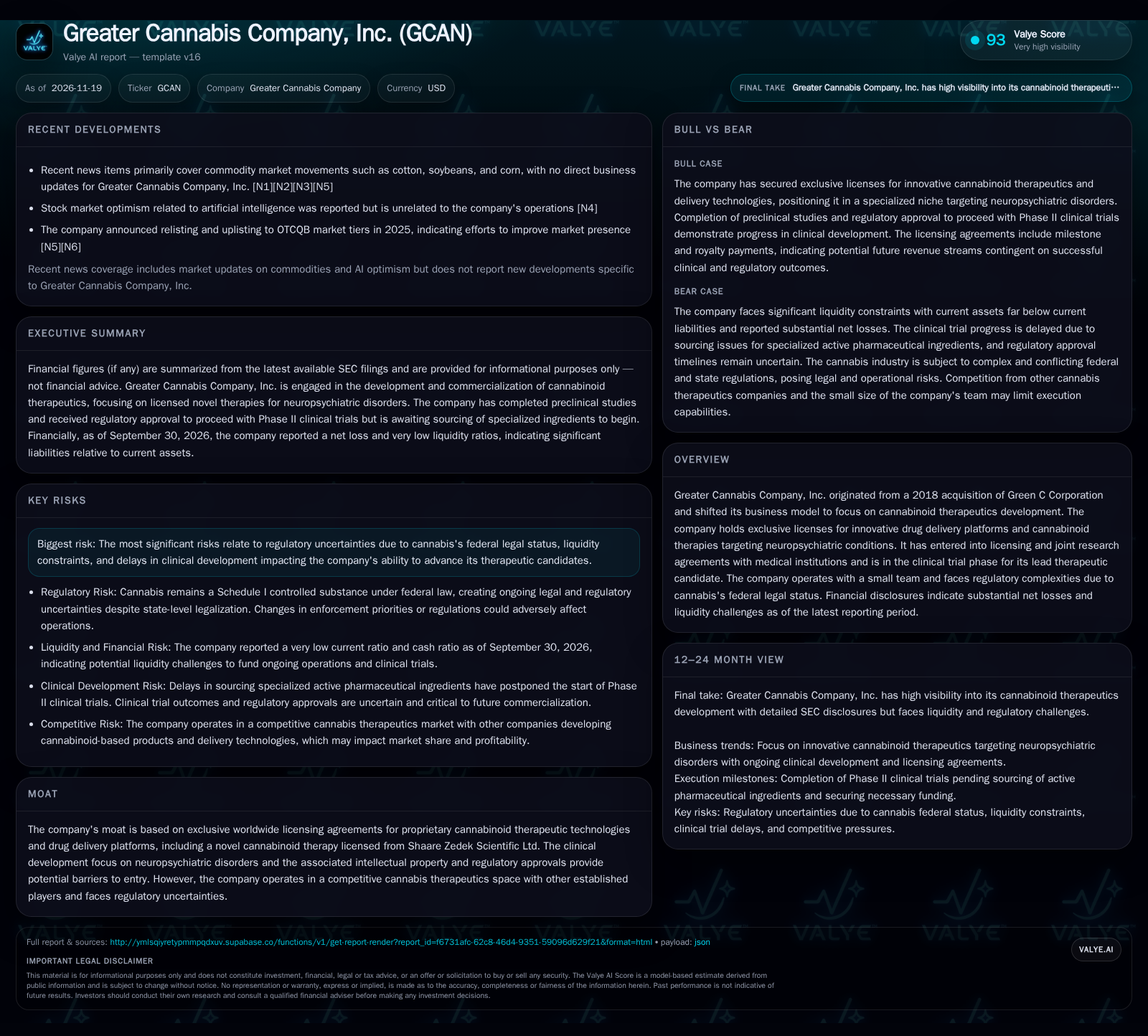
Greater Cannabis Company holds exclusive rights to a novel cannabinoid therapy targeting neuropsychiatric conditions and has completed preclinical work, but faces a critical cash shortfall and delays in advancing to Phase II trials. Its future hinges on resolving ingredient sourcing, securing funding, and navigating regulatory complexity in a highly competitive therapeutic market. [S2]
Greater Cannabis Company, Inc. stands at a precarious crossroads: it holds exclusive global rights to an innovative cannabinoid therapy with potential applications across neuropsychiatric disorders, but its clinical ambitions are sharply undermined by critical liquidity shortfalls, delayed trial initiation, and daunting regulatory complexity. With only one full-time employee and no meaningful recent revenues, the company’s near-term prospects depend almost entirely on its ability to secure both funding and operational momentum. The question is whether its intellectual property and licensing model can overcome these acute structural vulnerabilities before competitive and financial pressures force a strategic reset. [S2]
Liquidity Crisis and Delayed Clinical Milestones Define the Present
As of September 30, 2026, Greater Cannabis Company reported cash and equivalents of only $111,000 versus $12.2 million in current liabilities, resulting in a current ratio and cash ratio of 0.01—an acute liquidity crisis by any standard. The company posted a net loss of $90.3 million for the period, with no meaningful revenue disclosed since 2020. [S2]
Operationally, the company’s clinical ambitions are stalled: while it has completed preclinical studies and received regulatory approval to proceed with a Phase II clinical trial for its lead cannabinoid therapeutic, the trial has not started due to difficulties in sourcing specialized active pharmaceutical ingredients. Regulatory approval timelines remain highly uncertain and are now subject to new delays. [S2]
These facts place the company at a critical inflection point: its ability to advance the clinical pipeline and preserve strategic value is now directly tied to resolving both ingredient sourcing and a severe funding gap.
How the Therapeutics Licensing Model Might Generate Value—And Where It Breaks Down
Greater Cannabis Company’s economics are predicated on a high-risk, high-reward licensing model. The company holds exclusive rights to a novel cannabinoid therapy, with licensing agreements structured to include annual fees, milestone payments tied to clinical and regulatory progress, and royalties on future product sales. This structure minimizes up-front infrastructure costs but creates extreme dependency on clinical trial progress and regulatory wins.
In principle, a successful Phase II trial could unlock milestone payments or attract co-development partnerships, offering a pathway to non-dilutive funding or eventual commercialization. The company reported cash and liquidity metrics for the period; these figures do not by themselves establish operating runway, investment capacity, financial flexibility, or financing capacity. The single-employee structure limits fixed costs but also raises execution risk, as nearly all operational leverage and business development depend on external partners or consultants.
Capital needs are acute: clinical trials are capital-intensive, and the company’s current balance sheet provides no margin for error. Until a credible funding source—whether equity, partnership, or grant—is secured, the business model remains theoretical rather than operational.
Intellectual Property and Niche Focus vs. Scale, Capital, and Regulatory Headwinds
The company’s core competitive asset is its exclusive global license for a novel cannabinoid therapeutic targeting neuropsychiatric disorders such as autism, schizophrenia, Parkinson's, and Alzheimer's diseases. This IP, combined with proprietary drug delivery technology, represents a potential barrier to entry for direct competitors.
However, the broader cannabis therapeutics landscape is crowded with better-capitalized players, including pharmaceutical incumbents and specialized biotech firms with established clinical infrastructure. Companies such as Jazz Pharmaceuticals and Zynerba Pharmaceuticals operate in adjacent or overlapping spaces, often with larger pipelines, greater trial execution capacity, and more robust funding.
Regulatory complexity is a double-edged sword: while it may deter some new entrants, it also makes partnerships, commercialization, and even basic banking relationships more challenging. The ongoing Schedule I status of cannabis at the federal level in the U.S. creates persistent uncertainty and could deter potential licensees, acquirers, or co-development partners. The company’s lack of scale, minimal staffing, and cash position further erode any practical moat beyond its IP portfolio.
Unlocking Value Through Funding and Clinical Progress: What Would Need to Go Right
The most favorable scenario for Greater Cannabis Company involves rapidly resolving ingredient sourcing issues and securing enough funding—through equity, grants, or partnerships—to launch and complete the Phase II clinical trial. Positive clinical data would validate the scientific rationale for the lead asset and could trigger milestone payments under licensing agreements or attract new licensing and co-development partners.
Evidence that would confirm this scenario includes: announcements of successful ingredient sourcing, new funding rounds, or strategic partnerships; public disclosure of trial enrollment or interim data; and communications of milestone or royalty payments initiated by third parties.
If the company can demonstrate tangible clinical progress and retain exclusive rights, it could potentially command out-licensing deals or acquisition interest from larger biopharma players seeking to expand into cannabinoid neuropsychiatric therapeutics. In this scenario, the company could transition from a cash-constrained development-stage entity to a leveraged licensor or acquisition target.
Clinical Delays and Ongoing Cash Burn Force Strategic Alternatives
The most plausible trajectory given current facts is that Greater Cannabis Company continues to face delays in launching its Phase II trial due to both funding and ingredient sourcing bottlenecks. This could lead to further erosion of strategic value as clinical timelines slip, competitive pipelines advance, and the company’s ability to negotiate favorable partnerships diminishes.
Operational execution may be limited to seeking bridge financing, attempting to renegotiate licensing terms, or exploring asset sales to larger industry players. The lack of revenue and persistent net losses mean that, absent a funding event, the company may be forced to pursue a distressed sale or seek protection from creditors.
Confirmation would come from further public disclosures of delayed clinical milestones, continued lack of funding announcements, or SEC filings indicating going-concern warnings or strategic review processes. Conversely, evidence of funding or trial initiation would falsify this base scenario.
Funding Failure and Regulatory Shocks Could Force Asset Liquidation
In the worst case, the company fails to secure the necessary funding and ingredient supply to initiate its Phase II trial, while regulatory or legal developments further constrain its ability to operate or raise capital. Without material revenue, cash, or operational scale, the business could be forced into asset liquidation or bankruptcy, with IP and licenses sold at distressed valuations.
Adverse regulatory shifts—such as tightened federal enforcement or loss of state-level protections—could accelerate this process by freezing banking access, limiting insurance, or exposing the company to new compliance costs. A further risk is that competitors advance alternative therapies or delivery technologies that erode the value of Greater Cannabis Company’s IP portfolio.
Signs confirming this scenario would include: default or insolvency filings, asset sales at below-book value, or regulatory actions restricting operations. Evidence of competitive pipeline advances or loss of patent exclusivity would further validate this outcome.
Milestones and External Triggers That Could Reshape the Greater Cannabis Company Thesis
Announced initiation or enrollment of the Phase II clinical trial for the lead cannabinoid therapeutic—confirmation would signal progress toward value inflection.
Disclosure of any new funding event, equity raise, grant award, or partnership agreement—critical for bridging the liquidity gap.
Updates on ingredient sourcing and supply chain arrangements for specialized active pharmaceutical ingredients—a gating factor for trial initiation.
Public reporting of milestone or royalty payments received—would demonstrate external validation and start to operationalize the licensing model.
Any new regulatory developments at the federal or state level affecting the legal status of cannabis or cannabinoid therapeutics—could materially alter both risk and opportunity.
Evidence of competitive product approvals or clinical trial advances in neuropsychiatric cannabinoid therapeutics—would test the company’s ability to retain strategic relevance.
Disclosure of going-concern warnings, strategic alternative processes, or asset/liability restructuring—would indicate mounting operational distress.
Disclaimer: This is research-only, informational analysis and not investment advice. It may include AI-generated interpretation and general industry context. Always verify important details using primary sources.

Comments