
Woodward’s Record Year: Strategic Refocus, Aerospace/Industrial Tailwinds, and the Stakes of Leadership Transition
Woodward, Inc. closes fiscal 2026 with record sales and earnings, a robust balance sheet, and a deliberate exit from its China on-highway natural gas truck business. As leadership succession looms, the company’s ability to deepen its aerospace and industrial foothold will be tested against sector cyclicality, portfolio concentration, and the operational realities of its new strategic focus.
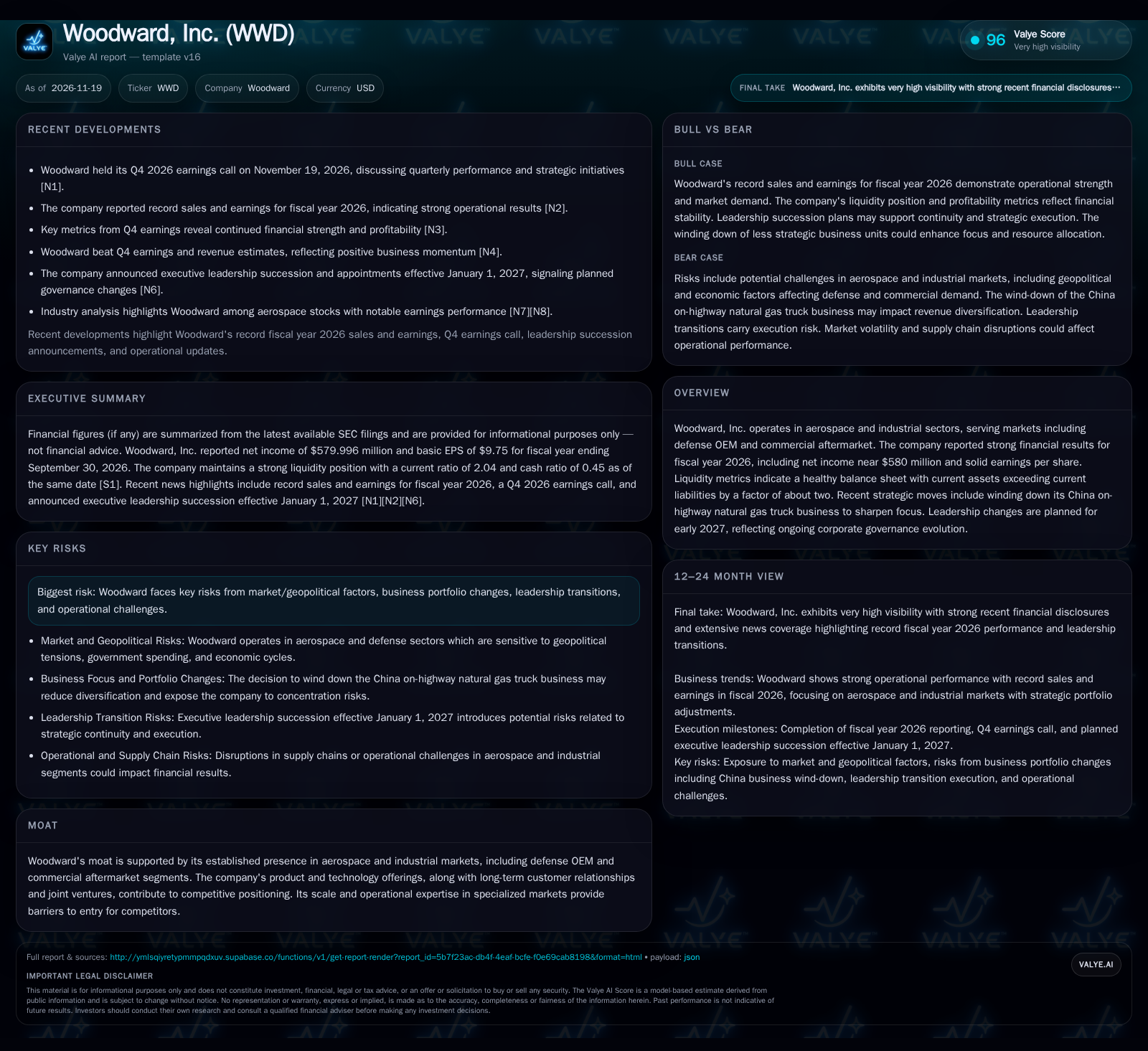
Woodward posted record sales and net income of nearly $580 million in fiscal 2026, driven by strength in its aerospace and industrial segments. The company is winding down its China on-highway natural gas truck business to sharpen its strategic focus. [S1] [N2] [N6]
Woodward, Inc. capped fiscal 2026 with record-breaking sales and net income, reflecting robust demand across its aerospace and industrial markets. However, with executive leadership transitions on the horizon and an increased emphasis on core markets, Woodward must navigate both the opportunities and risks that come with portfolio concentration and sector cyclicality as it embarks on its next phase of growth. [S1] [N2] [N6]
Fiscal 2026 Milestones: Record Performance and Strategic Retrenchment
Woodward reported net income of $579.996 million for fiscal year 2026, achieving record sales and earnings. Basic and diluted EPS reached $9.75 and $9.49, respectively, indicating robust profitability. The company’s balance sheet showed current assets of $2.37 billion and current liabilities of $1.17 billion as of September 30, 2026, resulting in a current ratio of 2.04 and a cash ratio of 0.45. Notably, Woodward is winding down its China on-highway natural gas truck business, a move designed to concentrate resources on more strategic aerospace and industrial operations. Leadership succession plans are set for January 1, 2027, marking a pivotal transition in corporate governance. [S1] [N2] [N6]
Profit Drivers and the Economics of Portfolio Focus
Woodward’s business model is anchored in supplying high-value components and systems for aerospace and industrial applications, with revenue streams likely split between original equipment manufacturers (OEM), aftermarket services, and—until recently—niche transportation segments. Pricing power in aerospace and defense is typically supported by customer certification requirements and long product cycles, which can translate into recurring aftermarket revenue and favorable margins. Variable costs in manufacturing can be high, but scale and engineering expertise offer operating leverage as volumes rise. The wind-down of the China on-highway natural gas truck business likely removes a lower-margin, potentially volatile revenue stream, allowing capital and management attention to be redeployed to more defensible, higher-margin domains.
The company’s reported record earnings and robust net income for 2026 suggest that its core segments are benefiting from strong demand and possibly improved product mix or pricing. However, as portfolio concentration increases, Woodward will depend more heavily on the cyclicality, capital intensity, and procurement cycles of aerospace and industrial customers. Sustaining margin expansion will require ongoing cost discipline, supply chain resilience, and continued investment in differentiated engineering solutions.
Moreover, the interplay between Woodward’s engineering capabilities and its manufacturing scale is critical in sustaining competitive advantage. High fixed costs in aerospace manufacturing mean that volume fluctuations can disproportionately impact margins, making demand forecasting and capacity planning essential. The company’s ability to leverage advanced manufacturing technologies, such as automation and additive manufacturing, could enhance cost efficiency and product customization, thereby reinforcing its value proposition. Additionally, the balance between OEM contracts and aftermarket services influences revenue stability; aftermarket sales typically generate higher margins but require sustained customer engagement and product reliability to maintain.
Defensible Niches and the Challenge of Concentration
Woodward’s competitive positioning rests on its established presence in aerospace and industrial markets, supplying critical components to defense OEMs and servicing the commercial aftermarket. Barriers to entry include long-term customer relationships, engineering certifications, and specialized manufacturing know-how. These factors create customer stickiness and can support pricing power, especially in the aftermarket, where switching costs are high due to qualification and reliability requirements.
However, the decision to exit the China on-highway natural gas truck business may heighten concentration risk, increasing exposure to aerospace and industrial cycles. Competitors in these segments range from diversified industrial conglomerates to specialized aerospace suppliers, many of whom are also seeking to expand aftermarket revenues and deepen customer integration. Technology substitution—such as electrification, alternative propulsion systems, or digital controls—could reshape demand patterns, requiring Woodward to continually invest in innovation and customer alignment.
In addition to technological innovation, Woodward’s competitive resilience depends on its capacity to anticipate and adapt to evolving regulatory and environmental standards, which increasingly shape aerospace and industrial product requirements. Compliance with emissions, safety, and digital integration mandates can create both barriers and opportunities. Firms that proactively invest in R&D to meet these standards may secure preferential supplier status, while laggards risk obsolescence. Furthermore, the company’s customer diversification within aerospace and industrial sectors—across defense, commercial aviation, and energy—can mitigate risks associated with sector-specific downturns, provided it maintains agility in reallocating resources and tailoring solutions to distinct market needs.
Sharpened Focus Unlocks Margin Expansion and Resilience
If Woodward successfully reallocates resources from its discontinued China transportation business into core aerospace and industrial segments, it could drive higher margins and more stable growth. A favorable scenario would see sustained or growing demand from defense and commercial aerospace customers, supported by multi-year procurement cycles and increasing aftermarket penetration. Operating leverage from higher utilization of existing manufacturing assets, combined with disciplined cost management, could amplify earnings growth.
Confirmation of this scenario would come from continued record-level sales and earnings, expanding margins, growing aftermarket revenue share, and evidence of successful new product introductions or contract wins in core segments. Conversely, signs of margin compression despite the portfolio shift, or failure to offset the lost China business with higher-quality revenue, would falsify the upside case.
A further dimension of potential upside lies in Woodward’s capacity to capitalize on emerging aerospace trends such as increased defense spending, modernization of fleets, and the gradual recovery of commercial air travel demand. If the company can deepen its penetration into aftermarket services, it may benefit from recurring revenue streams that are less sensitive to new aircraft production cycles. Success in expanding digital and software-enabled offerings could also differentiate Woodward, enabling it to capture value from the integration of advanced control systems and predictive maintenance solutions. These developments would enhance customer lock-in and create multi-year revenue visibility, supporting margin expansion and resilience.
Strategic Focus Yields Steady—But More Cyclical—Growth
The most plausible trajectory is that Woodward’s sharpened focus results in steady performance, with growth and margins tracking the broader cycles of the aerospace and industrial sectors. However, the wind-down of the China business reduces diversification, making the company more vulnerable to downturns in its primary markets.
This middle path would be confirmed by continued profitability and operational stability, but with earnings and sales more closely mirroring sector trends. If disclosed, a modestly rising aftermarket revenue mix and stable operating margins would support this scenario; unexpected volatility in results or customer demand would challenge the base case.
Portfolio Concentration Exposes Woodward to Sector Downturns
A negative outcome could materialize if aerospace or industrial markets experience a cyclical downturn or if geopolitical or macroeconomic shocks reduce demand from key customers. With the loss of diversification from its China on-highway natural gas truck business, Woodward’s earnings could become more volatile, and the company may face underutilization of manufacturing assets. Leadership transition risks could further undermine execution during periods of stress.
Downside confirmation would come from declining sales, margin compression, or significant customer losses in core segments. If disclosed, rising inventories or declining aftermarket revenue would be warning signs. Failure to execute on new product development or to adapt to market shifts would also challenge the company’s long-term resilience.
Milestones and Metrics to Assess Woodward’s Strategic Realignment
Year-over-year sales and net income growth in aerospace and industrial segments, especially relative to sector peers, will test the effectiveness of the company’s portfolio refocus.
Aftermarket revenue as a percentage of total sales—if disclosed—would help evaluate margin stability and recurring revenue strength.
Operating margin trends following the exit from the China business will indicate whether the portfolio shift is translating into higher profitability.
Execution on leadership succession and potential management turnover in early 2027 should be monitored for continuity and strategic clarity.
New product introductions, contract wins, or expansion into adjacent aerospace/industrial niches could signal continued innovation and customer stickiness.
Customer concentration metrics—if disclosed—would help assess risk exposure to large OEMs or specific programs.
Working capital efficiency and inventory management, particularly if sector demand softens, would reveal operational discipline.
Evidence of supply chain disruption or cost inflation—especially in aerospace/defense—could signal emerging risks to margins and delivery capability.
Disclaimer: This is research-only, informational analysis and not investment advice. It may include AI-generated interpretation and general industry context. Always verify important details using primary sources.

Comments