
Liquidity Services: Marketplace Expansion Ambitions Meet Macro and Geopolitical Crosswinds
With a profitable 2026, reported cash position, and a $2B GMV expansion target for its online asset remarketing platforms, Liquidity Services seeks to scale its transactional ecosystem. The company’s business model could benefit from digital network effects, but faces external risks from global supply chains, litigation, and economic volatility.
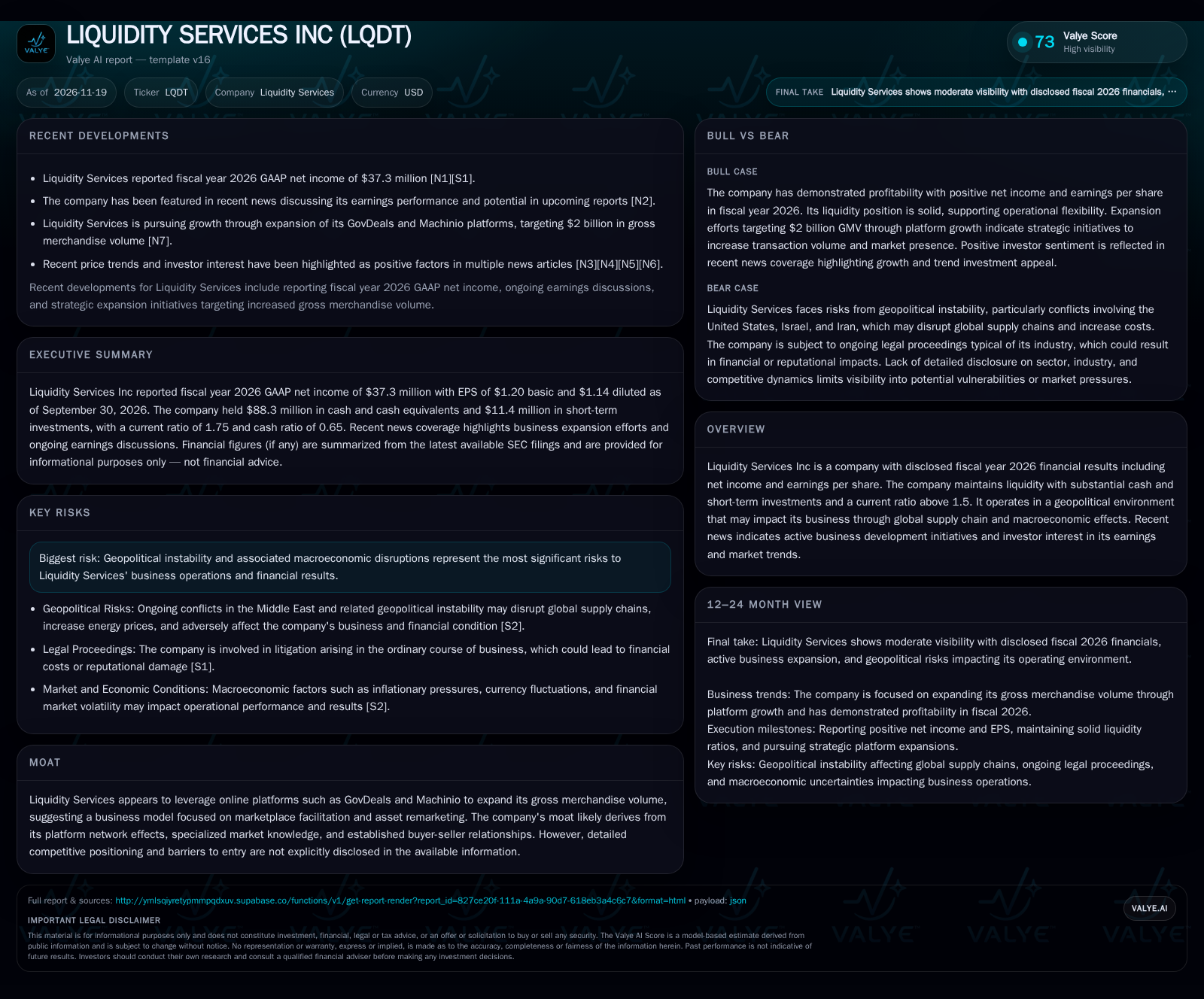
Liquidity Services reported $37.3 million in net income for fiscal 2026, holds over $99 million in liquid assets, and is targeting $2 billion in gross merchandise volume through platform growth. The company’s asset remarketing marketplaces, GovDeals and Machinio, drive its expansion ambitions. However, geopolitical instability and macroeconomic pressures could disrupt operations and supply chains, while the lack of detailed competitive disclosures limits direct assessment of moat durability. Monitoring platform transaction growth, margin development, and external risk exposure will be crucial.
Liquidity Services, Inc. capped fiscal 2026 with notable profitability, holding over $99 million in liquid assets and a current ratio of 1.75. Its core business—facilitating online asset remarketing via platforms like GovDeals and Machinio—is targeting a step-change in scale with a $2 billion gross merchandise volume goal. The company’s expansion strategy is set against a backdrop of macroeconomic and geopolitical headwinds, which could affect both the pace and economics of growth.
Profitability, Cash Reserves, and Expansion Targets Define the 2026 Snapshot
Liquidity Services reported $37.3 million in GAAP net income for fiscal year 2026, with basic earnings per share of $1.20 and diluted EPS of $1.14, signaling a profitable year at both operational and per-share levels [N1] [S1]. The company closed the fiscal period with $88.3 million in cash and cash equivalents and $11.4 million in short-term investments, supporting a current ratio of 1.75 and a cash ratio of 0.65 [S1]. The company reported cash and liquidity metrics for the period; these figures do not by themselves establish operating runway, investment capacity, financial flexibility, or financing capacity. Most notably, Liquidity Services is actively pursuing an expansion initiative aimed at achieving $2 billion in gross merchandise volume (GMV) through growth of its GovDeals and Machinio platforms [N7]. This ambition underscores an intent to drive higher transactional throughput and marketplace liquidity, but also raises questions about the commercial mechanics, scalability, and margin implications of such growth.
Marketplace Economics: Scale, Fee Structures, and the Leverage Question
Liquidity Services generates revenue primarily by facilitating transactions between buyers and sellers of surplus assets through its online marketplaces, including GovDeals (public sector surplus) and Machinio (industrial equipment). The business model likely involves charging sellers a commission or listing fee, and may include buyer premiums or value-added services, though the precise mix and pricing structure are not disclosed in the supplied evidence. As a digital platform, the company’s cost structure should exhibit relatively high fixed costs (technology, compliance, sales) with variable costs scaling more modestly, suggesting the potential for operating leverage as transaction volume increases.
The $2 billion GMV target implies an aspiration to materially increase throughput, which, if achieved with stable or improving take rates, could drive significant top-line growth. However, the ability to translate GMV expansion into improved margins depends on factors such as customer acquisition costs, platform incentives, and the competitive need to subsidize transactions or invest in new capabilities. Ultimately, the path to sustainable profitability hinges on the platform’s ability to maintain or improve margin per transaction as volume grows—a dynamic that will become clearer with future disclosures.
Platform Network Effects and the Challenges of Asset Remarketing
Liquidity Services’ competitive positioning appears to rest on its ability to aggregate buyers and sellers in specialized asset categories, leveraging the scale and liquidity of its GovDeals and Machinio platforms. In theory, network effects could create a virtuous cycle: more sellers attract more buyers, which in turn attracts more sellers, deepening marketplace liquidity. Specialized market knowledge and established institutional relationships—especially in public sector surplus and industrial equipment—may further reinforce switching costs for core customers.
However, the asset remarketing space remains fragmented, with competition from auction houses, generalist e-commerce platforms, and niche digital marketplaces. Barriers to entry are lower than in highly regulated or capital-intensive sectors, and competitors can challenge incumbency via technology, pricing, or bundled logistics services. While the report references expansion and positive investor sentiment, it does not establish the durability of Liquidity Services’ moat in the face of evolving digital commerce models or potential new entrants. The company’s ability to innovate on user experience, maintain transaction trust, and build differentiated data/analytics offerings will likely influence its long-term competitive standing.
If Platform Scale Drives Margin Expansion and GMV Targets Are Met
A favorable scenario would see Liquidity Services successfully scaling its online marketplaces to reach or exceed the $2 billion GMV target, while maintaining stable or rising take rates and controlling customer acquisition costs. As transaction volume grows, the company could realize operating leverage, with fixed platform and compliance costs spread across a larger revenue base. Enhanced data and analytics from increased transaction flow could allow for value-added services, further boosting margins and creating additional customer lock-in.
Confirmation of this scenario would come from sequential growth in GMV, rising revenue and margin per transaction, and evidence that customer retention and platform engagement metrics are strengthening (if disclosed). Positive news coverage of platform wins, new large institutional sellers, or expanded service offerings would further support the thesis. Falsification would be indicated by stagnant GMV, margin compression due to competitive pricing, or ballooning customer acquisition and support costs that offset volume gains.
Incremental GMV Growth Amid External Volatility and Mixed Margin Outcomes
The most plausible short- to medium-term outcome is that Liquidity Services achieves incremental, but not dramatic, gains in GMV and transaction volume on its platforms. Margins may fluctuate as the company invests in growth, faces competitive price pressure, or absorbs higher operating costs from macroeconomic and geopolitical disruptions.
This scenario would be confirmed by steady, but not exponential, growth in disclosed GMV or transaction volume, with operating margins remaining within historical ranges. Evidence of continued investment in platform capabilities and customer relationships would support a gradual expansion thesis, while persistent legal, geopolitical, or supply chain headwinds could constrain upside. Falsification would be indicated by either significant margin erosion or an inability to grow platform throughput despite ongoing investment.
Macroeconomic and Geopolitical Shocks Disrupt Supply Chains and Platform Growth
A risk scenario would involve severe macroeconomic or geopolitical disruptions—such as escalating conflicts involving the US, Israel, and Iran—leading to global supply chain interruptions, asset availability shortages, or sharp increases in logistics and compliance costs [S2]. These shocks could reduce the volume of assets flowing through Liquidity Services’ platforms or materially increase transaction frictions, undermining both GMV growth and margin stability.
Confirmation of this scenario would come from abrupt declines in platform GMV, rising costs per transaction, or negative revisions to growth and margin guidance. Additional evidence could include increased litigation costs, adverse legal outcomes, or customer attrition due to operational disruptions. Conversely, resilience in transaction volume or the ability to pass through higher costs to customers would serve to falsify the worst-case scenario.
What Will Determine if Liquidity Services Converts Scale into Durable Margin?
Sequential GMV growth on GovDeals and Machinio platforms, with disclosure of take rate and margin trends if available.
Changes in operating margin and per-transaction profitability as platform volume scales.
Customer acquisition costs and retention rates, particularly for institutional sellers and buyers (if disclosed).
Any evidence of platform network effects, such as rising engagement or repeat transaction rates.
Impact of geopolitical and macroeconomic events on asset supply, transaction flow, and logistics costs.
Updates on legal proceedings or material litigation outcomes that could affect financial performance.
Evidence of new service offerings, technology upgrades, or expansion into adjacent asset categories.
Rising or falling cash and short-term investment balances relative to investment in platform growth.
Disclaimer: This is research-only, informational analysis and not investment advice. It may include AI-generated interpretation and general industry context. Always verify important details using primary sources.

Comments