
Air Products & Chemicals: Hydrogen Expansion, Contract Stability, and the Stakes of Industrial Gas Transformation
Air Products & Chemicals, Inc. is leveraging its global industrial gases footprint and long-term contract model to drive core stability while advancing capital-intensive hydrogen projects that could redefine its growth trajectory. Recent earnings momentum and technology investments highlight both the resilience of its legacy business and the execution risks in energy transition bets.
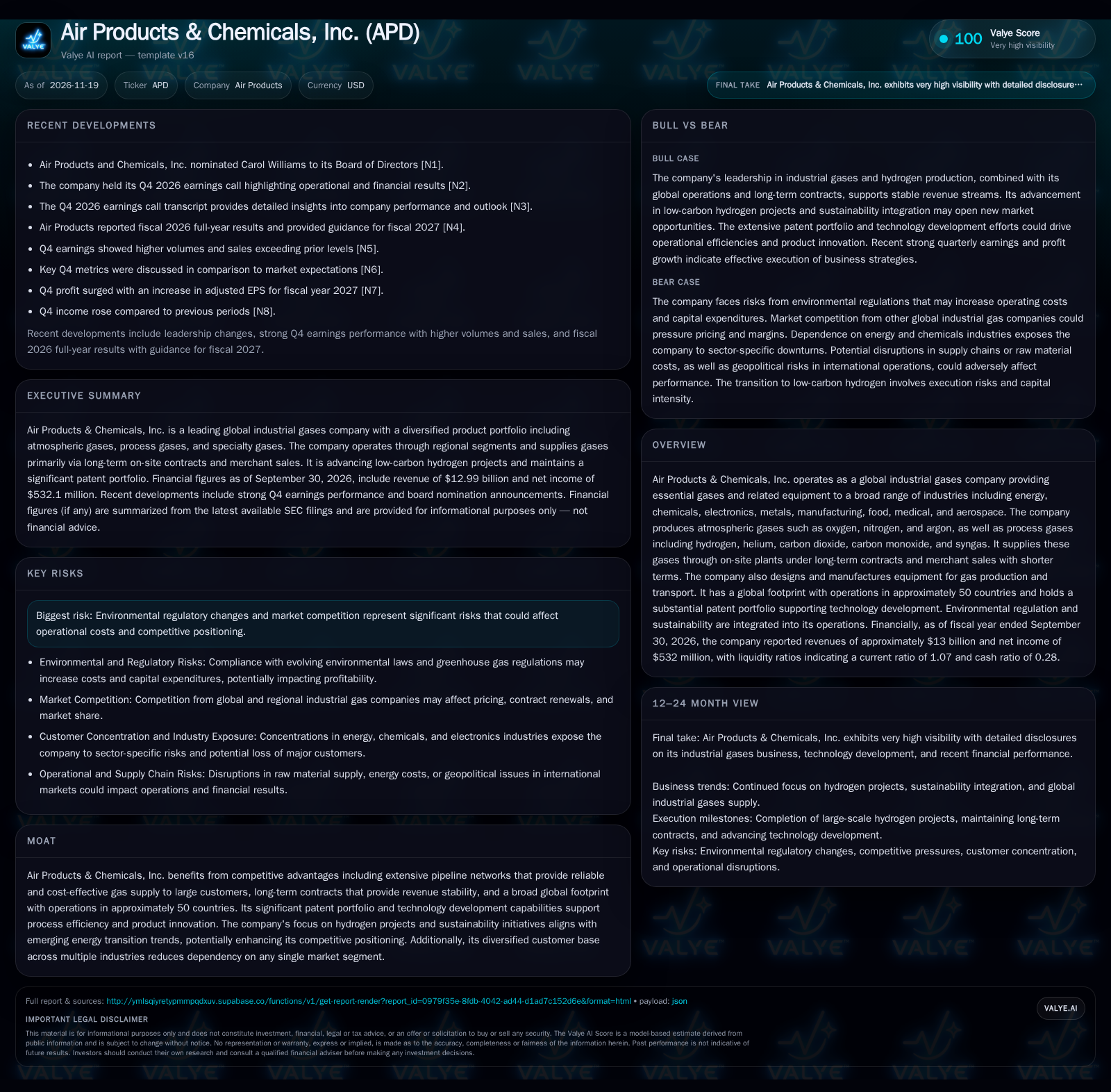
Air Products & Chemicals combines stable, regionally diversified industrial gas operations with large-scale hydrogen project ambitions. Recent strong earnings reflect volume gains and contract stability, but future growth hinges on successful execution in lower-carbon hydrogen and managing regulatory and capital pressures. Competitive dynamics, industry exposure, and evolving environmental mandates remain central to its risk-reward profile. [S1] [N5] [N8]
Air Products & Chemicals, Inc. stands at the crossroads of industrial stability and energy transformation. Its core business—regional supply of atmospheric and process gases under long-term contracts—anchors a resilient earnings base, as evidenced by recent profit and volume gains. Yet, the company's strategic pivot toward capital-intensive hydrogen projects and the integration of sustainability into operations signal a business model in transition. The next phase of Air Products’ value creation will likely be shaped by its ability to deliver on these hydrogen investments, navigate regulatory complexity, and defend its contract-driven advantages against global competition and shifting end-market exposures.
Recent Earnings Momentum and Strategic Shifts
Air Products & Chemicals reported fiscal 2026 revenue of $12.99 billion and net income of $532.1 million, with Q4 results showing higher volumes and income versus prior periods. This operational momentum was highlighted in earnings calls and market commentary, with sales exceeding estimates and profit surging in Q4. [S1] [N5] [N8]
The company’s business remains anchored by regional industrial gas sales—over 90% of consolidated sales—with about half from atmospheric gases. On-site, long-term contracts constitute roughly half of total sales, providing visibility and stability. [S1]
Strategically, Air Products is investing in hydrogen, advancing blue and green hydrogen projects like NEOM in Saudi Arabia, while most current hydrogen output remains gray. These capital-intensive projects signal a shift toward lower-carbon solutions, with sustainability and regulatory compliance becoming increasingly integral to operations. [S1]
Contract Structure, Volume Leverage, and the Hydrogen Capital Equation
The company’s economics are underpinned by a dual-channel model: on-site supply (long-term, high-volume contracts, typically with take-or-pay provisions) and merchant gases (shorter-term, volume-flexible arrangements). On-site contracts are attractive for their predictable cash flows and high switching costs for customers, who invest in co-located infrastructure. Merchant sales, while offering pricing flexibility, are more exposed to economic cycles and local competition.
Roughly half of Air Products’ sales are tied to on-site contracts, helping to cushion earnings against volatility in industrial demand. This model also creates operating leverage as incremental volumes can be supplied with relatively modest increases in fixed infrastructure, especially in mature regions. However, merchant gas margins are more variable, and the mix of contract types is a lever for both profitability and risk.
Hydrogen represents both a growth lever and a capital challenge. Traditional (gray) hydrogen is produced from fossil fuels and sold mostly under long-term deals, but blue (with carbon capture) and green (from renewables) hydrogen projects require significant upfront investment and may face longer payback periods. The economics of these projects depend on regulatory incentives, carbon pricing, and the willingness of industrial customers to pay green premiums—a dynamic still in early innings globally.
Equipment sales (air separation, hydrocarbon recovery, transport/storage) contribute less than 10% of revenue and are typically lower margin, but support the core gases business and reinforce customer stickiness. [S1]
How Scale, Contracts, and Technology Shape Defensibility
Air Products’ moat is built on scale, a global footprint, and an extensive pipeline and plant network, which enable cost-effective delivery and high reliability for large customers. Long-term, on-site contracts with take-or-pay terms create switching frictions and lock in multi-year revenue streams. The company’s patent portfolio (over 3,000 total patents) supports process innovation and operational efficiency. [S1]
Competition is intense, primarily from other global industrial gas majors and regional players. The main counterforces include price competition in merchant gases, customer bargaining power in cyclical industries, and the threat of technology substitution—such as on-site generation by customers or new hydrogen production technologies.
Regulatory and sustainability trends are double-edged: they may create demand for lower-carbon gases and specialty solutions, but also open the door for new entrants, government-backed projects, or disruptive technologies in hydrogen and carbon capture.
Customer diversification across energy, chemicals, electronics, and other verticals limits concentration risk, with no single customer exceeding 10% of sales. However, sectoral downturns in these end-markets can still materially impact demand. [S1]
If Hydrogen Bets Pay Off: Accelerating Growth and Margin Expansion
A favorable scenario would see Air Products successfully executing its blue and green hydrogen projects, securing long-term offtake agreements with industrial and mobility customers willing to pay green premiums. Regulatory tailwinds—such as carbon pricing, tax incentives, or mandates—could accelerate adoption and improve project economics.
If hydrogen volumes ramp as planned and Air Products leverages its engineering and plant-operating expertise to achieve cost leadership, margins on these projects could rise above legacy levels. The company’s early-mover advantage in large-scale hydrogen could translate into a defensible position as the market matures.
Evidence confirming this scenario would include signed multi-year hydrogen supply contracts with major customers, margin expansion in the hydrogen segment, and upward revisions to medium-term revenue or earnings guidance tied to new project wins or regulatory catalysts. Conversely, delays in project execution, cost overruns, or muted customer demand for low-carbon hydrogen would undermine this thesis.
Legacy Industrial Gases Anchor Results While Hydrogen Scales Gradually
The most plausible trajectory is that Air Products’ core industrial gases business continues to generate stable, if modestly growing, revenue and cash flow, anchored by its long-term contract base and global plant network. Merchant gases may see cyclical swings, but the contract mix provides ballast against sharp downturns.
Hydrogen projects likely scale incrementally, with initial volumes and margins below core business averages, reflecting the capital intensity and evolving customer willingness to pay green premiums. Investments in blue and green hydrogen proceed, but the pace of adoption is governed by regulatory clarity, customer readiness, and project execution.
Confirming evidence would be continued stable or slightly rising earnings from the legacy business, steady contract renewal rates, and periodic announcements of new hydrogen project milestones or offtake deals—albeit at a measured cadence. Falsifying evidence would be sustained underperformance in the core business, lack of hydrogen project progress, or significant cost overruns.
Execution Risk, Regulatory Shocks, and Margin Compression
An adverse scenario would unfold if environmental regulation drives up compliance costs faster than Air Products can pass them through, or if capital-intensive hydrogen projects face delays, cost overruns, or weak customer demand. Competitive intensity could erode merchant gas margins, especially if regional players undercut on price or if customers backward-integrate.
Sector downturns in energy, chemicals, or electronics could reduce industrial production volumes, pressuring both contract renewals and merchant sales. Geopolitical instability or supply chain disruptions in key international markets could further strain operations.
Confirming evidence for this scenario would include margin compression, guidance cuts, hydrogen project write-downs, or signs of customer attrition in core segments. Conversely, resilience in contract renewals, timely hydrogen project execution, and stable margins would counter this thesis.
Milestones and Metrics That Will Shape Air Products’ Investment Case
Progress and cost discipline on major hydrogen projects (such as NEOM) would help assess the credibility of the company’s energy transition ambitions.
Disclosure of new long-term hydrogen supply agreements, including offtake volumes, pricing structure, and customer identity, would clarify the commercial viability of low-carbon hydrogen investments.
Trends in contract renewal rates and new on-site contract wins for legacy industrial gases are critical for maintaining revenue stability.
Merchant gas volume growth versus pricing changes, if disclosed, would help test competitive dynamics and margin quality.
Capital expenditure guidance, project returns, and any changes in funding strategy would illuminate the risk/reward of ongoing investments.
Updates on regulatory drivers—such as carbon pricing developments or regional hydrogen incentives—will influence both opportunity size and execution risk.
Segment margin trends, especially in hydrogen versus core gases, would indicate whether new investments are accretive or dilutive to overall profitability.
Disclaimer: This is research-only, informational analysis and not investment advice. It may include AI-generated interpretation and general industry context. Always verify important details using primary sources.

Comments