
Autodesk Inc’s Strategic Evolution in Cloud, AI, and Industry-Specific Software Ecosystems
Autodesk continues to leverage its broad software portfolio and cloud platform investments to deepen industry integration and enhance customer workflows.
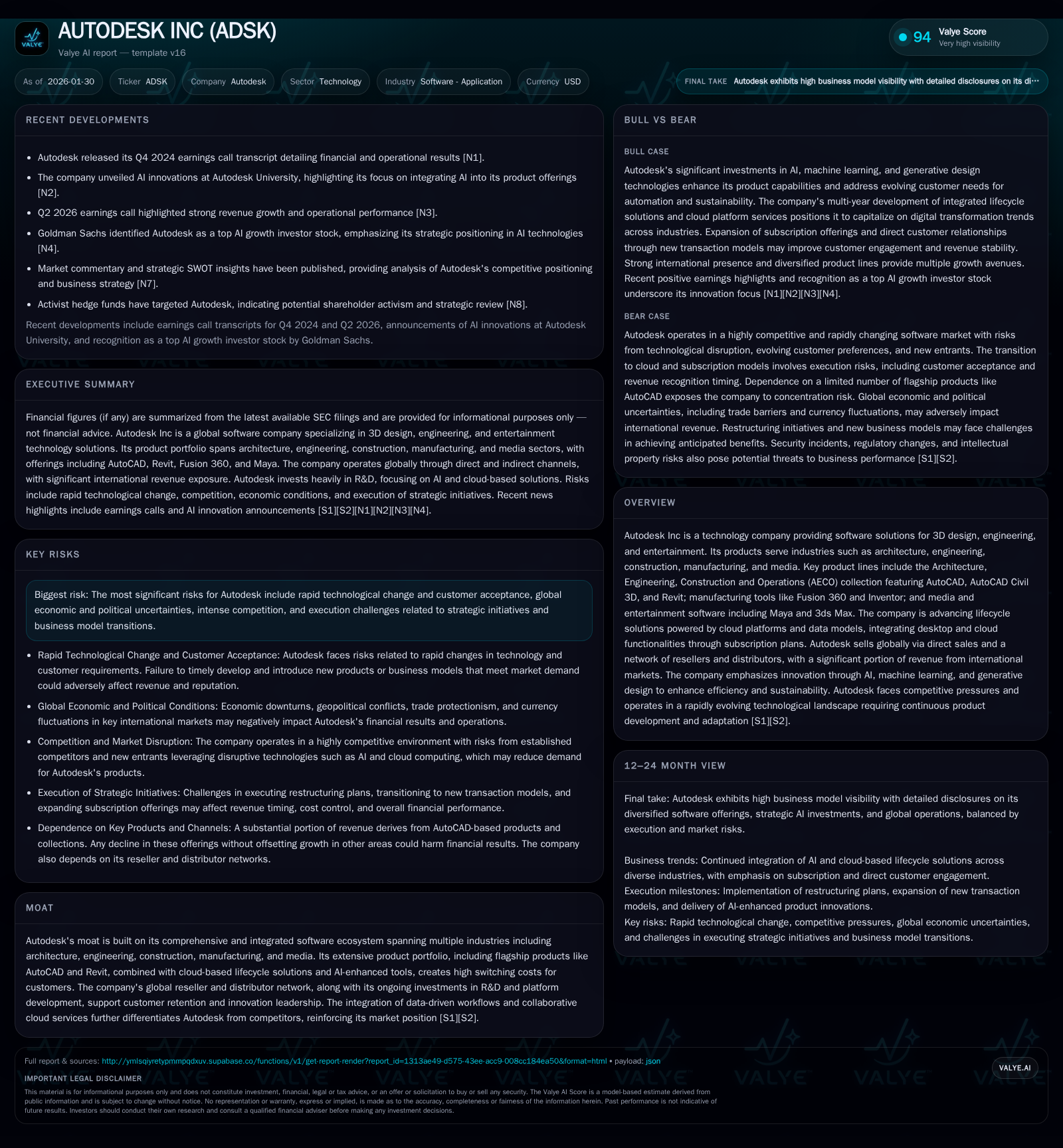
Autodesk’s recent quarterly results underscore ongoing strength in subscription revenue growth driven by expanded cloud and AI-enabled offerings. The company’s multi-industry software ecosystem, anchored by flagship products like AutoCAD and Revit, remains a key competitive moat. Shifts toward a new transaction model and direct customer relationships aim to optimize go-to-market efficiency. However, execution risks around strategic transitions, competitive pressures, and macroeconomic uncertainty persist. Autodesk’s focus on lifecycle solutions powered by data models and generative design positions it well, but navigating technological shifts and customer adoption will be critical going forward.
What Changed Recently
Autodesk’s Q2 2026 earnings, reported in late January 2026, showcased continued strength in revenue growth, driven primarily by increased adoption of cloud offerings and AI-powered enhancements across its industry verticals. The company unveiled significant AI innovations at Autodesk University, emphasizing generative design and machine learning tools that improve automation and sustainability outcomes for customers [N2][N5]. Concurrently, Autodesk initiated a restructuring plan announced in Q1 fiscal 2026 designed to optimize its go-to-market organization and reallocate resources toward strategic priorities including cloud, platform, and AI investments [N1][S14][S15].
These initiatives reflect Autodesk’s transition from legacy desktop software toward integrated subscription and cloud solutions, supported by a new transaction model that combines self-service purchasing, consistent pricing, and improved data capture on customer behavior. The model was rolled out progressively across North America, EMEA, and APAC regions since 2023 and 2024, with further expansion into indirect channels ongoing in fiscal 2025 [S2].
Business Model as a System
Autodesk operates a multi-faceted business model centered around software solutions for 3D design, engineering, manufacturing, and media creation. Its product portfolio is segmented primarily into three categories: Architecture, Engineering, Construction and Operations (AECO); Manufacturing; and Media & Entertainment (M&E) [S1][S6].
Within AECO, the Architecture, Engineering, and Construction Collection includes flagship software such as AutoCAD, AutoCAD Civil 3D, and Revit, which help professionals design, document, and deliver building and infrastructure projects with higher quality and predictability [S1]. Manufacturing tools like Fusion 360 and Inventor target product design and production workflows, while M&E products such as Maya and 3ds Max support digital content creation for films, games, and visualization [S6].
The company’s subscription plans blend traditional desktop functionality with cloud-based capabilities, enabling device-independent, collaborative workflows for designers and stakeholders. This hybrid model supports flexible usage patterns including project-based users and small businesses, expanding Autodesk’s customer base [S4].
A key strategic element is the new transaction model, which shifts the majority of customer transactions to direct dealings with Autodesk, even when sales are facilitated by Solution Providers or resellers. This model enhances customer control, streamlines pricing, and generates valuable data to improve product offerings and the buying experience. Approximately 58% of revenue in fiscal 2025 was derived from indirect channels, with a continuing shift toward direct sales underway globally [S2].
Customer support is multi-tiered, combining direct outreach, self-service portals, and reseller/distributor assistance. This structure enables scale while maintaining technical expertise across different customer segments [S3].
Autodesk invests heavily in research and development to maintain technology leadership, focusing on cloud platform services, generative design, AI and machine learning, and integrating data workflows across the lifecycle of projects and products [S4][S17]. The Autodesk Platform Services initiative supports third-party developers building on Autodesk’s ecosystem, facilitating a connected design and manufacturing environment [S5].
Industry Map & Competitive Battlefield
Autodesk operates in a highly competitive and rapidly evolving software landscape serving AECO, manufacturing, and digital media markets. The competitive field includes global incumbents such as Dassault Systèmes (SolidWorks, CATIA), Bentley Systems, PTC, Siemens PLM, and Adobe, as well as specialized firms like Nemetschek AG and Hexagon AB [S11].
Barriers to entry are moderate given the software industry’s characteristics, including the low marginal cost of software distribution and the steady availability of computing power. However, Autodesk’s moat arises from its broad integrated product portfolio, the stickiness of its subscription ecosystem, and high switching costs rooted in data continuity and workflow integration across the project lifecycle [S1][S4].
The industry is undergoing platform disruption driven by cloud computing and mobile accessibility, requiring incumbents to evolve their product delivery and business models quickly [S11][S21]. Additionally, AI and generative design technologies are reshaping customer expectations and competitive dynamics. Autodesk is positioning itself as a leading AI investor in the sector, aiming to embed these capabilities across its offerings [N4][N5].
The company must also contend with market pressure from agile startups and the risk of in-house development by large customers, especially in manufacturing and AECO sectors. Pricing competition and the availability of third-party applications compatible with Autodesk products further complicate the landscape [S21][S22].
Where the Economics Become Real
Autodesk’s unit economics hinge on scaling named-user subscriptions, expanding penetration within existing client portfolios, and increasing cloud service consumption. AutoCAD and AutoCAD LT, along with related collections, represent a significant revenue base—accounting for approximately 25% of total net revenue in recent periods—making their sustained success critical [S7][S8].
Migration from perpetual licenses to subscription and cloud-based models has improved revenue predictability but introduced complexities around billing linearity and cash flow timing [S11][S13]. The new transaction model and token-based Flex offerings provide more granular consumption-based pricing, potentially enhancing customer acquisition and retention but also requiring ongoing investment in infrastructure and sales capabilities [S2][S14].
Gross margins are influenced by the mix between traditional desktop software and cloud functionality, as cloud services entail higher infrastructure costs (e.g., AWS usage) and ongoing R&D expenses particularly related to AI and platform development [S9][S17]. Autodesk’s restructuring efforts aim to optimize operational efficiencies but may entail short-term cost increases and disruption [N1][S15].
Customer acquisition costs are managed through a combination of direct sales and an extensive reseller/distributor network of approximately 1,260 partners worldwide, with incentive programs designed to align channel efforts with strategic priorities [S2][S3]. The company’s ability to cross-sell and upsell to existing AutoCAD users into industry collections and cloud capabilities is a critical lever for revenue growth and margin expansion [S4][S17].
Liquidity as of late 2025 shows approximately $2 billion in cash and equivalents, but current liabilities exceed current assets, reflecting ongoing investment and operational commitments [S24]. Maintaining disciplined cost control while funding innovation remains a balancing act.
Diligence Questions / Disconfirming Signals
- How effectively will Autodesk execute its restructuring plan without disrupting customer relationships and sales momentum?
- Will the transition to the new transaction model and consumption-based Flex offerings accelerate customer adoption or create friction, especially in indirect channels?
- Can Autodesk sustain or grow its AutoCAD-based revenue given emerging competitive threats and evolving customer preferences?
- How quickly will customers embrace AI-driven generative design tools, and will these innovations translate into meaningful differentiation and pricing power?
- What is the risk of technological obsolescence or displacement from emerging platforms or new entrants offering disruptive approaches?
- How resilient is Autodesk’s business model to macroeconomic volatility, including global geopolitical uncertainties and infrastructure spending fluctuations?
- Are there any lingering impacts or risks from the prior internal investigation and regulatory scrutiny, including potential reputational damage?
- How will Autodesk balance ongoing R&D investments with profitability goals amid competitive and operational pressures?
- What is the potential impact of shifts in channel mix on overall revenue growth and margin profiles?
- How dependent is Autodesk on a relatively small number of core products, and what contingency plans exist if these see declining adoption?
This analysis is based solely on publicly available information from recent news and SEC disclosures. It aims to provide a comprehensive overview of Autodesk’s business model, competitive environment, and operational dynamics without making investment recommendations. Readers should conduct their own due diligence and consult professional advisors before making any investment decisions.
Disclaimer: This is research-only, informational analysis and not investment advice. It may include AI-generated interpretation and general industry context. Always verify important details using primary sources.

Comments