
Allied Energy, Inc.: Profit Trends, Strategic Ambiguity, and Transparency Issues
Allied Energy, Inc. reports modest revenue and profitability with a clean SEC compliance record and a recent history of acquisitions, but persistent gaps in business-model disclosure and an outsized share count cloud the company’s long-term outlook and investment case.
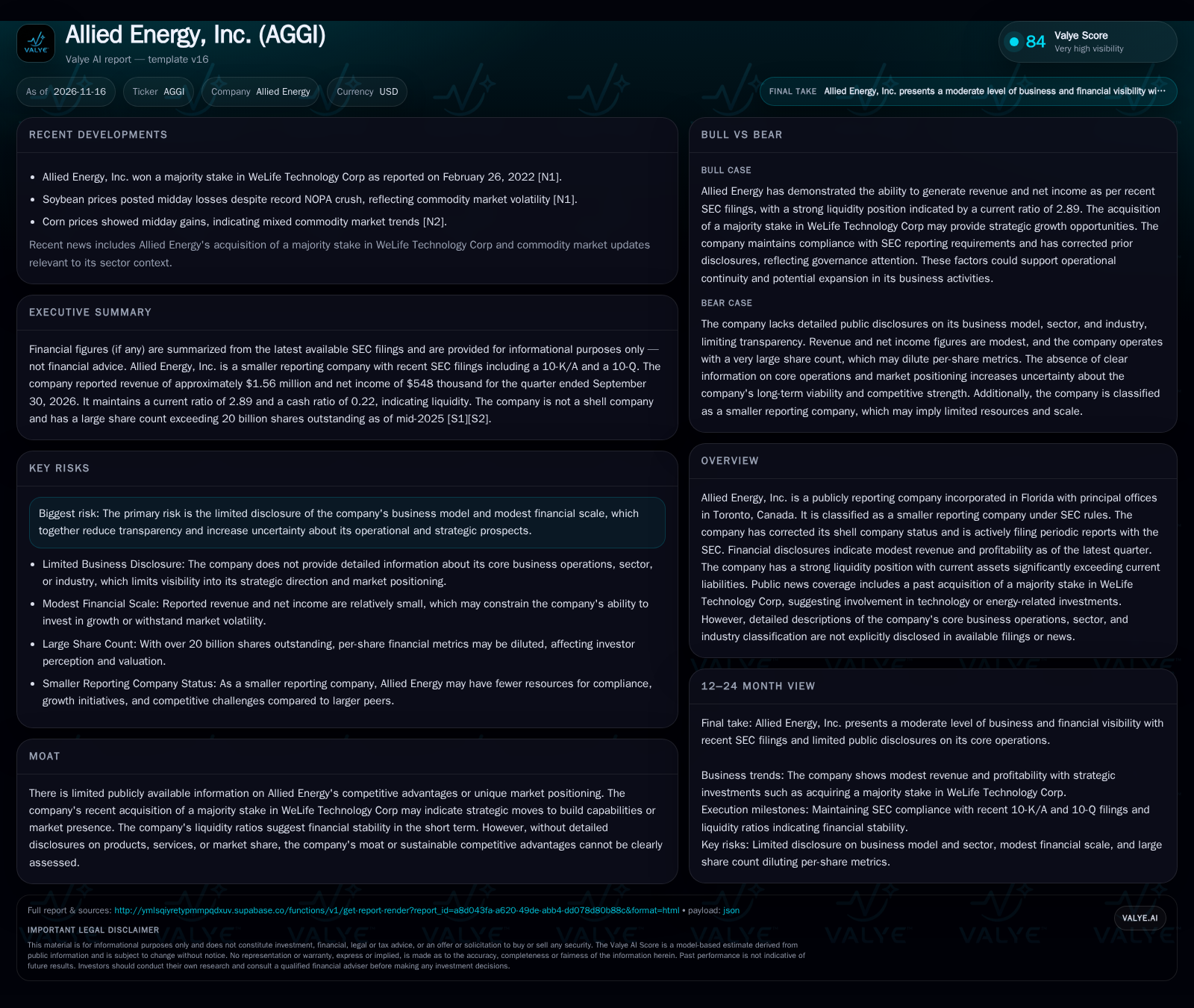
Allied Energy, Inc. is a smaller reporting company with principal offices in Toronto and incorporation in Florida. For the quarter ended September 30, 2026, it reported $1.56 million in revenue, $548,379 in net income, and a current ratio of 2.89. Despite positive earnings and a recent acquisition, the company’s core operating model, sector, and growth drivers remain poorly disclosed, and a very large share count dilutes per-share results. The near-term picture is one of operational stability, but the strategic direction and competitive positioning are difficult to assess given limited transparency. [S2]
Allied Energy, Inc. presents an unusual public-market profile: operational offices in Toronto, legal incorporation in Florida, and a spotty public record that has only recently been clarified with the correction of its shell status.Its latest financials show modest but positive revenue and net income, and the company boasts a reported current ratio. Yet, investors face a stubborn lack of transparency regarding Allied’s core business activities, sector, and strategy. While a past acquisition hints at ambitions beyond pure energy, the absence of operational detail, coupled with an extremely high share count, means any thesis on Allied Energy remains speculative and contingent on future disclosure.
Profitability Gains and Compliance Amid Uncertain Corporate Identity
For the quarter ended September 30, 2026, Allied Energy, Inc. reported revenue of $1,556,349 and net income of $548,379, translating to $0.0136 in basic and diluted earnings per share [S2]. The company reported cash and liquidity metrics for the period; these figures do not by themselves establish operating runway, investment capacity, financial flexibility, or financing capacity. [S2] Cash and cash equivalents totaled $205,018 at period end [S2]. As of June 30, 2025, the company had approximately 20.19 billion shares outstanding [S1]. Allied Energy also clarified its status as not a shell company in an amended 2025 annual report filed April 17, 2026 [S1]. Despite these concrete financial and compliance milestones, the company’s core business activities, sector, and revenue drivers remain undisclosed, making it difficult for investors to understand what is powering the reported profitability or its sustainability.
Revenue Drivers, Scale Effects, and Dilution Impact on Value Creation
With modest revenue and net income on a very large share base, Allied Energy’s business economics are fundamentally constrained by scale and dilution. The company’s profitability in the latest quarter suggests that, at least for now, operating expenses are being kept in check relative to revenue. However, without disclosure on the business model—whether revenue is generated from energy services, technology licensing, investments, or another source—the margin structure, cost base, and capital requirements remain opaque.
If Allied’s operations relate to energy, as its name suggests, the company could be exposed to commodity price volatility, high capital intensity, and regulatory complexity. If its revenue is tied to technology or service contracts (as suggested by the WeLife Technology Corp acquisition), a more variable cost base and potential for software-like margins could exist, but this cannot be confirmed without further detail.
The very high share count—over 20 billion shares—means even profitable quarters translate into minimal per-share earnings, potentially depressing valuation multiples and limiting the attractiveness of equity-based financing.
Market Positioning Challenges Due to Limited Strategic Transparency
Allied Energy’s competitive position is impossible to define with confidence due to the absence of public disclosures regarding its core business operations, sector, or product suite. The company has demonstrated an ability to generate positive net income and to acquire assets (e.g., WeLife Technology Corp), which may indicate a willingness to diversify or pivot strategically. However, without details on market share, customer concentration beyond historical anecdotes, or product differentiation, it is unclear whether Allied operates in a commodity business, a niche technology segment, or as a holding company with diversified interests.
Potential competitors could range from small-cap energy firms to technology-driven service providers, depending on Allied’s true business mix. The lack of recurring customer concentration in 2026 could signal either a diversified customer base or volatile, non-recurring business. Notably, the company’s smaller reporting company status and modest financial scale suggest limited resources to compete with larger, better-capitalized peers in any sector.
Factors That Could Boost Valuation Through Clearer Strategy and Growth
The most favorable scenario for Allied Energy would involve the company disclosing a coherent, scalable business model—ideally in a sector with strong secular growth or high-margin opportunities. If Allied leverages its acquisition of WeLife Technology Corp to pivot into technology or energy-tech services, and demonstrates recurring revenue, operating leverage, or proprietary capabilities, the market could reward the stock with higher valuation multiples.
Evidence that would confirm this scenario includes: detailed public filings or investor presentations outlining core business lines, customer contracts, and growth strategy; disclosure of technology assets, patents, or service platforms; and sequential growth in revenue and margins. A shift toward recurring revenue, visible contract backlog, or partnership announcements with credible industry players would further support this thesis. Falsification would occur if the next filings fail to provide operational transparency or if revenue and profitability stagnate or decline.
Persistence of Current Profitability Levels Despite Strategic Ambiguity
The most plausible path is that Allied Energy continues to report modest revenue and net income while maintaining SEC compliance and a conservative balance sheet. Without new disclosures or business developments, the company’s valuation is likely to remain constrained by its massive share count and the market’s inability to underwrite future growth or competitive strength.
Confirmation of this scenario would entail a continuation of current financial results, with no material change in business disclosure or sector positioning. If Allied continues to file on time and maintain a positive current ratio but does not provide meaningful operational updates or evidence of growth initiatives, investors will likely treat the company as a low-visibility microcap, with limited trading interest and compressed valuation multiples. Falsification would require either a sharp change in financial performance (positive or negative) or a sudden pivot in strategic direction, disclosed in future filings.
Risks of Decline Hidden by Lack of Transparency and Market Clarity
The principal risk is that Allied Energy’s lack of business-model transparency conceals deteriorating fundamentals, one-off revenue sources, or unsustainable profitability.
Downside confirmation would include a sequential decline in revenue or net income, delayed SEC filings, or disclosures of going-concern risks. Additional dilution through large equity issuances—given the already high share count—could further erode per-share value. A failure to disclose meaningful business updates or to articulate a growth plan would reinforce the market’s skepticism and could result in further share price pressure or loss of coverage altogether.
Potential Developments That May Alter Allied Energy’s Outlook
Any new SEC filing or press release that provides a detailed business description, sector classification, or explicit articulation of revenue streams would fundamentally change the company’s risk/reward profile.
Disclosure of customer concentration, contract structure, or recurring revenue metrics (if disclosed) would help test whether Allied has a sustainable, scalable operation.
Evidence of sequential revenue and net income growth, or margin expansion, would support a more constructive view on operating leverage and business quality.
Announcements regarding new acquisitions, divestitures, or strategic partnerships—particularly those that clarify core business activities—would be pivotal.
Monitoring the absolute and per-share impact of any further equity issuances is essential given the company’s already massive share count.
If disclosed, any guidance on capital expenditure plans or R&D investment would illuminate management’s confidence and growth priorities.
Disclaimer: This is research-only, informational analysis and not investment advice. It may include AI-generated interpretation and general industry context. Always verify important details using primary sources.

Comments